


 Equity management

 Equity management
- Fund management

 Fund management
 - Fund managementFund management
- Fund managementFund management




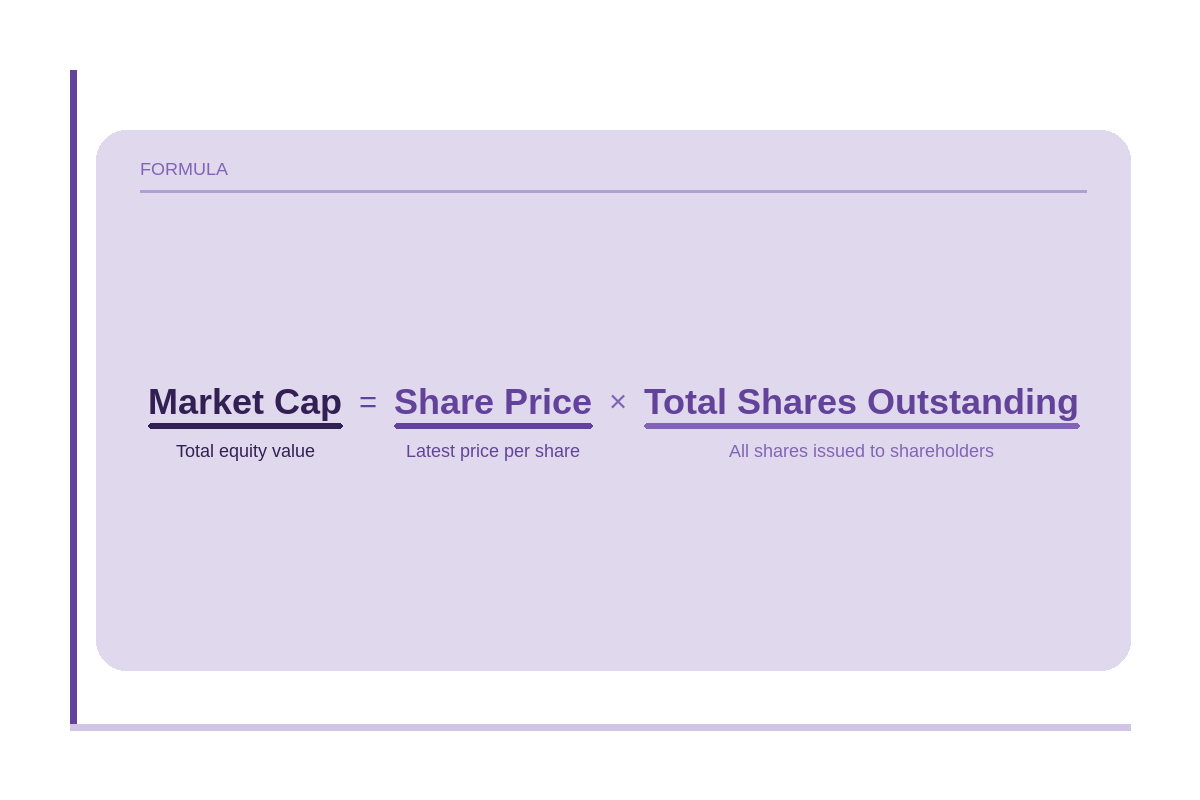
Market capitalization, or market cap, represents the combined dollar value of all a company's outstanding shares of stock. You calculate it by multiplying the current share price by the total number of shares outstanding. Investors use market cap to size up companies, compare them against peers, build diversified portfolios, and gauge the risk and growth potential of a stock before buying it.
That single number does a lot of work. It decides whether a company lands in the S&P 500 or the Russell 2000, how index funds weight it, and how analysts categorize it for portfolio management.
Outstanding shares refer to all shares a company has issued that are currently held by investors, including company insiders and large institutions. The count does not include treasury shares, which are shares the company has repurchased and retained on its own balance sheet.
In the US market, investors and analysts generally group companies into 6 tiers based on their market cap. While exact thresholds vary slightly by source, here are the standard categories used across the industry:
These categories help with benchmarking and comparison but say nothing about profitability, debt levels, or acquisition price.
What market cap omits matters equally. It excludes debt, ignores the cash sitting on the balance sheet, and has no direct relationship to liquidatable value. A company with $1 billion in market cap and $900 million in net debt is in a fundamentally different position from one with the same market cap and $200 million in cash. Enterprise value, not market cap, is the measure that accounts for both.
You calculate market capitalization by multiplying a company's current share price by its total number of outstanding shares. That is the whole equation for market capitalization, and it stays the same whether you are valuing a $300 million small-cap or a multi-trillion-dollar giant.
For US public companies, the standard is the latest closing price. It's what most analysts, financial databases, and SEC filings rely on, since it gives you a consistent, verifiable number instead of one that shifts by the minute.
The closing price is the last price at which a share traded during the regular session on its primary exchange, officially reported by the NYSE or Nasdaq at market close. This is the convention used for standard market cap reporting; averaging the day's high and low isn't typical unless you're running a specific volume-weighted analysis.
Intraday prices, by contrast, shift continuously while markets are open and aren't meant for comparable, citable figures. If you do need to reference a live number, say, in a board deck or investor update, label it with the exact date and time so your audience knows it's a snapshot, not the official closing figure.
Financial data providers and SEC EDGAR filings generally display market cap using the most recent regular-session close. After-hours trades happen but rarely make it into published market cap figures. Whenever you pull a number to cite, name the source and date so it can be verified.
Shares outstanding are all shares currently held by investors, including institutional holders, company insiders, and retail shareholders. They exclude treasury stock, which are shares the company has bought back and taken off the market. Treasury shares carry no voting rights, receive no dividends, and don't count toward market cap because the company cannot economically own a stake in itself.
Financial databases and SEC filings report shares outstanding net of treasury stock. That is the number you plug into the formula. For US public companies, you'll find it on the cover page of the 10-K or 10-Q filing, or in the stockholders' equity section of the balance sheet, updated quarterly.
Worth knowing as you go further: shares outstanding is not the same as fully diluted shares. For public companies the gap between the two is usually small. For early-stage startups, it can be significant enough to change the entire valuation conversation, which is why private-company valuation relies on the fully diluted count instead.
Example: Riverbank Software is a hypothetical company used to demonstrate the calculation.
Say a Series B SaaS company based in Austin, Texas, called Riverbank Software closed its last priced round at $12.50 per share. Its cap table (capitalization table) records 8,000,000 shares outstanding.
Market cap = $12.50 × 8,000,000 = $100,000,000
Riverbank's implied market cap at the round price is $100 million. A basic calculator or spreadsheet handles the multiplication; no specialized tool is needed for this step. But Riverbank also carries 1,200,000 stock options outstanding in its employee equity pool, and the basic formula ignores all of them. That gap matters the moment anyone asks about diluted ownership or starts negotiating the next round.
Fully diluted market cap is the total equity value of a company calculated using fully diluted shares: every share that would exist if all options, warrants, restricted stock units (RSUs), simple agreements for future equity (SAFEs), and convertible notes converted to common stock today. For early-stage startups, the gap between basic and fully diluted share counts often exceeds 20 percent, meaning the basic formula routinely overstates per-share value.
The basic formula uses only shares that are issued and outstanding. That number is almost always lower than the fully diluted count for a startup, because early-stage companies typically maintain option pools representing 10 to 20 percent of fully diluted shares, alongside SAFEs from pre-seed rounds awaiting conversion and sometimes warrants issued to early advisors or lenders. None of these appear in shares outstanding until a triggering event converts them to equity.
Sophisticated investors always negotiate on fully diluted ownership. When a Series A term sheet states an investor is buying 20 percent of the company, they mean 20 percent of the fully diluted cap table, not 20 percent of shares outstanding. If your market cap calculation uses the basic count while the investor uses the diluted count, you're working from different numbers, often without realizing it until the deal is closing.
Let’s return to the Riverbank Software example. Its basic market cap was $100 million (8,000,000 shares × $12.50). Add 1,200,000 outstanding options and the fully diluted share count becomes 9,200,000. At the same $12.50 per share, fully diluted market cap rises to $115 million. That $15 million gap is the entire option pool, and it is not a rounding error.
Getting the diluted count right requires an accurate, current cap table. That means tracking every instrument: common shares, preferred shares, outstanding options, RSUs, SAFEs, convertible notes, and any warrants. A spreadsheet that hasn't been updated since the last two grants will produce a wrong diluted share count, and a wrong market cap figure follows directly.
.png)
Market cap measures the equity layer only: share price times shares outstanding, with no adjustment for debt or cash. Enterprise value (EV) adds total debt to market cap and subtracts cash and cash equivalents, estimating what it would cost to acquire the entire business. That gap is why market cap and company worth rarely match, as the earlier example showed, two companies can carry identical market caps while sitting on very different balance sheets.
For acquisition pricing, leveraged buyout modeling, and cross-company comparison where capital structures differ, enterprise value is the correct metric. Lenders, private equity firms, strategic buyers, and investment bankers structure deals on EV multiples, since it accounts for the full cost of taking control of a business, debt included. Market cap alone leaves that cost out entirely.
The short version: Market cap tells you what the stock market says the equity is worth today. Enterprise value tells you the total price of the whole business, including debt.
To calculate market cap for a private startup, multiply your fully diluted share count by the implied price per share from your most recent priced funding round or the fair market value from a current 409A valuation, the two are not interchangeable and typically produce different numbers. No stock exchange sets a live price, so you're always deriving an estimate from the most recent documented investment or appraisal, one that needs updating after every new round or 409A refresh.
When you close a priced equity round, investors pay a specific price per preferred share, and that price implies a post-money valuation. If investors paid $5.00 per share and your fully diluted share count after the round is 10,000,000, the implied post-money market cap is $50 million ($5.00 × 10,000,000). This is the number term sheets reference and what most investors mean when they talk about "valuation" at a given round.
The structural limitation here is real. Investors paid for preferred stock carrying liquidation preferences, anti-dilution protections, and participation rights that common shareholders don't hold. The preferred share price overstates the value of a common share on a one-to-one basis. That gap is precisely why 409A valuations exist as a separate exercise.
A 409A valuation is an independent appraisal of a private company's common stock fair market value, required by the IRS under Section 409A of the internal revenue code.
A qualified appraiser uses methodologies such as the option pricing model (OPM) or probability-weighted expected return method (PWERM) to allocate enterprise value across the equity structure and arrive at a defensible common share price. This is the price you must use when setting stock option exercise prices to avoid punitive tax treatment.
Multiplying the 409A common share fair market value by your fully diluted share count gives a more conservative implied market cap than the preferred round price. It's the right starting point when modeling employee equity grants, running dilution scenarios, or communicating equity value to employees.
Neither figure is a real market price. The round price rests on negotiated investor terms; the 409A rests on appraiser methodology and comparable transactions. When you share either figure in a board deck, investor update, or employee equity statement, label it as an estimate, note the date, and specify which per-share input you used.
For any of this to hold up over time, your cap table needs to be current and complete.
An outdated cap table with missing SAFEs or untracked grants produces a wrong fully diluted share count. A wrong share count produces a wrong implied market cap. That error flows directly into dilution calculations, round modeling, and every ownership conversation you have with investors or employees.
Market cap is a useful shorthand, but it has real limitations that every investor should understand.
1. Reflects perception, not fundamentals: Market cap is driven by share price, and share prices can be influenced by speculation, hype, or fear. A company's market cap can double in a year while its revenue barely moves
2. It ignores debt: A company drowning in debt can have the same market cap as a debt-free competitor, even though their financial health differs. That is the gap enterprise value fills
3. It is a moving target: Market cap changes every second that the market is open. A figure you look up in the morning could be materially different by the close that afternoon
4. It is only for public companies: Since private companies do not have publicly traded shares, they do not have a traditional market cap. Valuations for private companies are typically derived from funding rounds, discounted cash flow models, or comparable public company analyses
5. It does not account for dilution: If a company issues new shares through secondary offerings or employee stock options, the share count increases and the market cap calculation changes even if the share price holds steady
A company's market cap changes whenever its share price changes, and the share price changes for two broad reasons: shifts in investor sentiment and changes in the share count itself.
It shifts continuously, and there are several forces that cause it to move.
Crypto market cap follows the same basic logic: current token price times circulating supply. Circulating supply is tokens actively in the market, distinct from locked team allocations or unminted reserves. Data providers such as CoinMarketCap and CoinGecko track circulating supply in real time.
Some analysts also watch fully diluted valuation (FDV), which substitutes total or maximum token supply for circulating supply. When a large share of supply remains locked, FDV can run several multiples above market cap, signaling potential future dilution as those tokens enter circulation. The dynamic is the same as option pool dilution in equity: supply that doesn't exist yet still has the potential to reprice everything outstanding.
Market cap calculation looks simple on the surface: price times shares. The complexity, and the risk, sits in which share count you use.
Basic shares outstanding tells you what's issued today; fully diluted shares tell you what your cap table actually owes everyone who holds an option, a SAFE, a warrant, or a convertible note.
For a public company the gap is usually small. For an early-stage startup it can run 20 percent or more, which means the choice of share count isn't a technicality, it's the difference between a number that holds up in a negotiation and one that falls apart the moment an investor asks a follow-up question.
None of this holds up on a cap table that's out of date. A missed SAFE conversion or an untracked option grant quietly changes your fully diluted count, and every market cap figure built on top of it inherits the error. Treat the calculation as only as good as the cap table behind it, and update both together, every time something changes.
While market capitalization helps investors assess public companies, private businesses need independent valuations to determine fair market value for employee equity, fundraising, financial reporting, and compliance.
With Qapita's 409A valuation, you get reliable, defensible valuations designed to support every stage of your company's growth. Talk to an expert.
A post-money valuation is the implied total equity value of a startup immediately after a funding round closes, calculated as the price per share paid by new investors multiplied by the fully diluted share count after new shares are issued. It is the startup equivalent of market cap at that moment. The key difference is that post-money valuation reflects a single negotiated transaction, not a continuously traded market price, so it carries wider uncertainty.
Granting new options does not immediately change market cap because options are not shares yet. They enter the fully diluted share count and affect fully diluted market cap calculations, but they do not change the basic issued share count until exercised. If your model uses fully diluted shares, adding new option grants increases the denominator and, at the same per-share price, increases fully diluted market cap proportionally. Basic market cap stays unchanged until the options convert.
Not exactly. Market capitalization reflects the market value of a company's equity based on its stock price. It does not account for debt, cash, or other assets. Enterprise value is often considered a more comprehensive measure of total company value.
A down round sets a new per-share price below the previous round's price. Since market cap equals price per share times share count, a lower price directly reduces implied market cap even if no other changes occur. Anti-dilution provisions in earlier investors' preferred stock terms typically trigger at that point, potentially increasing the share count and further compressing per-share value for common stockholders. Down rounds also reset the 409A baseline, affecting option pricing going forward.
No. Market cap applies to public companies whose shares trade openly on a stock exchange. Private companies value themselves through other methods, including priced funding rounds that set a valuation at the time of investment and 409A valuations that establish the fair market value of common stock for purposes like pricing employee stock options.