Financial Reporting

Stock based compensation reporting, with real expert support​

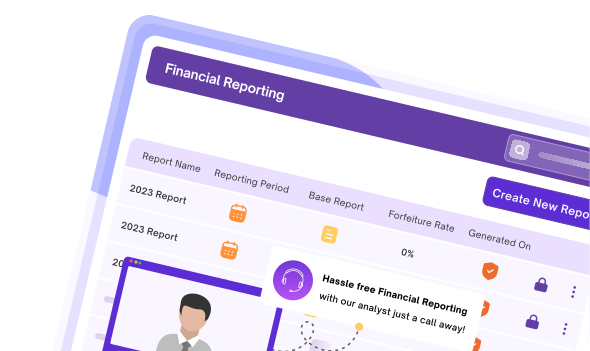
Generate audit-ready expense reports with confidence. Full support for Black-Scholes, Binomial, and Monte Carlo models, with expert guidance on everything from modifications to market-based performance conditions.
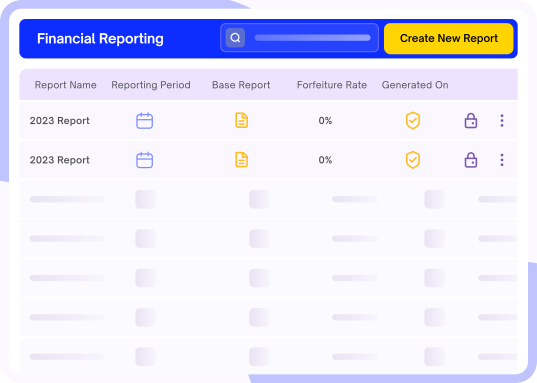
A screen shot of a financial report.A blue and white sign with a headset on it.A man with a beard wearing glasses and a black shirt.

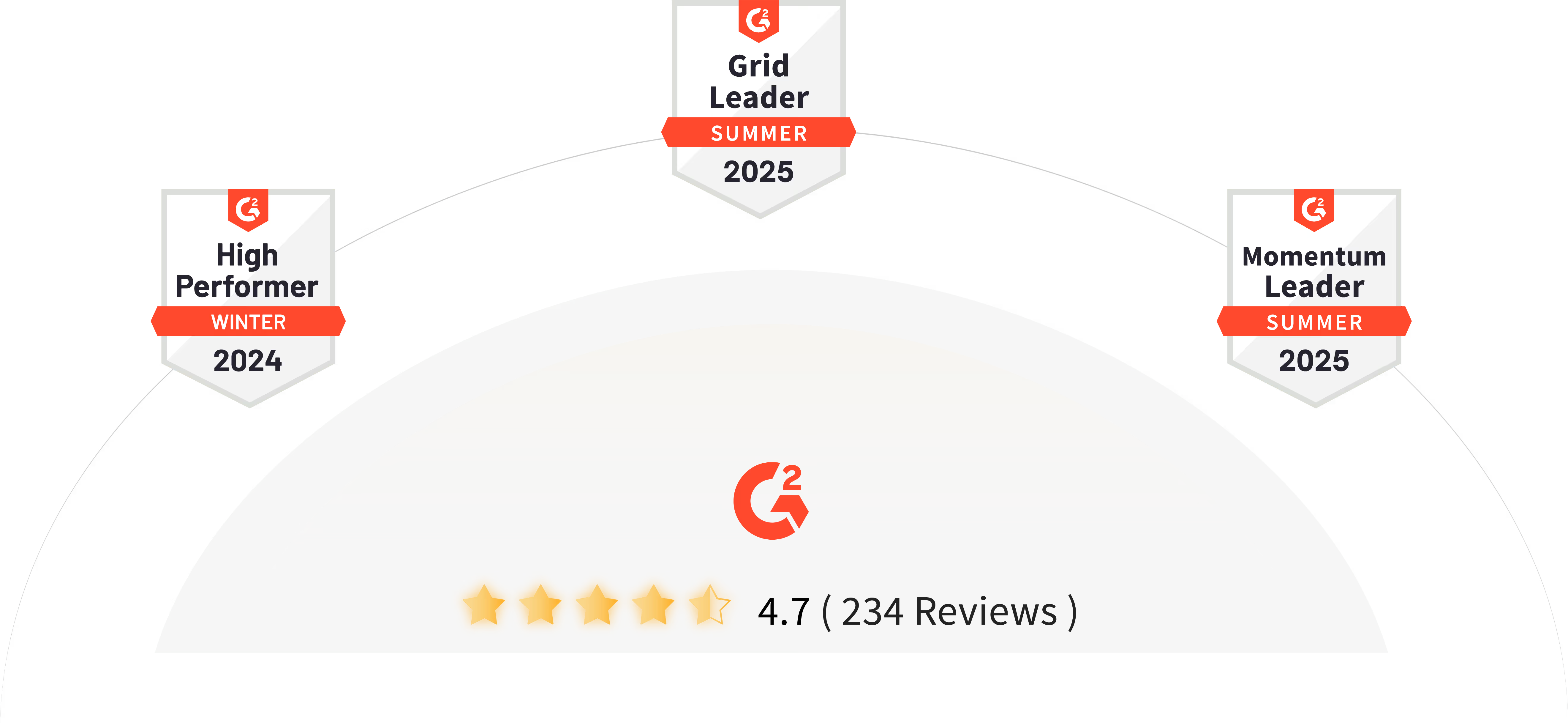
Recognized as a Global Leader on G2

We are ranked the best in Customer Satisfaction, Enterprise and Mid-Market.

Benefits of Qapita’s financial reporting software​

Preserve reporting integrity

Full control and clarity over your financial reporting. Lock in each period’s expense reports to preserve audit integrity and ensure any backdated changes or true-ups are carried forward to the next reporting cycle. No accidental overwrites, no rework, just reporting the way it should be.

Simplify accounting complexity

Qapita gives you more than just outputs. Our expensing team supports you through edge cases, audit prep, and accounting treatment. Whether it’s forfeiture logic or understanding how a repricing impacts amortization, we’re here to help you navigate the nuances.

More than software

From valuation inputs to amortization policy, Qapita is built by professionals who’ve worked on thousands of stock-based compensation reports. You get the flexibility of self-service with the assurance that expert help is always within reach.

Features that make financial reporting easy​

Audit-Ready ASC 718 and IFRS 2 Reports

Every company is different. Your valuation should reflect that.

Qapita automates expense calculations across plans, grants, and reporting periods, all while maintaining the detail, documentation, and controls required by auditors. Whether you follow ASC 718 or IFRS 2, you get clean, exportable reports and full transparency into amortization schedules and assumptions.
transparent-blue-bg
Support for Black-Scholes, Binomial & Monte Carlo

Reviewed. Verified. Signed by experts.

We provide full support for fair value determination using Black-Scholes, Lattice/Binomial, and Monte Carlo simulations. Whether you’re pricing vanilla options or complex PSUs, our team will help you select and justify the appropriate model and explain how it flows through to your reporting.
Guidance on Modifications, Repricing & More

Knowledge and experience to help you navigate complexity

Wondering how to treat option repricing? Replacement grants? Market-based performance conditions? Our expensing specialists help you make the right accounting call, and explain the implications clearly. We’ll work with your auditors and help you prepare disclosures when things get nuanced.
Flexible Amortization and Cost Center Allocation

Fits your accounting policy, not the other way around

Support straight-line, graded, and front-loaded methods. Track vesting changes, terminations, and forfeitures dynamically. Allocate expense by cost centre, team, or geography along with mobility tracking included for international employees and inter-entity transfers.
Seamless Migration

Bring your history. Leave the headaches.

Moving your expensing to Qapita doesn’t mean starting over. Upload your life-to-date expense data so everything you’ve already booked is captured, locked, and preserved. Qapita ensures reporting continuity by protecting prior periods and carrying forward any true-ups or adjustments into future cycles. No duplicate entries. No audit gaps. Just clean, trusted expense schedules from day one.
Testimonials

Words from our valued customers

Reporting Obligations simplified.
We can easily download various reports, including summary reports. This has significantly streamlined the reporting process, making it super easy for us to generate the necessary reports for all reporting obligations.
Sijo  V
Enterprise (>1000 emp.)
Impressive Reporting Capabilities
Qapita's reporting capabilities are very useful. The Financial Reporting feature provides us with detailed and accurate reports that are essential for our business decisions.
Anonymous
Mid-Market (51-1000 emp.)
Efficient Equity Reporting
Qapita's Financial Reporting capabilities are excellent. It provides us with detailed reports that are easy to download and share with stakeholders.
Siddhi J.
Enterprise (>1000 emp.)
Qapita is good and evolving
I really liked the feature which has been recently introduced for bifurcating the single pool balance to different plans.
Amit B.
Senior Manager - People & Culture Mid-Market(51-1000 emp.)
Presence

Helping you elevate your equity management

Private Companies
2,400+
Equity Under Management
US $55B+
Equity Plans Designed
1,400+
Stakeholders
500,000+
Companies Served
2400+
Countries Covered
60+
Stakeholders on Platform
500,000+
Equity Plans Designed
1000+
Valuation Reports per Year
500+
Qapita works with companies across the globe from Seed Stage to Listing and Beyond
A logo for a company called acko.

Audit-ready reports at your fingertips!

Stay confident with accurate reporting that scales with you.
Other Offerings

Accuracy you can prove, speed you can trust

Stock Plan Management

Design, manage, and communicate employee stock plans with clarity, from first grant to global rollout, for teams and stakeholders.

Cap Table Management

Track, issue, and report equity in one secure platform that grows with you, keeping ownership clean, compliant, and transparent.

Equity Compensation Advisory

Expert guidance to design equity programs that align with your goals, stage, and people - tailored, not copy-paste.
FAQs

Frequently asked questions

What valuation models does Qapita support under ASC 718?

Qapita supports Black-Scholes, Binomial (Lattice), and Monte Carlo simulations—allowing companies to choose the right model based on grant type and market conditions. Our experts can guide you in model selection and explain how valuations flow through to your financials.

How does Qapita handle modifications and repricing of stock options?

Modifications, such as option repricing or grant replacements, can complicate accounting under ASC 718. With Qapita, you get expert-backed guidance on how to account for these changes, including market-based performance conditions. We help you understand the impact and prepare accurate disclosures.

Can Qapita support cost center allocation for stock-based expenses?

Yes. Qapita allows flexible allocation of equity compensation expenses across cost centers, departments, teams, and geographies. We also support mobility tracking for international employees and inter-entity transfers—ensuring your expense recognition reflects your actual organizational structure and accounting policy.

What happens to my past data if I switch to Qapita?

Transitioning your ASC 718 reporting to Qapita doesn’t mean losing historical data. Qapita offers seamless migration of life-to-date expense records, protecting prior period entries and carrying forward true-ups or adjustments. This ensures audit continuity and avoids the need for duplicate entries.

How does Qapita support companies preparing for audits?

Qapita’s reports are audit-ready by design—backed by clear assumptions, valuation logic, and supporting schedules. Our team can also liaise with your auditors to answer questions and support a smooth review process.
Financial Reporting 101

What is ASC 718 financial reporting?​

ASC 718 (Accounting Standards Codification Topic 718) is the US GAAP accounting guidance for share-based payment awards, commonly referred to as “expensing stock options” and other equity compensation. In simple terms, it ensures equity awards are treated as real compensation costs that are estimated, recognized, and disclosed - rather than only being described in footnotes.​​

ASC 718 financial reporting typically covers awards such as stock options and other equity-based compensation arrangements, and it focuses on producing audit-ready expense and disclosure support that reflects the true cost of equity compensation over time. This becomes especially important as companies scale, raise institutional capital, or undergo GAAP audits where consistent treatment and clear supporting schedules are expected.​

Who needs it: Startups/private companies that are moving into audits, institutional fundraising, lender reporting, or transaction/IPO readiness where audit-ready reporting is expected.​

When you need: Commonly updated at least annually, and often quarterly once audit and investor reporting expectations increase.​

ASC 718 vs IFRS 2: ASC 718 applies to US accounting rules, while IFRS 2 is the equivalent standard under International Financial Reporting Standards (IFRS) for share-based payments.​

Why ASC 718 is important?​

ASC 718 is critical for accurate, compliant, and investor-ready reporting of equity-based compensation - especially as companies scale, raise capital, and approach audits or exit events.​

Compliance requirements: Following ASC 718 helps ensure your company meets required accounting standards and reduces risk from non-compliance, including potential legal and reputational impact.​

Financial transparency: ASC 718 requires clear reporting of equity compensation expense, giving investors and stakeholders a more accurate view of your company’s financial position.​

Internal decision making: ASC 718 clarifies the true cost of stock-based compensation, improving decisions on incentives, capital allocation, fundraising, and overall financial strategy.​

Forecasting and planning: Proper ASC 718 accounting strengthens financial models and planning, supporting decisions on growth strategy, resource allocation, and fundraising timelines.​

Valuation & exit strategy: Accurate ASC 718 reporting supports credible valuation for M&A or IPO outcomes by reflecting equity compensation correctly, which can influence investor confidence and deal attractiveness.​

How ASC 718 reporting works​

ASC 718 reporting converts equity award activity (such as stock options and RSUs) into a consistent,
period-by-period stock-based compensation expense that can be booked and supported during audits.​
1

Fair value is determined at grant​

A fair market value (FMV) is established for the option on the grant date to estimate what the award is worth for accounting purposes. Key drivers typically include the option term, strike price, risk-free interest rate, current value of the underlying share, and expected volatility.​
2

Expense is calculated​

Instead of recording a one-time cost, stock-based compensation expense is spread over the period the employee earns the award - most often aligned to the vesting schedule. Companies commonly use either a straight-line approach (even allocation) or an accelerated approach (such as FIN28) that recognizes more expense earlier.​

3

Methods and assumptions disclosed

ASC 718 requires transparency on how valuations were calculated, including the valuation model used (e.g., Black-Scholes, binomial, or other methods) and the underlying assumptions (volatility, dividend yield, risk-free rate, expected life) along with where the inputs came from.​
4

Financial statement is reported​

Reporting typically includes the total stock-based compensation expense recognized for the period and its impact on the financial statements, including profitability measures and (where applicable) earnings per share.​

Challenges of stock-based compensation reporting​

Stock-based compensation reporting gets complex as companies scale because it sits at the intersection of equity data, valuation assumptions, and finance reporting timelines. It becomes even harder when grants evolve over time and when teams operate across entities or countries.​

Data fragmentation​ ​

Equity data often lives in multiple places (cap table, HR, legal docs, finance spreadsheets), which can lead to inconsistencies in grant terms, vesting status, cancellations, and employee movements. These mismatches create reconciliation effort and increase the risk of reporting errors.​

Valuation and assumptions​ ​

Stock option expense depends on assumptions and models, and small changes (volatility, expected term, risk-free rate, share value inputs) can materially impact reported expense. Maintaining a consistent methodology and defensible assumptions over time is challenging, especially through funding rounds or market shifts.​

Ongoing award changes​ ​

Real-world programs rarely stay static - new grants, terminations, forfeitures, repricing, acceleration, performance conditions, and other modifications can change the accounting outcome and increase the operational workload each reporting period. Managing these changes without breaking continuity is a common pain point.​

Audit and timeline pressure​

As companies move toward audits, board reporting, or transactions, finance teams must produce repeatable, traceable reports on tight close timelines. The challenge is not only getting the numbers right, but also producing clear support files and explanations that hold up under scrutiny.​

Confident Reporting Starts Here

Expert-backed reporting so you’re always prepared for audits.