


 Equity management

 Equity management
- Fund management

 Fund management
 - Fund managementFund management
- Fund managementFund management




When discussing a company's equity structure, particularly in terms of ownership and valuation, the term 'outstanding shares' frequently comes up. Outstanding shares represent a company's stock currently held by all its shareholders, including institutional investors, company insiders, and the public.
It affects financial health, stock performance, and shareholder value. But what exactly are outstanding shares, and why are they important? Let's delve deeper into the concept.
Outstanding shares represent the overall quantity of a company's shares that are presently held by shareholders. The total of outstanding shares may change over time because of corporate actions like stock splits, share buybacks, or new issuances.
Outstanding shares are crucial for calculating key financial measures including EPS and market capitalization, providing investors with a snapshot of the company's total market value.
Outstanding shares are categorized into different types, each defining what a shareholder is entitled to within a company.
Outstanding shares are not static. They change based on corporate actions like stock splits, buybacks, or new share issuances. For example, when a company buys back its own shares, the outstanding count decreases. When it issues new shares to raise capital, the count increases.
These shares are important because they directly feed into key metrics like market capitalization, earnings per share (EPS), and ownership percentage, all which investors and founders rely on to evaluate a company's health and value.
Calculating outstanding shares is straightforward. The formula subtracts the shares a company has repurchased from the total shares it has issued to date:
Outstanding shares = Issued shares − Buyback shares
Example of outstanding shares
Here is a hypothetical example to illustrate how the formula works in practice:
Say a company has issued 1,00,000 shares in total. Over time, it buys back 10,000 shares through a repurchase program.
Outstanding Shares = 1,00,000 − 10,000 = 90,000 shares
These 90,000 shares are what investors hold, what gets traded on the exchange, and what is used to calculate market cap and EPS.
Outstanding shares are one of several share types that appear across a company's capital structure. Each share type serves a distinct purpose and carries different implications for investors.
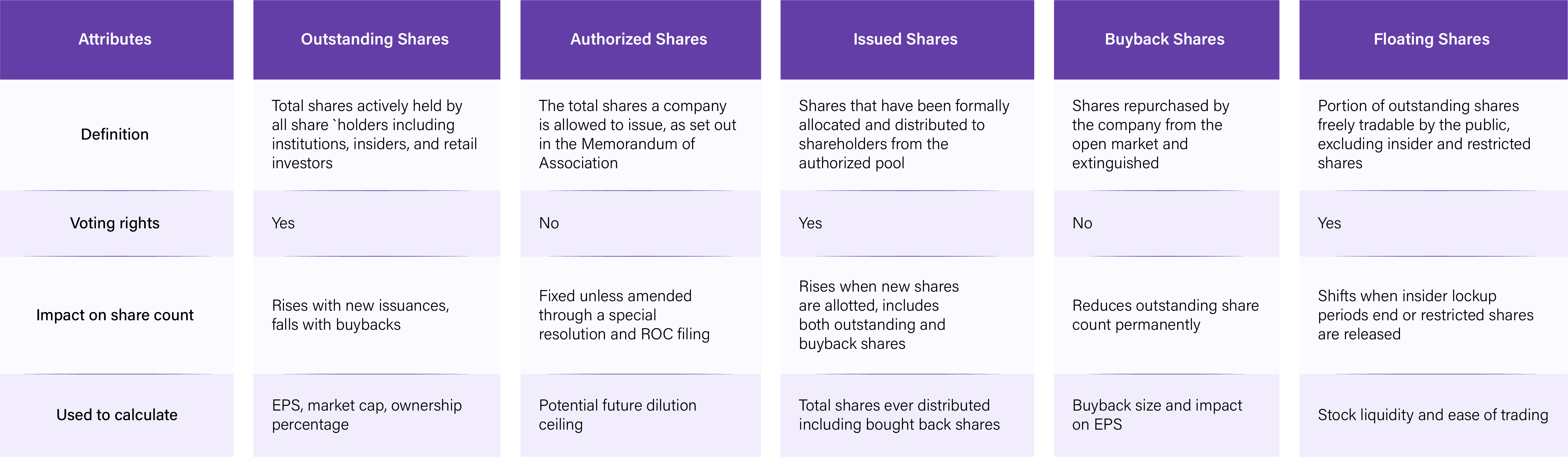
When a company's share count changes during a financial year, due to buybacks or new issuances, using a simple end-of-year number to calculate EPS would give an altered picture. Weighted average shares outstanding accounts for how long each share count was in effect during the period, giving a more accurate result.
Weighted Average Shares = (Shares × Time Period) / Total Period
Example: A company starts the year with 1,00,000 shares. In July it issued 20,000 new shares.
This 1,10,000 is what gets used in EPS calculations, not the year-end count of 1,20,000.
There are two versions of weighted average shares outstanding:
As a rule, diluted EPS is always lower than or equal to basic EPS since more shares means lower earnings per share. Investors typically focus on diluted EPS as it reflects a more realistic picture.
Outstanding shares play a direct role in two of the most important financial metrics investors use:
Earnings Per Share (EPS): The higher the number of outstanding shares, the lower the EPS, assuming net income stays the same. This is why share issuances that increase outstanding shares can concern investors, as it dilutes earnings across more shares. EPS captures the profitability of a company on a per share basis.
EPS = Net Income / Outstanding Shares
Market capitalization: Market cap measures the total market value of a company. The
Market cap = Outstanding shares × Current share price.
The number of outstanding shares is not fixed. Several corporate actions can increase or decrease the count over time.
1. Stock splits: In a stock split, a company divides each existing share into a fixed number of new ones. The total value of the company does not change, only the share count goes up and the price per share comes down proportionally. Example, in a 2:1 split a company with 1,00,000 shares trading at ₹1,000 each will see its share count double to 2,00,000 while the price halves to ₹500. The overall market cap remains unchanged at ₹10,00,00,000.
2. Stock dividends (bonus shares): When a company issues bonus shares, it distributes additional shares to existing shareholders at no cost, typically in proportion to their current holdings. This increases the number of outstanding shares but does not change the company's overall value or a shareholder's ownership percentage.
3. Share repurchases (buyback): A buyback is when a company purchases its own shares from the market. These repurchased shares are extinguished immediately and are no longer counted as outstanding, which reduces the total share count. This often increases EPS since the same earnings are now divided among fewer shares.
4. Convertible securities: When convertible instruments such as bonds, notes, or preferred shares are converted into equity, new shares are issued and added to the outstanding count. This increases the total number of outstanding shares and can dilute existing shareholders' ownership percentage.
Outstanding shares are distributed across different types of shareholders:
Outstanding shares serve several important purposes for a company and its investors
Outstanding shares can work against a company if not managed carefully. Here are the key disadvantages
1. Dilution Risk: Issuing new shares can dilute existing shareholders' ownership percentages and reduce their control over corporate decisions.
2. Market Perception: Frequent changes in the number of outstanding shares can lead to uncertainty among investors regarding management's intentions or financial stability.
3. Management Control: If external investors hold a large number of shares, it can dilute the founders' control over the company's decision-making process.
Most people look at a company's revenue or profit to judge its health. But experienced investors know that the story often lies in the share structure. How many shares are outstanding, who holds them, and how that number has changed over time reveals far more about a company's strategy, priorities, and financial discipline than most metrics ever will.
Outstanding shares have a significant influence on a company's valuation, stock performance, and ownership structure. They determine how market cap and EPS are calculated, how much control founders retain, and how attractive the company is to outside investors. Startups especially must manage them carefully, using shares to raise capital and reward employees without diluting ownership to the point of losing control. For founders, it is about protecting ownership while creating room to grow. For investors, it is about understanding not just today's earnings, but who benefits from them tomorrow.
Managing outstanding shares across funding rounds, stock options, and convertible instruments can get complex fast. Qapita is an end-to-end equity management platform that brings structure and transparency to your cap table, keeping it real-time, accurate, and audit-ready at every stage of your growth.
Book a free demo with our team today.
Total equity is the rupee value of what belongs to shareholders after all liabilities are deducted from total assets, it is a financial value. Outstanding shares is simply the count of units currently held by shareholders. One tells you how many shares exist, the other tells you what the company is worth to its shareholders.
Normal shares or common shares are a specific class of share that gives holders ownership and voting rights. Outstanding shares is a broader count that includes all classes of shares currently held by shareholders, both common and preference. Every common share is an outstanding share, but not every outstanding share is a common share, especially in companies that have issued preference shares to certain investors.
Floating shares are the tradeable portion of outstanding shares, what is freely available for buying and selling on the open market. They exclude shares held by insiders, shares under a lockup period, and restricted holdings. Outstanding shares is the total count across all shareholder categories. Floating shares give a more accurate picture of a stock's liquidity and how easily it can be transacted in the market.
Outstanding shares are not inherently good or bad. Context is everything. A rising share count from new issuances can signal that a company is raising capital to fund growth, but it can also dilute existing shareholders' ownership. A falling share count from buybacks can reflect management's confidence in the business, but it can also mean the company lacks better uses for its cash. The number itself matters less than the reason behind the change.
It typically means the company has bought back its own shares. These shares are extinguished immediately and cannot be reissued, reducing the total share count. This increases EPS since the same earnings are now distributed across fewer shares and can signal that management believes the stock is undervalued. In some cases, a decrease can also result from a reverse stock split where shares are consolidated to increase the price per share.
Yes, but not all of them. Outstanding shares that are not subject to restrictions or lockup periods can be freely bought and sold on the stock exchange. However, shares held by promoters, insiders, or employees under an ESOP vesting period cannot be sold until conditions are met or the lockup period expires. Once restrictions are lifted those shares become part of the tradeable float and can be sold freely.
When convertible instruments such as bonds, notes, or preference shares are converted into equity, new shares are created and added to the outstanding share count. This increases the total shares in circulation and dilutes the ownership percentage of existing shareholders. This is why analysts track diluted shares outstanding, which factors in all potential conversions, to get a more realistic picture of a company's share structure and EPS.