


 Equity management

 Equity management
- Fund management

 Fund management
 - Fund managementFund management
- Fund managementFund management
Private investment funds have long been the domain of institutions and ultra-high-net-worth individuals, but as private markets grow, more founders, fund managers, and sophisticated investors are taking notice. These pooled vehicles open doors to private equity, venture capital, real estate, and hedge fund strategies that simply aren't available through a stock exchange.
In this guide, we break down what private investment funds are, how they're structured, who can access them, and what you need to know before participating, whether you're looking to invest or launch your own fund.
Private investment funds are pooled vehicles that aggregate capital from select investors to access opportunities unavailable to individuals. These include private equity, venture capital, real estate, and hedge funds, each pursuing distinct strategies and risk profiles, unified by collective participation in private markets.
In the U.S., managed investment funds are generally categorized as investment companies under the Investment Company Act of 1940 and must register with the SEC unless exempt. Private funds bypass registration by qualifying under Sections 3(c)(1) or 3(c)(7), distinguishing them from public, registered investment companies.
Private investment funds come in many forms, each designed for a different kind of opportunity. Here are some of the most widely used types across private markets.
To highlight what distinguishes private funds, compare them with public funds. Regulation and investor type are the main factors shaping how each fund operates and the risks it carries.
Private funds offer investors exclusive, long-term opportunities that may yield higher returns than public markets, making them appealing to those seeking unique investment strategies.
.jpg)
Launching a private investment fund is not just a financial decision, it is a legal, operational, and strategic undertaking that requires careful planning at every stage. Here is a step-by-step breakdown of what the process involves.
1. Choose your fund type: The first decision is to determine what kind of fund you want to run. Private equity, venture capital, hedge funds, real estate funds, and credit funds all operate differently, each with its own investment strategy, target assets, and investor expectations. Your choice here shapes everything that follows, from how you raise capital to how you structure returns.
2. Define your target investors: Who you raise from determines how your fund is structured. Institutional investors, family offices, and high net worth individuals each come up with different expectations around reporting, governance, and liquidity. Identifying your investor base early ensures your structure and compliance approach are built around the right requirements from day one.
3. Establish the legal structure: Your fund’s structure shapes taxation, liability, and fundraising. Here are popular options to consider:
Consult legal experts to ensure your structure aligns with your vision and goals.
4. Obtain regulatory approvals: Investment funds live in a tightly regulated world. Depending on your location, you’ll need backing from bodies like the Securities and Exchange Commission or the Financial Conduct Authority.
Compliance rules shift by fund type and jurisdiction. Picking the right regulatory framework is a game-changer.
5. Build fund operations: Efficient fund administration keeps your operations transparent and compliant. Key steps include:
Many funds boost efficiency by outsourcing specialized administrators.
6. Raise capital: Fundraising is make-or-break. Pitch your vision and strategy to institutional investors, HNIs, and family offices.
Build a compelling private placement memorandum (PPM) that lays out your strategy, risks, terms, and expected returns.
7. Ensure tax and reporting compliance: Different fund structures come with unique tax rules and reporting duties. Plan ahead to maximize returns and sidestep compliance headaches.
Private funds rely on exemptions under Sections 3(c)(1) and 3(c)(7), limiting investors to accredited investors or qualified purchasers. Retail investors cannot participate, and these exemptions also cap the fund investor count.
In practice, only financially sophisticated individuals, family offices, or institutions with sufficient resources qualify. Eligibility hinges on financial strength and experience, reflecting the higher risks.
These restrictions safeguard investors. Since private funds use complex strategies and carry greater risk, only those with the knowledge and capacity to handle losses can participate.
The legal framework governing private investment funds dictates which types of investors they may accept, primarily accredited investors or qualified purchasers. Each fund's legal structure determines its eligibility, depending on the regulatory exemption utilized.
Accredited investors are individuals or entities who meet income or net worth thresholds set by regulators.
Qualified purchasers, on the other hand, meet a significantly higher wealth threshold.
Here are the key differences between the two at a glance
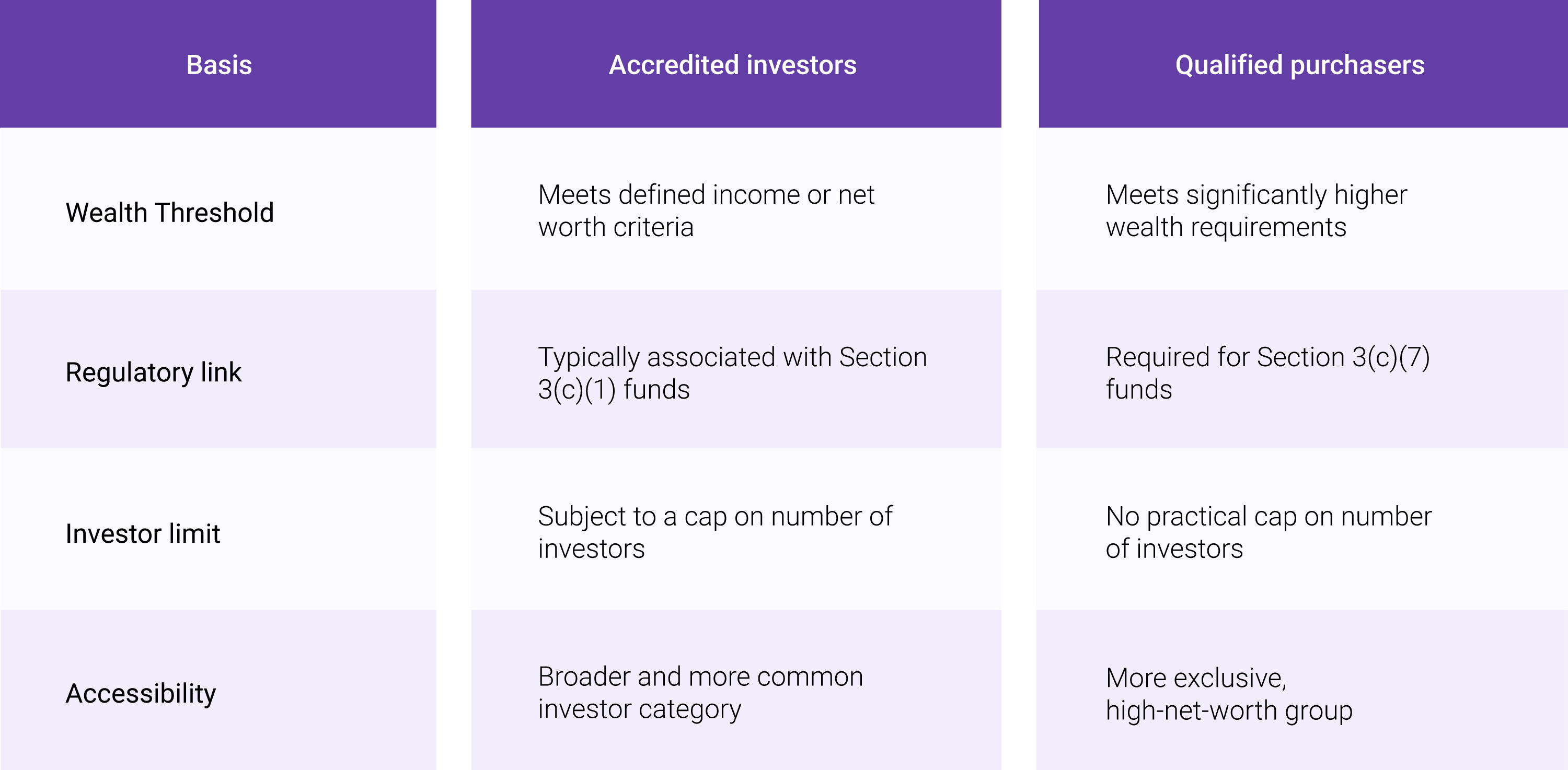
Here are the advantages of private investment funds.
Here are the risks of private investment funds.
To understand how private funds operate in practice, it helps to examine their structure and how that structure aligns incentives among all participants.
Private funds consist of General Partners (GPs) who manage investments, and Limited Partners (LPs) who provide capital.
Both sides benefit from a well-designed economic model that aligns their incentives. To illustrate how these incentives work, let’s look at the fees and profit-sharing arrangements.
Returns are distributed through a waterfall mechanism, ensuring fairness and transparency as profits are split between LPs and GPs at each stage. This not only clarifies how gains are allocated but also establishes investor rights, enhancing accountability.
Thus, the structure not only allocates returns, but it also builds accountability, which brings us to the importance of investor rights.
While private funds offer less public transparency than traditional investments, they are not unregulated. Investor rights are embedded in the fund’s structure to preserve trust and oversight.
Limited Partners typically receive protections enabling them to remain informed and engaged:
Collectively, these rights counterbalance the flexibility enjoyed by fund managers. They ensure that, even in a less liquid and transparent environment, investors retain oversight and control.
Private investment funds offer experienced investors ways to diversify and earn higher returns. They provide access to alternative strategies outside traditional avenues.
However, these funds carry higher risk, require greater capital, and are subject to complex regulations.
A clear understanding of fund types, fees, risks, and rights helps investors make informed choices that align with their goals.
Managing a private investment fund comes with layers of complexity: portfolio tracking, investor reporting, and fund administration that can't afford to slip.
Qapita's Fund Management Platform brings it all together. Fund Portfolio Management gives you real-time investment visibility while Fund Administration ensures accurate, audit-ready operations, so you can focus on returns, not paperwork.
Request a Demo to see Qapita in action.
Common investment vehicles such as bonds, stocks, mutual funds, and exchange-traded funds (ETFs) often yield strong returns, but they remain vulnerable to market volatility. If you liquidate your holdings during a downturn, you may realize losses.
Private investment funds typically pose greater risks than traditional investments because they invest in alternative assets, offer limited liquidity, and are more susceptible to market volatility. However, this increased risk may also present opportunities for higher returns.
Private investment funds accept only accredited investors, that is, people or organizations that meet strict income or net worth requirements. This ensures they can manage risks and understand complex investments.
Private funds unlock value by actively selling investments at higher prices. Through dynamic transactions such as IPOs, mergers, acquisitions, and secondary sales, returns grow.
Private investment funds mainly fall into four categories: VC, PE, hedge funds, and private credit funds. VC funds invest in early-stage companies; PE funds acquire mature businesses; hedge funds use various strategies across public markets; private credit funds lend directly to companies. Each type differs in investment strategy and portfolio assets.