


 Equity management

 Equity management
- Fund management

 Fund management
 - Fund managementFund management
- Fund managementFund management



A right of first refusal (ROFR) and a right of first offer (ROFO) are contractual terms in a stockholders' agreement that control how you, as a founder, can sell your shares to an outside buyer. Both rights hand your investors a say in who joins the cap table, the record of who owns what percentage of your company, but they trigger in a different order and shift negotiating leverage in different directions.
Here's how ROFR vs ROFO plays out in practice, and which one you should push for at the negotiating table.
Well as the name indicates, these are certain contractual rights given to shareholders that govern the transfer of shares by a set of shareholders to a third party.
Pre-emptive rights concern the issuance of fresh shares by the company for investment going into the company, while ROFR and ROFO apply to the transfer of shares by an existing shareholder to a third party. In this case, the consideration against the shares goes towards the selling shareholder.
ROFR is the right given to a shareholder (or a set of shareholders) to have an opportunity to buy shares of the selling shareholder at the same price and terms or higher as being offered by a potential third party buyer.
1. In case a shareholder is looking to sell shares to a third party ROFR basically mandates this selling shareholder to offer their shares to the right holder on the same terms as the bid from a third-party potential buyer.
2. Hence, whenever ROFR is applied, it is assumed that the selling shareholder is supposed to receive a bid for the given number of shares from a potential third party buyer.
3. Shareholder(s) with ROFR can then choose to buy the shares at the same price and terms as the third-party bid, or 'Refuse' the offer. Hence the name: 'Right of First Refusal', only after they first refuse to buy the shares themselves can the seller proceed to sell to the third-party buyer at the same or a higher price
It's for the same purpose as ROFR, but with a slight difference in the process. Unlike ROFR where the selling shareholder has to first receive a bid from a third-party buyer before offering it to the ROFR shareholder.
In case of ROFO the selling shareholder needs to first offer the shares to the shareholder(s) with ROFO before soliciting any third party bids. Hence the term 'Right of First Offer
Both rights exist to give a stockholder, usually the investor, a chance to buy shares before an outsider does. That protects two things at once: the investor's ability to grow their position, and the company's control over who ends up on the cap table. A competitor, an activist buyer, or a misaligned financial party showing up as a new stockholder can complicate governance long after the deal closes.
In most financings, investors negotiate for these rights over founder and employee shares. It's less common, but increasingly seen in founder-friendly deals, for founders to negotiate the reverse: a ROFR or ROFO over investor shares, so a lead investor can't sell a large block to a competitor or an unaligned buyer without the company getting a look first.
There's no single standard clause. Language varies by law firm and by round, but the mechanics stay consistent. Here's how each right typically reads in a Series A or Series B stockholders' agreement.
ROFR language, in practice: If a founder or another stockholder decides to sell shares to a third party, that stockholder must give the investor the right to purchase those shares on the same price and terms as the outside offer, before completing the sale.
ROFO language, in practice: If a founder or another stockholder plans to sell shares, that stockholder must first notify the investor and invite an offer. The investor then has a defined acceptance period, often 30 days, to submit a binding bid. Only if the investor's offer is rejected, or the acceptance period lapses, can the stockholder sell to a third party, at a price no lower than what the investor offered.
Both rights aim to give your investor a shot at buying shares before anyone else, but the order of operations, and the leverage that comes with it, is completely different. Here's how the two compare side by side.
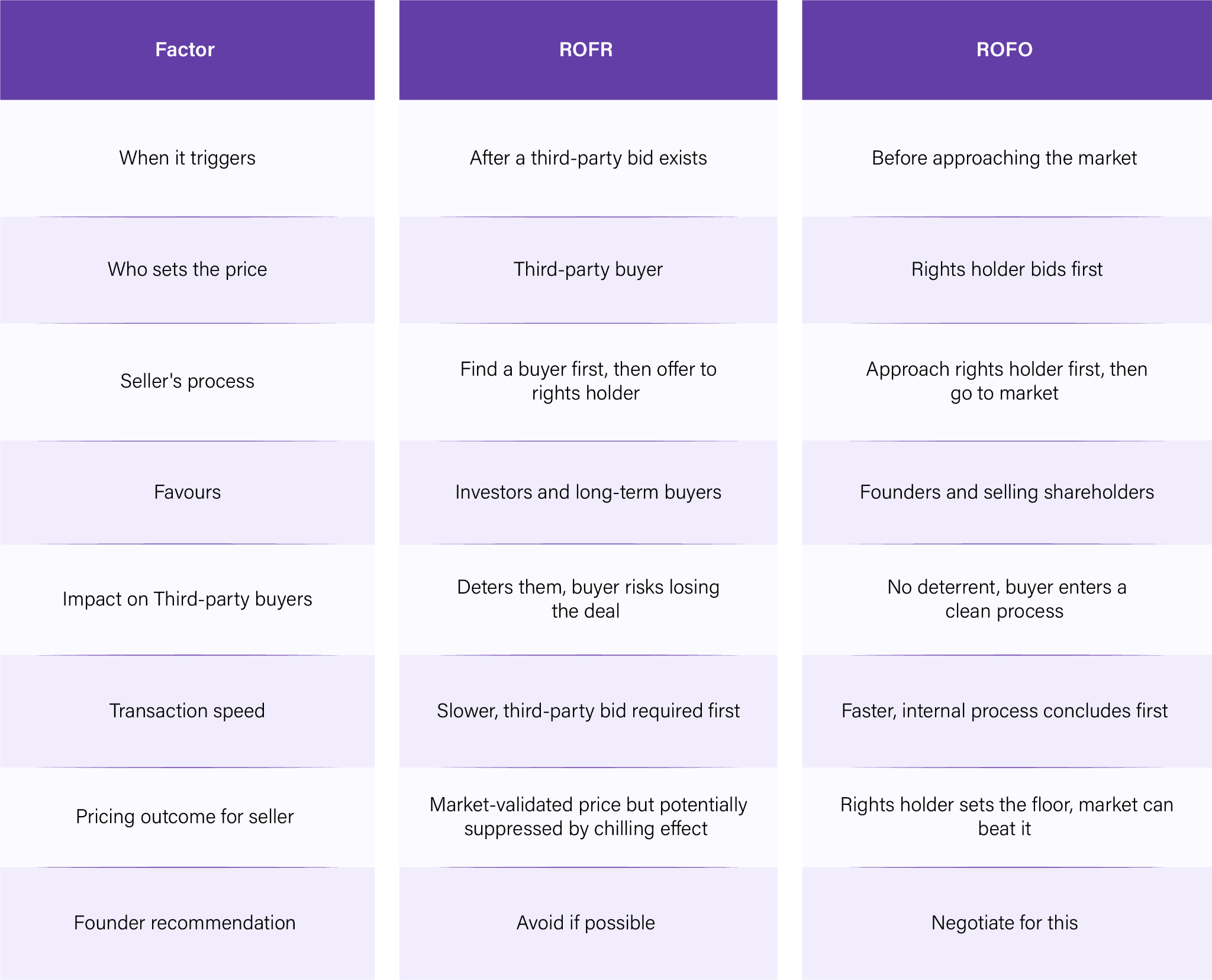
Neither right is universally better. Each carries tradeoffs for the founder selling shares and the investor holding the right, and the fine print in your stockholders' agreement decides how much those tradeoffs matter in practice.
For this reason, founders generally negotiate for ROFO over ROFR whenever they have the leverage to choose it. It shifts the burden of pricing onto the investor and keeps a path to the open market if that price falls short.
Before you agree to either clause, it helps to see the numbers. Model how a ROFR or ROFO exercise affects your ownership percentages with Qapita's cap table management software, so you're negotiating from data, not guesswork.
The right choice depends on which side of the table you're sitting on and how much negotiating leverage you have at that round. Here's a simple way to think about it.
Understanding how ROFR and ROFO work, there are a few contractual details that can impact a founder's ability to sell shares when the time comes.
1. Acceptance period: ROFR and ROFO clauses come with an acceptance period which defines the duration the right holder has to respond to the offer. Typically, this duration is 30 days. Avoid having it longer than 30 days.
2. Lock-in clauses: Founders should be cautious of any promoter Lock-In clauses in SHA which will prohibit any full or part transfer of shares to a third party (we'll cover this in the upcoming series). This will play out even before ROFO/ROFR triggering! So prior approval from investors needs to be taken even before finding a third-party buyer. More on this soon.
3. Tag-along clauses: Along with ROFO and ROFR, Investors typically also have tag clauses which gives them the right to tag along their shares in sale of any shares by the promoters. This might impact the actual number of shares the promoters can sell. We'll cover this too shortly.
4. ROFR vs. ROFO: It is advisable for founders to negotiate giving investors a ROFO instead of ROFR as it also puts an onus on investors to determine a reasonable price instead of just accepting or rejecting a price given by a third party (in case of ROFR). This gives an option to the selling shareholder to either accept the price or go to the market in anticipation of a higher price. Thus, selling shareholders in case of ROFO might maximise a higher value.
5. Mind the language: While what is mentioned in this blog is assuming the usual clauses seen in SHAs, Founders should note that these are contractual rights, and the terms and language can be completely customized by the parties to suit their needs. So be careful of what you are signing up for. Avoid giving away these rights to all shareholders/investors. You can limit it to strategic or lead investors who have a significant shareholding.
If the rights holder doesn't respond within the acceptance period, most stockholders' agreements treat that silence as a waiver for that specific transaction. The founder can then close the sale with the third-party buyer, typically on terms no more favorable than what was offered to the rights holder.
The right doesn't disappear for good. Declining to exercise ROFR or ROFO for one sale doesn't extinguish the right permanently. It reactivates the next time the same stockholder looks to sell shares.
Watch the revival language in your SHA. Many agreements state that if a sale doesn't close within a set window after the acceptance period expires, often 60 or 90 days, the right of first refusal or offer is revived. A founder who doesn't close the third-party deal in time has to start the whole process over, re-offering the shares to the rights holder before trying the market again.
Move quickly once the window opens. Once the acceptance period lapses without a response, treat the clock as running. Delays beyond the SHA's specified window can revive the rights holder's claim and force you to restart the ROFR or ROFO process from scratch.
Most founders treat ROFR and ROFO as investor protections to accept and move past. That undersells what these clauses actually do. They shape how your cap table behaves under pressure, and an investor holding ROFR or ROFO controls the pace, the pricing, and the visibility of every secondary sale you attempt.
The clause you sign at your term sheet stage doesn't just matter on signing day. It determines the conversation you'll have years later, when a buyer is ready, due diligence is done, and an investor has 30 days to decide whether to step in.
Founders who negotiate well focus on four levers:
Get precise on those four points at the term sheet stage, and you'll avoid the secondary sale that stalls, suppresses your price, or never closes.
When ROFR or ROFO rights are exercised, the impact lands directly on your cap table, ownership percentages shift, transfer records need updating, and compliance documentation follows. Managing that manually is where errors happen.
Qapita's cap table management platform keeps your ownership records accurate and audit-ready at every stage. From recording secondary transactions and share transfers to modelling how a ROFR exercise affects dilution across your shareholder base, everything is tracked in one place with a clear audit trail.
The platform supports the full spectrum of equity, founder shares, investor preferred stock, stock plan management, SAFEs, and warrants, with built-in workflows for board consents, investor updates, and structured governance. Trusted by over 2,800 fast-growing companies globally and rated the best in customer satisfaction on G2, Qapita is built for founders who want clarity over their equity at every stage of the company.
Book a demo to see how Qapita can bring structure and confidence to your equity management.
If the rights holder doesn't respond within the acceptance period, typically 30 days, the right lapses for that specific sale. The stockholder can then proceed with the third-party buyer at the same or a higher price. The right isn't gone permanently. It stays in force and reactivates the next time that stockholder looks to transfer shares.
No. A pre-emptive right is a contractual right that lets existing stockholders buy newly issued shares in a fresh financing round, protecting their ownership percentage from dilution. ROFO and ROFR instead govern the transfer of shares an existing stockholder already owns. They trigger on a sale, not an issuance, and the proceeds go to the selling stockholder rather than to the company.
Yes. Founders have a legitimate interest in controlling how a large investor stake gets transferred. A stockholder selling a significant block to a competitor or a misaligned buyer can affect the company's governance and direction long after the deal closes. Founders can negotiate mutual rights, applying ROFR or ROFO to investor transfers as well as their own. It's not standard in most boilerplate agreements, but it's increasingly common in founder-friendly deals.
It depends on how the stockholders' agreement and equity plan documents are drafted. If the agreement covers all stockholders without carve-outs, employees who've exercised stock options and hold shares can trigger ROFR or ROFO when they sell in a secondary transaction. Founders should confirm whether option holders fall within the transfer restrictions, and check how any Rule 701 exemption interacts with the sale, before setting up an employee liquidity program.
No. A right of first negotiation (ROFN) is a contractual right that gives the rights holder only the opportunity to negotiate before the seller looks elsewhere, with no obligation on either side to agree on terms or a price. ROFO goes further: the rights holder must receive a concrete, binding offer, and the seller can't approach the market until that process plays out. ROFN is the weakest of the three rights for the party holding it.








-T.jpeg)