


 Equity management

 Equity management
- Fund management

 Fund management
 - Fund managementFund management
- Fund managementFund management




A tender offer is a formal proposal to purchase shares from eligible shareholders at a stated price during a defined period. Public-company offers are often priced above the quoted market price, while private-company prices are negotiated using factors such as financing history, share-class rights, company performance, and investor demand.
A private-company tender offer is a controlled secondary transaction. A public-company tender offer may support an acquisition, a change in control, or an issuer repurchase.
Tender offers are one form of liquidity event, but they do not require the company to list its shares or sell the entire business.
In a private company, a tender offer is a company-controlled liquidity event that lets employees, founders, and early investors sell vested shares or exercised options on uniform terms without waiting for an IPO or acquisition.
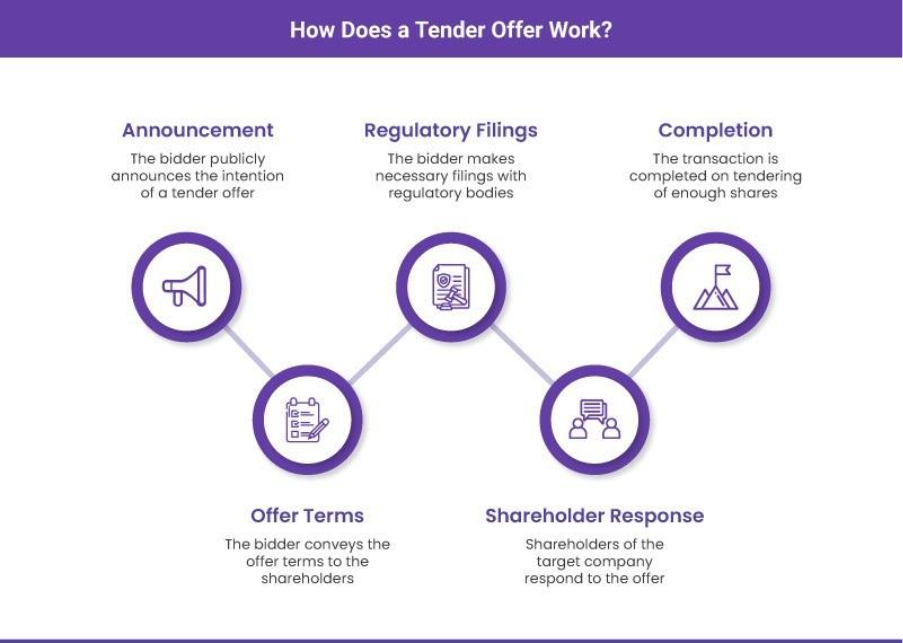
The most useful classification is based on who purchases the shares and where the purchase money goes.
The company uses its own cash reserves to purchase shares directly from eligible employees, founders, or early investors. The repurchased shares are either retired or moved into the company treasury, which decreases total outstanding shares, prevents dilution, and concentrates ownership among the remaining stakeholders without involving outside parties.
An approved external investor (such as a new or existing venture capital firm) provides the capital to buy shares directly from existing holders. Cash moves straight from the buyer to the selling participants, meaning the transaction does not touch the company’s balance sheet, total outstanding shares remain unchanged, and equity ownership simply transfers to the new investor.
An acquiring entity bypasses the target company’s board of directors and management, who oppose the acquisition, by making a direct, public offer to shareholders to buy their voting stock at a premium, aiming to accumulate enough shares to gain majority control of the company.
For private companies, tender offers are a practical way to turn illiquid equity into real value on the company's own terms. The most common reasons include:
In the public markets, the purpose usually shifts toward acquisition and consolidation, where a buyer uses a tender offer to build a controlling stake. That's a different goal from the liquidity-driven offers most private companies run.
Private-company shares have no continuously quoted public price. The tender price is therefore a negotiated transaction term, not an automatically observable market value.
Eligibility in a private company usually extends to current employees, former employees, early investors, and founders. But being a shareholder doesn't automatically qualify you. Companies set the rules.
Common eligibility criteria include:
1. Vested ownership or exercised shares: Unvested equity typically doesn't count. Options usually need to be exercised into actual shares.
2. Tenure or employee status: Some offers limit participation to employees past a certain service milestone, or exclude certain leaver categories.
3. Share class or grant type: Common stock, preferred, RSUs, and exercised options may be treated differently.
4. Participation caps: Limits on how much any individual can sell.
5. Required documentation: Election forms and acknowledgments completed before the deadline.
Here is a step-by-step guide to help prepare your company to navigate the tender offer process effectively:
When shareholders sell shares to an outside investor, they pay capital gains tax on the difference between the sale price and their tax basis. The applicable treatment depends on how long they held the shares.
If the company repurchases its own shares, the proceeds may be taxed as capital gains or as a dividend, depending on the shareholder’s ownership before and after the transaction.
Employees may also owe ordinary income tax if they exercise stock options as part of the tender offer. The final treatment depends on the award type, holding period, and transaction structure, so participants should consult a qualified tax adviser.
A tender offer gives shareholders a defined opportunity to convert private shares into cash. If you decline, you retain your shares and any future upside, along with the risks and limited liquidity of private-company ownership.
A future tender offer, IPO, or acquisition is never guaranteed. Even if another opportunity arises, its price, eligibility rules, participation limits, and timing may differ. Evaluate the current offer on its own terms, considering the after-tax proceeds, your financial needs, concentration risk, and confidence in the company’s prospects.
The right decision balances the value of cash available today against the uncertainty and potential value of the shares you continue to hold.
Qapita’s tender-offer solution connects cap table data with workflows and expert support for offer structuring, eligibility, approvals, documentation, participant communications, elections, settlement, and post-transaction reconciliation.
Considering a liquidity program for employees, founders, or early investors? Book a demo to see how Qapita can support your next tender offer.
To tender shares means to offer them for sale under the terms of a formal tender offer. The shareholder submits an election stating how many eligible shares they want to sell. The buyer may accept all, some, or none of those shares depending on the offer conditions and any proration rules.
“Tender business” usually refers to a procurement process in which companies submit competitive bids to supply goods or services. It is different from a stock tender offer, which involves an offer to purchase securities from shareholders.
A stock tender offer is a formal proposal by a company or third-party buyer to purchase shares from eligible shareholders at a stated price during a defined period. Shareholders decide whether to participate, subject to the offer’s eligibility requirements, purchase limits, and other conditions.
A private company may conduct a tender offer to create liquidity for employees, founders, or early investors, manage its ownership structure, or meet investor demand for shares. A public company may use one to repurchase its own stock, while an outside bidder may use a tender offer to acquire a significant stake or pursue control of the target company.








.png)