


 Equity management

 Equity management
- Fund management

 Fund management
 - Fund managementFund management
- Fund managementFund management


.png)

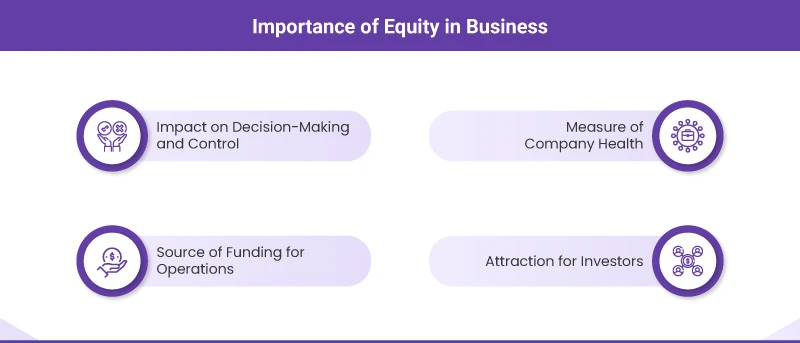
When you start a company, you and your co-founders hold all the equity. As you raise funding and build a team, you'll share that ownership with investors and employees, so understanding equity in business, and knowing how to calculate it, becomes essential to running your company well.
Equity in business is the residual interest in a company's assets after you account for all liabilities. In simple terms, it's the value left over when you subtract total liabilities from total assets at any given point in time. This value, or equity, is what shareholders and owners can claim as their stake in the company. Every shareholder contributes to that equity, regardless of the size of their stake.
The distribution of equity ownership depends on your business structure. In a sole proprietorship, you hold 100% of the equity as the only owner. In a partnership with two equal partners, each partner holds 50%. Add a third equal partner, and each person's share drops to 33%.
You calculate the amount of equity in a business by subtracting total liabilities from total assets. This assets-minus-liabilities equation gives investors and analysts a clear view of your company's financial health.
Equity grows through two main channels:
You raise equity capital to purchase assets, fund projects, and cover operations. Private investors and venture capitalists often prefer equity investments because they share in your company's profit and growth, not just a fixed return.
Equity represents an investor's proportional stake in a company based on the shares they hold. Shareholders benefit from potential capital gains, dividends, and voting rights on corporate decisions, and company performance and market conditions determine the value of that equity. When you issue new shares, you dilute the ownership stake of existing shareholders. The two broad types of equity, common stock and preferred stock, each carry a different set of rights and privileges.
Equity in business can be positive or negative. Positive equity means your assets cover your liabilities; negative equity means your liabilities exceed your assets. Prolonged negative equity can signal balance sheet insolvency, which investors see as a red flag. Shareholder equity alone doesn't tell the whole story, though: pair it with cash flow analysis, profit margins, the debt-to-equity ratio, and return on investment (ROI) to get a full picture of your startup's financial health.
Equity in business splits into two broad categories: owner's equity and non-owner's equity. Owner's equity reflects what founders invest and reinvest in the company. Non-owner's equity, often called investor or shareholder equity, comes from external parties who become shareholders after investing in the business.
Here's what each type means for you as a startup founder.
Owner's equity, also known as owner's capital, is the portion of the company that founders own outright. It includes your initial investment plus any earnings you've reinvested in the business.
Capital investment is the initial seed money you invest in the company, along with any additional funds you add as the business grows. This capital investment forms the financial foundation of your company, funding everything from your first hire to your first product launch.
Non-owner's equity, also called investor's equity or shareholder's equity, represents the ownership interest of external investors who've purchased shares in your company. These investors might be individuals, venture capital firms, or other entities that put capital in return for a share of ownership.
Shareholder's equity breaks down into stock components, retained earnings, capital contributions, and unrealized gains or losses. Two stock components carry enough weight for founders to understand in detail: common shares and preferred shares.
A common share is a unit of stock that gives the holder ownership in a company along with voting rights on matters like board elections and major corporate decisions. Founders and employees typically hold common stock. Common stockholders receive dividends only after preferred shareholders get paid, and in a liquidation, they're last in line behind debt holders and preferred shareholders.
Because of that lower priority, common stock usually carries a lower price per share than preferred stock in the same funding round. What common stockholders gain in exchange is voting power and, over the long run, more direct exposure to the company's growth in value.
A preferred share is a class of stock that gives investors priority over common stockholders on dividends and liquidation proceeds, typically in exchange for giving up voting rights. Venture capitalists and other institutional investors usually negotiate for preferred stock when they fund a company.
Preferred stock often comes with a liquidation preference, a contractual right that lets the investor recover their invested capital, or a multiple of it, before common stockholders see a dollar from a sale or wind-down. Many preferred shares also carry conversion rights, letting the investor convert to common stock if that produces a better outcome, along with anti-dilution provisions that protect their ownership percentage in a down round.
Beyond common and preferred stock, non-owner's equity includes a few other components:
Employee equity is the ownership stake you grant to employees, usually through stock options or restricted stock units (RSUs), so they share in the company's growth alongside founders and investors. It's one of the most common ways startups compete for talent without paying market-rate cash salaries in the early years, and it's the type of equity your team is most likely to ask you about.
Most startups grant employee equity as incentive stock options (ISOs) or non-qualified stock options (NSOs). ISOs are only available to employees and offer more favorable tax treatment if you meet IRS holding-period requirements, while NSOs are open to employees, contractors, and advisors but get taxed as ordinary income at exercise.
Private companies typically rely on SEC Rule 701 to issue this equity without registering the securities. As of 2026, Rule 701's disclosure threshold sits at $10 million in aggregate sales during any rolling 12-month period, a limit the SEC raised from $5 million under the Economic Growth, Regulatory Relief, and Consumer Protection Act.
Employees who receive stock options often benefit from filing an 83(b) election with the IRS. This lets them pay tax on the value of their equity at grant, when it's typically low, rather than at vesting, when the value may have grown substantially. The election must reach the IRS within 30 days of the grant date.
It's also worth introducing your team to qualified small business stock (QSBS). Under Internal Revenue Code Section 1202, as expanded by the One Big Beautiful Bill Act of 2025, employees and investors who hold qualifying C-corporation stock issued after July 4, 2025, can exclude up to $15 million in gain, or 10 times their basis if greater, from federal tax, provided they meet the holding-period and company-size requirements.
Vesting is the process by which an employee earns full ownership of granted equity over time, rather than receiving it all at once. Most startups use a four-year vesting schedule with a one-year cliff: the employee earns nothing until their first anniversary, then 25% vests immediately, with the remaining 75% vesting monthly or quarterly over the next three years.
A cliff protects your company from granting meaningful equity to someone who leaves after a few months. Many equity plans also include acceleration clauses that speed up vesting if the company gets acquired or if an employee is terminated without cause, so it's worth defining these terms clearly in your stock plan documents before you grant a single option.
As a startup founder, understanding the differences between equity and debt matters for your financing strategy. Here's how the two options compare across ownership, repayment, cost, risk, and control.
Calculating equity in business starts with your company's total assets and total liabilities. Here's the step-by-step process:
Equity = Total assets − Total liabilities
This gives you the net value shareholders own, the residual interest in your company's assets after liabilities.
For a private company, the total assets side of this formula gets harder to pin down, since you don't have a public share price to work from. That's where a 409A valuation comes in: an independent appraisal that sets the fair market value (FMV) of your common stock for tax purposes. The IRS requires this valuation under Internal Revenue Code Section 409A to set a defensible strike price for employee stock options, and an outdated or unsupported 409A can trigger tax penalties for the employees who exercise those options.
Equity only has real value once you can convert it into cash, and startups typically offer three paths to get there. Each comes with its own timeline, tax treatment, and level of company control.
Tender offers have become especially useful for later-stage private companies. They give employees and early investors a path to partial liquidity while you stay private longer, without diluting control the way a full exit would. Qapita's Tender Offers product shows you how equity turns into cash for employees and early investors, without forcing a full exit or loss of control.
Understanding equity in business, and knowing how to calculate it, gives you a clear read on your company's financial health and shapes decisions on funding, hiring, and growth. Managing it gets complicated fast once you add investors, employee stock plans, multiple funding rounds, and compliance requirements like 409A valuations and ASC 718 reporting.
That's where Qapita comes in. We're an equity management platform that pairs software with managed services: plan design consulting, 409A valuations from qualified experts, employee townhalls, and financial analyst support, so you're never navigating a fundraise or a compliance deadline alone.
Our platform offers cap table and equity management tools for founders, finance, legal, and HR teams, plus fund administration and portfolio reporting for investors. We manage more than $67 billion in equity value across 2,800 customers, including 57 unicorns, and we've added more than 100 US customers in under a year.
See how your cap table stays accurate through every fundraise with Qapita.
Equity in business represents your ownership interest in a company. It's the residual value of your assets after you deduct liabilities, and for shareholders, it reflects their stake in the company's worth. You can increase equity by reinvesting profits or bringing in new investors, both of which support long-term growth.
If an investor offers $1 million for 10% equity, they're proposing to invest $1 million in exchange for a 10% ownership stake in your company. That offer implies your company's total valuation is $10 million, since $1 million represents 10% of $10 million. This is often called the post-money valuation once the investment closes.
The better choice depends on what you're optimizing for. Royalties give you ongoing income tied to sales or usage without giving up ownership, while equity gives investors a stake in your company and the potential for a much larger payout if you grow significantly. Equity tends to suit high-growth startups better; royalties suit steadier, revenue-generating businesses.
Equity can benefit your company since it provides capital without a repayment obligation, shares risk with investors, and helps you attract talent through employee stock plans. The tradeoff is that you give up part of your ownership and, potentially, some control over decisions. Whether that's a good deal depends on how you structure and manage your equity.
Having 5% equity in a company means you own 5% of its total shares or value. As an equity holder, you're entitled to 5% of profits distributed as dividends, and if the company sells, you'd receive 5% of the proceeds after the company pays off debts and other obligations.
A stock is a specific financial instrument: a share certificate that represents partial ownership in a company. Equity is the broader concept, the total value of ownership in a company, which can take the form of stock, retained earnings, or other ownership interests. Stock is one way equity gets represented and traded, but equity also includes value that never converts into tradeable shares.
Equity gives you actual ownership in a company, including a claim on its future value and, often, voting rights. A profit-sharing plan gives employees a portion of the company's profits as cash or a retirement contribution, without any ownership stake or voting rights. Equity ties your reward to the company's overall value; profit sharing ties it strictly to short-term profitability.