


 Equity management

 Equity management
- Fund management

 Fund management
 - Fund managementFund management
- Fund managementFund management




A golden parachute is a contractual agreement designed to provide substantial compensation to top executives if they lose their jobs due to mergers, acquisitions, or other corporate takeovers. This agreement typically guarantees executives substantial benefits such as severance pay, stock options, bonuses, and continued health insurance or pension contributions.
The golden parachute meaning goes beyond a simple severance check. These agreements typically bundle together several forms of compensation at once: a cash severance payment, accelerated vesting of stock options or restricted stock, continuation of health insurance, and sometimes pension or retirement contributions. The goal is to give a departing executive a soft landing, hence the "parachute" in the name, if a corporate transaction costs them their job.
Companies negotiate golden parachute clauses in advance, usually when hiring a C-suite executive or renegotiating their contract, rather than improvising a package after a deal is already underway. That advance negotiation is part of what makes golden parachutes controversial: the payout is locked in well before anyone knows whether the executive's performance will have anything to do with the eventual outcome.
Golden parachute clauses are specific provisions included in executive contracts. They provide substantial compensation packages for company leaders when their jobs are lost due to a merger or takeover. These terms are often negotiated when hiring executives and are included in their employment contracts to reassure them, particularly if your startup is actively seeking investment or acquisition. By offering such a package, you are making it clear that your executive team's interests are protected.
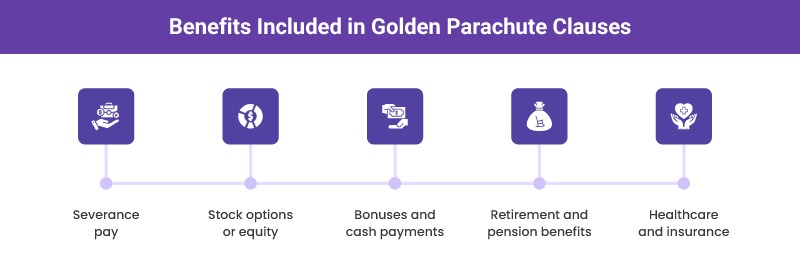
Here are the typical benefits provided under these clauses:
1. Severance pay: This often represents a multiple of the executive's annual salary, providing substantial financial support in the event of job loss. For instance, an executive might receive two to three times their base salary as severance.
2. Stock options or equity: Vesting of unearned or deferred equity compensation is common, including the accelerated vesting of existing stock options. This means executives can immediately exercise stock options or receive equity they would have earned over time, ensuring they benefit from the company's success even if their tenure ends early.
3. Bonuses and cash payments: Lump-sum payments that can be a substantial portion of the total compensation. These bonuses are designed to reward executives for their service and ensure they have a financial cushion.
4. Retirement and pension benefits: Continued contributions to retirement accounts and pensions are included, ensuring that executives' long-term financial security is maintained even after their departure.
5. Healthcare and insurance: Ongoing health, dental, and life insurance coverage post-departure is often provided, maintaining the executive's benefits as they transition out of their role.
Golden parachute clauses are activated by specific triggering events that significantly alter the company's control or ownership structure. Understanding these triggers helps you appreciate how these agreements provide security to executives during times of corporate upheaval.
1. Mergers and acquisitions: When your company merges with or is acquired by another entity, executives might be forced to exit or have their roles redefined. Golden parachutes ensure they receive fair compensation despite these changes.
2. Hostile takeovers: In scenarios where your company is forcibly acquired without the consent of existing management, golden parachutes protect executives from being ousted without adequate compensation. This provides a layer of security and incentivizes executives to act in the company's best interest during an unwanted takeover attempt.
3. Change of control provisions: These clauses are triggered when the control of your company passes to new owners, regardless of the executive's performance. This means executives are protected even if the change in control is part of a strategic decision rather than a performance-based outcome.
Golden parachutes serve a handful of practical purposes for a company, beyond simply being a generous perk.
Not every payment made to a departing executive is treated as a golden parachute payment for tax purposes. Under IRC Section 280G, a payment only qualifies as a parachute payment if it meets three conditions:
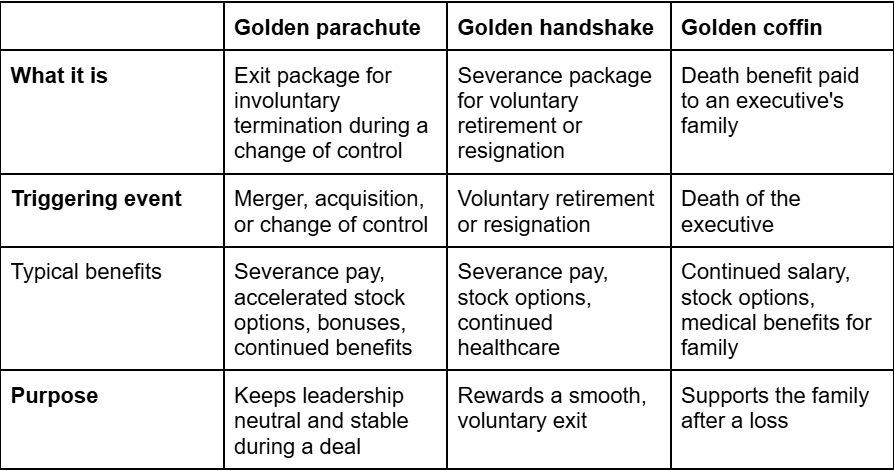
While golden parachutes are specifically linked to liquidity events such as mergers and acquisitions, golden handshakes and golden coffins serve different purposes in executive compensation. Understanding the distinctions between them can better navigate the complexities of executive compensation packages.
The role of Section 280G in golden parachutes:
Section 280G of the Internal Revenue Code (IRC) imposes tax penalties on excessive golden parachute payments to ensure they do not become overly burdensome on your company or the executives.
Under Section 280G, an 'excess parachute payment' is defined as any amount exceeding three times the executive's base amount (average annual compensation over the past five years). Payments that cross this threshold are subject to additional taxes.
If a payment qualifies as an excess parachute payment, your company cannot deduct this excess amount, and the executive faces a 20% excise tax on top of their regular income tax. This significantly reduces the net payout for the executives and increases the financial burden on your company.
You can mitigate these tax burdens by carefully structuring compensation packages. Ensure that payments are reasonable and necessary for the services rendered, which may exempt them from being classified as excess parachute payments.
As discussed earlier, Section 280G imposes a 20% excise tax on the recipient of the golden parachute payments if the total compensation exceeds three times their base amount. To mitigate the significant tax implications of golden parachutes, you can use the following strategies:
1. Shareholder approval: For private companies, obtaining shareholder approval for golden parachute payments can cleanse these payments from the excise tax. This involves holding a vote, documenting the approval, ensuring compliance, and reducing tax liabilities.
2. Reasonable compensation analysis: Conducting a reasonable compensation analysis can help reduce the parachute payment amount by demonstrating that part of the compensation is for services rendered after the change in control. This can exclude a portion of the payment from being considered an excess parachute payment.
3. Restructuring payments: You can restructure the compensation package to avoid triggering Section 280G. This might include spreading payments over multiple years or converting some payments into non-cash benefits, thereby minimizing immediate tax impacts.
4. Equity compensation: Utilizing equity compensation, such as stock options or restricted stock, can help reduce the immediate tax burden. This approach aligns the interests of executives with the long-term performance of your company, providing incentives without excessive tax consequences.
Golden parachutes offer several strategic benefits for your company, making them an attractive feature in executive compensation packages.
1. Attracting top executive talent: Golden parachutes act as powerful recruitment tools, enticing highly sought-after executives to join your team. By offering job security and financial protection, you make high-risk roles more appealing to top-tier talent. Executives are more likely to accept positions in companies undergoing significant transitions if they know they are financially safeguarded.
2. Ensuring executive objectivity: During major corporate events like mergers or hostile takeovers, golden parachutes help executives remain neutral. Knowing that their financial security is assured, executives are less likely to oppose beneficial deals due to personal job security fears. This objectivity ensures better decision-making that aligns with the company's best interests.
3. Offering job security: Golden parachutes provide executives with leverage in negotiations, both during their tenure and upon exiting the company. Executives are more likely to make decisions that benefit the company's long-term health when they are financially protected. This security allows them to focus on strategic goals rather than short-term job preservation.
4. Enhancing the company's reputation: Including a golden parachute in an executive compensation package can enhance your company's reputation, signaling to investors, stakeholders, and potential employees that your company values leadership stability and long-term commitment. Providing such agreements demonstrates that you are forward-thinking and prepared to support your leadership through challenging transitions.

Golden parachutes have faced significant criticism from shareholders and corporate governance experts for the following reasons.
1. Excessive compensation for poor performance: One of the most common criticisms is that golden parachutes reward executives even when the company underperforms. High-profile cases have emerged where executives received large payouts despite overseeing poor financial performance, leading to shareholder outrage. This perception of rewarding failure can damage a company's reputation and erode shareholder trust.
2. Shareholder opposition and corporate governance issues: Shareholders often view golden parachutes as misaligned with their interests. Since executives already receive substantial compensation, many shareholders argue that golden parachutes are unnecessary and a misuse of company funds. This opposition can lead to conflicts within the company and complicate governance.
3. Negative public perception and media scrutiny: Golden parachutes have drawn significant public and media scrutiny, especially in cases where executives walk away with massive payouts while other employees face layoffs. The public often sees these packages as examples of corporate greed, which can harm the company's image and lead to increased regulatory scrutiny.
4. Regulatory and tax concerns: Golden parachutes face increased regulation and scrutiny, particularly under Section 280G of the IRS code. Excessive golden parachutes can trigger tax penalties for both the company and the executive, adding to the financial burden. Navigating these regulations requires careful planning and professional advice to avoid unintended consequences.
Here are some notable examples of golden parachute packages in corporate history:
1. Carly Fiorina (Hewlett-Packard): Carly Fiorina, the former CEO of Hewlett-Packard, received a golden parachute worth about $40 million when she was ousted in 2005. Despite the company's stock losing half its value during her tenure and tens of thousands of layoffs, Fiorina walked away with a substantial payout. This case drew significant media attention and public scrutiny, highlighting the disparity between executive compensation and employee layoffs. The controversy surrounding her departure underscored the challenges of balancing executive rewards with company performance and public perception.
2. Robert Nardelli (Home Depot): Robert Nardelli, who served as CEO of Home Depot from 2000 to 2007, received a staggering $210 million payout when he was forced to resign. Nardelli's tenure saw significant growth in sales, but his management style and disagreements with shareholders over his compensation led to his departure. The size of his golden parachute sparked debates about executive pay and corporate governance. This case illustrates the complexities of executive compensation and the potential backlash from shareholders and the public when payouts are perceived as excessive.
3. Bob Chapek (The Walt Disney Company): Bob Chapek, ousted as Disney's CEO in November 2022, left with a severance package worth more than $20 million, including remaining base salary, a pro-rated bonus, and accelerated company stock. Unlike the Fiorina and Nardelli cases, Chapek's departure was a board-driven termination rather than a merger or acquisition, but the size and structure of his exit package renewed public debate over golden-parachute-style payouts and how boards value departing executives regardless of the reason for their exit.
Golden parachutes significantly impact mergers and acquisitions (M&A), influencing both the likelihood and terms of a deal. These packages often form part of broader anti-takeover measures, such as poison pills. By guaranteeing substantial compensation to executives in the event of a takeover, golden parachutes make hostile takeovers more costly and less attractive to potential acquirers. This deterrent effect helps protect your company from unwanted acquisition attempts, maintaining stability and control.
Golden parachutes also affect the terms of a merger. When acquirers know that executives will receive significant payouts, they may be more willing to negotiate favorable terms to avoid the financial burden of these packages. This alignment of interests can lead to better deals for your company.
However, the cost implications of golden parachutes can also influence strategic decisions. You might weigh the financial burden of these packages against the potential benefits of a merger. This assessment can sometimes deter or delay acquisition plans, leading to more calculated and thoughtful decisions.
A golden parachute is a straightforward idea with real complexity underneath, it guarantees an executive a defined exit package if a merger or acquisition costs them their job, and in return, it provides more stable leadership and a smoother path through corporate transactions. But the details, what counts as a parachute payment, how the 3x threshold works, and what triggers the 20% excise tax, determine whether a package is a smart retention tool or an expensive liability for both the company and the executive.
Boards and founders negotiating these agreements are best served by understanding the golden parachute tax rules upfront, structuring payments with the 280G safe harbor in mind, and getting professional advice before a deal is on the table rather than after.
Golden parachutes are offered to executives to mitigate the potential financial hardship they might face if the company undergoes a significant change, such as a merger, acquisition, or bankruptcy. These packages often include severance pay, stock options, and other benefits. The purpose is to incentivize executives to remain with the company during times of uncertainty and to avoid legal disputes or negative publicity that could arise from sudden layoffs.
Golden parachutes are typically reserved for a company's most senior executives, including the CEO, CFO, and other C-suite officers, though some companies extend similar protections to a broader group of senior vice presidents or key employees. Under Section 280G, the relevant category is "disqualified individuals," which includes officers, highly compensated employees, and shareholders who own 1% or more of the company.
A golden parachute gives a CEO financial protection against that outcome and, just as importantly, removes the incentive to block or delay a deal purely out of self-interest, since their compensation is secured either way.
Yes, golden parachutes are legal in the United States. They are a negotiated contractual benefit, subject to disclosure requirements (public companies must disclose them in proxy statements) and to the tax consequences under Sections 280G and 4999 once payments cross the relevant thresholds.
A golden parachute is specifically tied to an involuntary termination following a merger, acquisition, or other change of control. A golden handshake is a broader term for a severance package offered when an executive retires or leaves voluntarily, independent of any corporate transaction.
No. Golden parachutes are negotiated individually and are far more common among C-suite executives at large or publicly traded companies than among executives generally. Smaller private companies and startups may not offer them at all, or may limit them to a founder or CEO.
Golden handshakes are typically offered to senior executives or long-tenured employees who are retiring, resigning by mutual agreement, or being encouraged to leave voluntarily as part of a restructuring.