


 Equity management

 Equity management
- Fund management

 Fund management
 - Fund managementFund management
- Fund managementFund management




Stock options and warrants both give the right to buy shares at a set price, but they are not the same instrument. In US private companies, warrants typically go to investors or lenders in financing or debt deals, while stock options go to employees as compensation. Both create new shares when exercised, so both dilute existing owners.
Mixing them up on a term sheet or cap table creates real dilution surprises. This guide helps you identify which instrument a term sheet or cap table entry describes, and judge its likely dilution and tax implications. Qapita’s platform and equity professionals help you model that impact before you sign.
A stock warrant is a financial instrument issued by a company that offers the holder the right, but not the obligation, to purchase the company's shares at a predetermined price within a specified timeframe. This price is known as the exercise price.
Unlike stock options, which are used to motivate employees, warrants are primarily a financing tool. Companies often issue different types of warrants to raise capital, reward investors, or get favorable terms for other financial transactions. For example, your startup might offer its own warrants to early investors as an incentive to participate in funding rounds.
Warrants represent a contractual agreement between your company and the warrant holder. They can be included in various financial instruments, such as bonds, preferred stock, or as standalone securities.
Warrants show up in deals, not in your payroll. That is the fastest way to keep them straight from options.
Understanding how stock warrants operate is essential for effectively using them in your fundraising strategy.
The process begins with the issuance of a stock warrant certificate. This is when your company or a third party, issues the warrants and sets the terms and conditions. These terms include the total number of shares available for purchase, the exercise price, and the expiration date.
The exercise price is the price at which the warrant holder can purchase your company's shares. It is typically set above the current market price at the time of issuance to incentivize the holder.
Unlike stock options, which often have a vesting period, stock warrants can typically be exercised at any time from the date of issuance until the expiration date. This period can be several years, providing the holder with a longer timeframe to decide whether to exercise their warrants.
When the holders decide to exercise their warrants, they purchase the shares from your company at the exercise price. If the prevailing market price exceeds the exercise price, the holder gains by selling the shares immediately.
For example, suppose your startup issues a warrant permitting the holder to buy 1,000 shares at an exercise price of $10 per share anytime within the next five years. If, after three years, the market price of the shares has risen to $15, the holder can exercise the warrant, buy the shares for $10 each, and sell them for $15 each, making a profit of $5 per share, or $5,000 in total.
Here are the two main types of stock warrants that your startup can issue:
Equity warrants are issued directly by your company and give the holder the right to purchase shares at a specific price before the warrant expires. They are often used as an added benefit in equity financing to make investments attractive for investors. By offering equity warrants, you can potentially raise more capital at a lower valuation.
Debt warrants, on the other hand, are issued in combination with debt instruments. They allow the holder to purchase equity in your company at a predetermined price. These are often used to lower the interest rate on the debt or to make the debt offering more appealing to investors.
Equity warrants are warrants linked to a company's equity rather than a traded market instrument. In practice, that usually means a private-company right to buy shares directly from the issuer on negotiated terms. This is different from debt-linked warrants, which come attached to a loan or note package.
Both of those differ from listed or publicly traded warrants, which behave more like securities that change hands on an exchange or secondary market. For most startups, the relevant version is the negotiated equity or debt-linked warrant, not the listed kind.
For startup readers, the distinction is simple. Private-company warrants are negotiated deal terms sitting on your cap table, while publicly traded warrants are market securities that can change hands broadly. If a term sheet or article mentions SPAC warrants or listed warrants, that is usually a public-market topic, not the private-company equity question you are trying to answer.
A stock option is a compensation right that lets an employee, consultant, or other service provider buy company shares later at a set exercise price, usually after vesting. In US startups, options are granted under an equity plan for service and retention, not as part of a financing transaction.
Typically, stock options are granted with a vesting schedule. This means that employees can only exercise them after a certain period of employment. This structure helps retain key individuals and ensures their commitment to the long-term success of the issuing company.
Common scenarios in which stock options are issued include during the hiring process, as part of an annual compensation review, or when a company is trying to retain a valued employee. They are also often used in early-stage startups to compensate for lower salaries.
The process of stock options begins with the grant date, which is when private companies provide the options to the employee. At this point, you also set the strike price at which the employee can buy shares of stock in the future. This specified price is generally the market price of the company stock on the grant date.
However, employees can only exercise these options after a period of time. Most stock option grants include a vesting period, which is a timeframe during which the options gradually become theirs to exercise. This vesting period is often divided into increments, such as quarterly or annually.
For example, if an employee has a four-year vesting schedule with a one-year cliff, they will only own the options at the end of the first year. After that, they will gradually acquire ownership of the options over the next three years.
Once the options are vested, the employee can choose to exercise their options. This means they can buy the company's stock at the strike price. If the stock's market price is higher than the strike price, the holder can make a profit by exercising their options and then selling the stock.
Let's illustrate this with an example. Imagine your startup provides an employee with 1,000 stock options, having an exercise price of $10 per share. The options vest over four years, with 25% vesting each year. After one year, the employee can exercise 250 options and buy 250 shares at $10 each. If the market price of the stock is $15 per share, the employee can make a profit of $5 per share, or $1,250 in total.
There are primarily two categories of stock options: ISOs and NSOs, each with its own set of rules and tax implications.
ISOs are specifically designed for employees and offer significant tax advantages. To qualify for ISO status, the options must be granted as compensation for services performed by the employee.
One of the primary advantages of ISOs is their potential tax benefits. If certain conditions are met (such as holding the shares for a specific period after exercise), employees may be able to avoid paying income tax at the time of exercise.
Any gain at the time of selling the shares can qualify for the lower long-term capital gains tax rates compared to higher ordinary income tax rates.
NSOs are more flexible than ISOs and can be granted to employees, directors, contractors, service providers, or even new investors. However, they lack the tax advantages of ISOs.
When employees exercise NSOs, they must pay income tax at ordinary rates on the gap between the Fair Market Value (FMV) and the strike price while exercising. This amount is considered taxable income for that year. Employees will also owe capital gains tax when they eventually sell the shares.
Warrants and options share a surface similarity: both are a right to buy shares at a set price before an expiration date. Underneath that, they differ on issuer, recipient, dilution logic, exercise pricing, transferability, lifespan, and tax. Here is the comparison at a glance.
Both instruments can create new shares when exercised, so both dilute existing holders in private-company usage. Warrant terms run longer than most option terms, commonly 5 to 10 years, and can stretch up to 15.
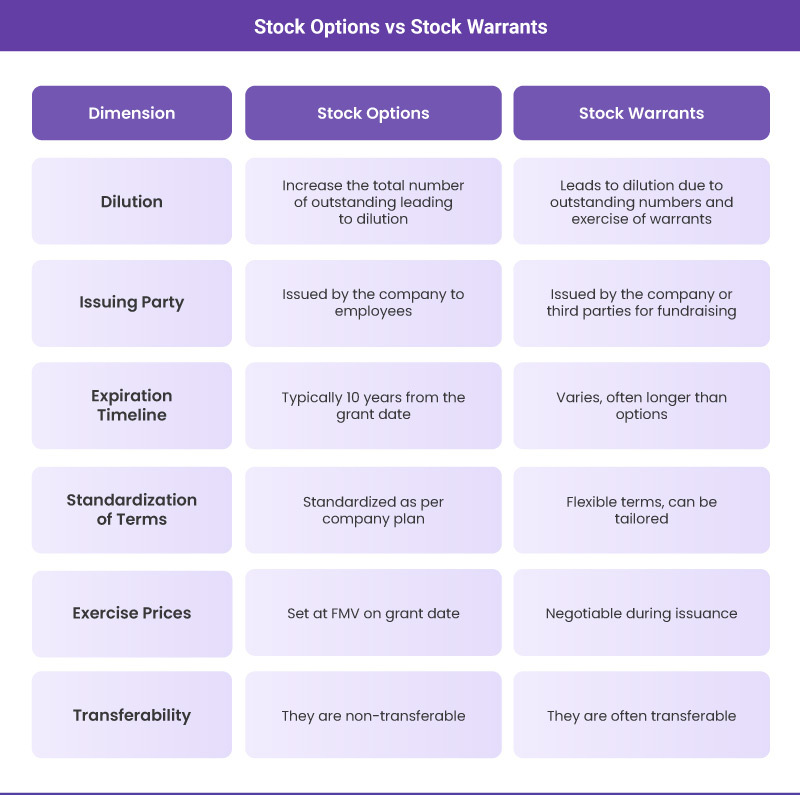
In US startups, warrants usually go to investors and lenders, while options usually go to employees and other service providers. Employee warrants can exist, but they are not the standard compensation tool. The standard tool is the stock option, backed by an option pool and a defensible 409A valuation.
Advisors sit in a gray zone. Some receive options through an advisor plan, and some receive warrants as part of a broader arrangement. Read the document to know which one you are holding.
Private-company warrants are commonly valued using deal terms, expected time to expiration, strike price, volatility, and the company's current share value. In finance practice, option-style models such as Black-Scholes are often used as a reference framework when a fair-value estimate is needed.
Value is driven by the spread between current equity value and strike price, plus the time and optionality remaining. When companies report warrant fair value, that measurement typically follows ASC 820, while share-based awards fall under ASC 718 and certain warrants are classified under ASC 815, per Financial Accounting Standards Board guidance. A reliable fair value estimate usually starts from a defensible 409A valuation.
When a warrant is exercised, the company typically issues new shares, so the ownership percentages of existing holders go down unless they also participate. That makes warrants especially important in private-company modeling, because the dilution comes from the financing or debt deal itself, not from employee compensation.
Here is the basic math. Say your company has 10,000,000 fully diluted shares and issues a warrant for 100,000 new shares. Full exercise increases the share count to 10,100,000. A holder who owned 1,000,000 shares owned 10.0% before exercise and owns about 9.9% after, assuming nothing else changes.
Small in isolation, but warrants stack on top of your option pool and every future round. That is exactly why founders and finance leads model the fully diluted picture before signing.
The key difference is origin and recipient. A company issues warrants to investors, lenders, or partners as part of a deal, while it grants options to employees and service providers as compensation. Both let the holder buy shares at a set price before expiry.
Usually yes. When a warrant is exercised, the company issues new shares, which lowers existing holders percentages. Employee options are also dilutive in private companies. That is why founders model the fully diluted cap table before signing any deal that adds warrants.
It is possible but uncommon. The standard equity compensation tool for US employees is the stock option, granted under a plan. Warrants usually go to investors, lenders, and partners, so employee warrants are the exception, not the rule.
Warrant terms are negotiated and tend to run longer than option terms, commonly five to ten years and sometimes up to fifteen. The exact expiry date lives in the warrant agreement, so the certificate controls the deadline, not a general rule of thumb.
The warrant agreement usually governs whether the right is assumed, cashed out, accelerated, or terminated. Deal counsel often negotiates treatment during the sale process, so buyers, sellers, and holders know the payout method before closing begins.
Usually no. Until exercise, a warrant holder commonly has contractual rights defined in the warrant documents but lacks stockholder rights such as voting or dividends unless the agreement grants them. The answer depends on the charter, deal papers, and state law.
Yes. Private company warrants are usually issued under board-approved financing documents, and some companies also require stockholder approval under charter terms or investor rights. Counsel should confirm corporate authority, reserved shares, and securities law compliance before certificates are released.