


 Equity management

 Equity management
- Fund management

 Fund management
 - Fund managementFund management
- Fund managementFund management



Subordinated debt is a loan or bond that ranks below other debts in terms of repayment priority. If a borrower defaults or goes through bankruptcy, holders of subordinated debt are only paid after all senior creditors have been made whole. Because of this lower standing in the repayment hierarchy, the debt is also commonly referred to as junior debt.
To define subordinated debt simply: it is any form of borrowing where the lender's claim on assets sits behind the claims of senior debt holders. This lower priority does not make the instrument valueless. It simply means the subordinated lender takes on more risk than a traditional bank lender, and is compensated with a higher interest rate in return.
Subordinated debt sits in the middle of the capital stack, occupying the space between senior secured debt at the top and common equity at the bottom. In a liquidation scenario, the order of payment runs from senior debt holders first, then subordinated debt holders, and finally equity investors.
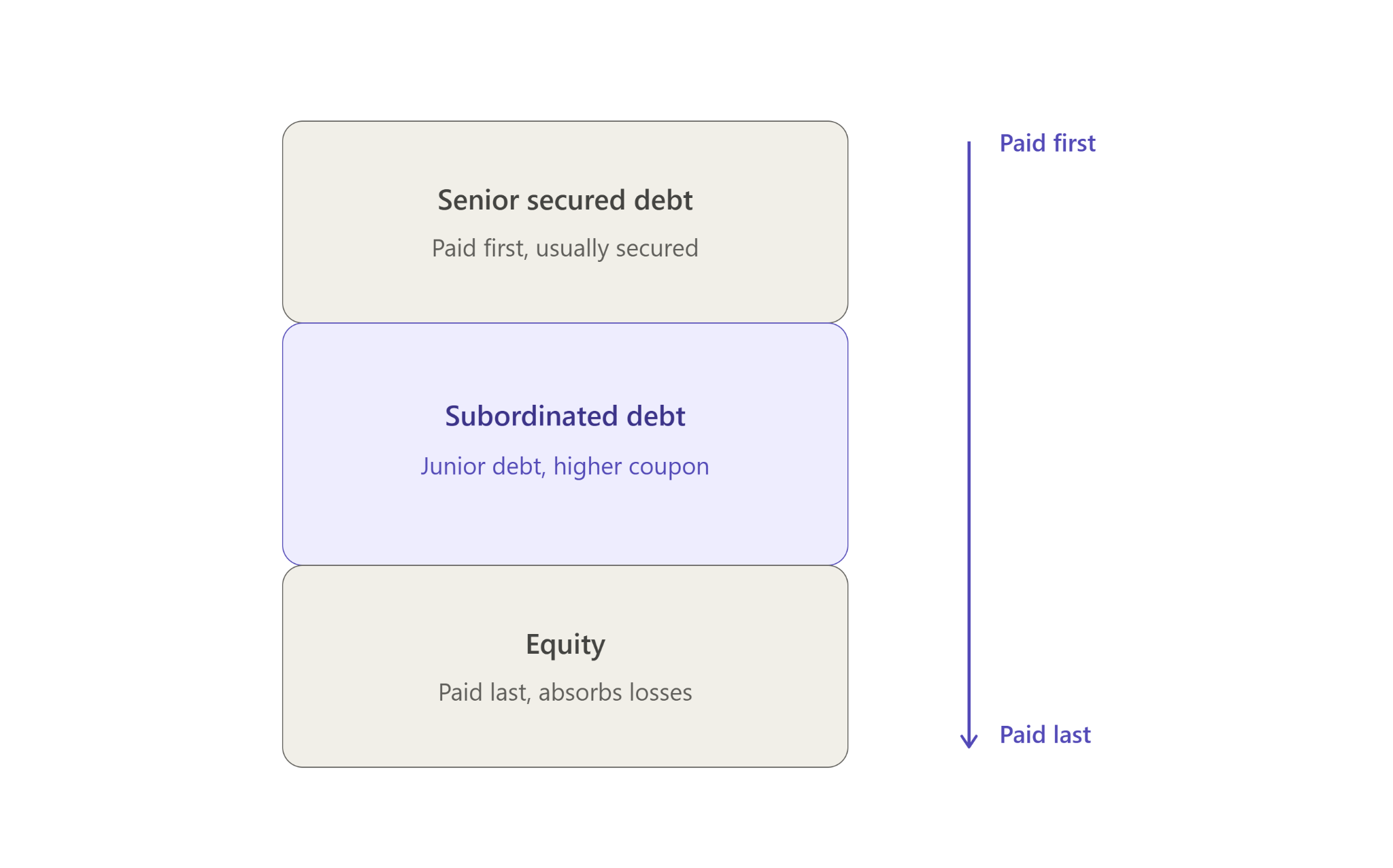
Subordinated debt has a distinct set of characteristics that separate it from senior loans and equity instruments.
When a company needs capital beyond what its senior lenders will provide, it can turn to the subordinated debt market. A subordinated lender steps in to fill that gap, accepting a junior position in the repayment hierarchy in exchange for a higher yield.
Here is how the structure works in practice. A company first secures senior debt from a bank or institutional lender. That senior lender typically requires first-priority claims on the company's assets. The company then approaches a separate subordinated lender to raise additional funds. Both lenders are aware of their respective positions in the capital stack from the start.
A subordination agreement formalizes this arrangement. It is a legal contract between the senior lender and the subordinated lender that confirms the senior creditor's priority over the subordinated creditor in any repayment or default scenario. The agreement makes clear that debt cannot be subordinated to other claims without the senior lender's knowledge and consent.
If the company fails to repay, the bankruptcy court follows this hierarchy strictly. Senior creditors recover first. Whatever remains after senior claims are settled goes to subordinated debt holders. Equity holders are last in line and often receive nothing if assets are insufficient.
Subordinated debt gives borrowers access to additional capital without giving up equity ownership. It bridges the funding gap when senior debt capacity is exhausted, lowers the blended cost of capital compared to issuing equity, and broadens the investor base by attracting mezzanine funds, BDCs, and insurance companies that senior lenders would not reach.
For companies:
For lenders and investors:
The three main forms of subordinated debt , subordinated notes and debentures, mezzanine debt with equity kickers, and convertible subordinated debt, each carry different equity features and risk profiles. Each is defined below.
A subordinated note is an unsecured debt instrument that ranks behind senior creditors. A subordinated debenture is a subordinated bond backed only by the issuer's general creditworthiness, not specific collateral. Both rely entirely on the issuer's ability to pay. Banks widely use subordinated notes to raise regulatory capital.
Mezzanine debt is a mix of senior debt and equity: a subordinated loan that carries high coupons plus an equity kicker, commonly warrants or conversion rights. It is placed between senior debt and equity in the capital structure. Private equity sponsors use it in buyouts and growth financings to push leverage higher without giving up more ownership.
Convertible subordinated debt is a subordinated note that can convert into equity under set terms. It differs from a plain subordinated note because the holder has a path into ownership, not just a fixed claim. This blends junior ranking with upside participation, which sets up a common point of confusion covered in the FAQs below.
These sit directly behind first-lien senior debt but are still secured against the same collateral. In a default, second-lien holders only recover from that collateral once the first-lien lenders have been paid in full. They're the most senior form of subordinated debt, so they price tighter than the instruments below, but the recovery gap between first and second lien in a distressed sale can be severe.
Fixed-rate, typically unsecured bonds issued by below-investment-grade borrowers. They're generally longer-dated than bank debt, carry incurrence covenants rather than maintenance covenants, and often include call protection that limits early repayment. The tradeoff for the issuer is a higher coupon in exchange for looser ongoing restrictions and no amortisation.
Rather than paying interest in cash, the borrower adds it to the outstanding principal, so the balance compounds. This preserves cash for a borrower that doesn't generate enough of it yet, which is why PIK shows up in buyouts and growth-stage financing. The risk sits with the borrower: the debt grows even while nothing is being repaid, and a company that can't grow into the obligation ends up materially more leveraged at maturity than at close.
Subordinated debt appears across several areas of US business finance, often in situations where the capital stack needs to be layered across multiple risk tiers.
In private equity, subordinated debt is a core tool for deal structuring. When a PE firm acquires a company through a leveraged buyout, it typically layers the capital structure with senior secured debt, subordinated debt, and equity. The subordinated tranche, often provided by a mezzanine lender or private credit fund, allows the sponsor to maximize the amount of debt in the deal and reduce the equity check required.
The sub debt in these transactions often carries PIK interest options, meaning the borrower can defer cash interest payments and instead allow the balance to accrue. This preserves cash flow in the early years after an acquisition, which is particularly useful when the acquired business is in growth mode.
Some subordinated debt instruments in PE deals also include equity warrants, which give the lender a small ownership stake in the business. This aligns the lender's incentives with the company's success and provides additional return if the company is eventually sold at a premium.
Unitranche loans, which have become common in middle-market PE transactions, blend senior and subordinated debt into a single facility with one lender. The interest rate sits between traditional senior and sub debt rates, reflecting the blended risk across both layers.
Companies turn to subordinated debt for a handful of practical reasons that go beyond simply needing more capital.
The distinction between subordinated debt and senior debt comes down to four primary factors: repayment priority, collateral, interest rate, and covenant structure.
Subordinated debt is used by companies, private equity sponsors, and banks alike. It occupies the critical middle layer of the capital structure, providing access to capital that senior debt alone cannot deliver and doing so without the ownership dilution that equity financing requires. The subordinated lender accepts junior status in the repayment hierarchy and, in exchange, earns a higher yield than a conventional bank lender.
For companies considering this option, the key is understanding what it costs and how it fits alongside existing debt. Sub debt loans carry higher interest rates, and in a default scenario, repayment is never guaranteed. But for businesses with strong cash flows and a clear need for additional capital, subordinated debt offers a flexible, non-dilutive path forward. Understanding where it sits in the capital stack, how the repayment process works, and what differentiates it from senior debt is the foundation for using it well.
A bank subordinated note is a common example: a 10-year unsecured note ranking behind all deposits and senior obligations that counts toward Tier 2 regulatory capital. A mezzanine tranche in a leveraged buyout is another: a subordinated loan with a high coupon plus equity warrants for upside participation.
Subordination describes repayment priority; conversion describes an option to become an equity holder. Subordinated debt ranks below senior debt but remains debt. Convertible debt can convert into equity and is not always subordinated. Convertible subordinated debt is both: it ranks junior to senior creditors and carries a conversion option.
In bankruptcy, subordinated debt holders are repaid only after all senior secured and unsecured creditors are fully satisfied. Because subordinated debt is typically unsecured and issued at high leverage levels, recovery rates are often low or zero. Standstill provisions also bar holders from accelerating repayment until senior debt is resolved.
Subordinated debt and mezzanine debt are not the same. All mezzanine debt is subordinated, but not all subordinated debt is mezzanine. Mezzanine debt combines a subordinated loan with an equity kicker, warrants or conversion rights. A plain subordinated note carries only a fixed coupon and principal, with no equity feature.








.png)