


 Equity management

 Equity management
- Fund management

 Fund management
 - Fund managementFund management
- Fund managementFund management




Your strike price is the fixed price you pay per share when you exercise your stock options. You do not get to choose it, your company sets it based on a 409A valuation completed on your grant date. Two employees hired just months apart at the same company can hold very different strike prices, because the fair market value (FMV) of the company's stock shifts over time.
This guide breaks down what a strike price is, how to read it against your company's current FMV, and what to consider before you exercise.
A strike price is the fixed per-share amount written into an option contract, it is the price you pay to buy company shares when you exercise your options. For employee stock options, this number is set on your grant date and stays the same for the entire life of the grant.
Now, as a startup founder, you must understand that your employees' stock options give them the right to buy a certain number of shares of your company at this predetermined price. While the strike price remains constant, the Fair Market Value (FMV) of your company's shares typically fluctuates over time.
The opportunity for your employees to profit from their stock options arises when they can sell their exercised shares at a price higher than the strike price. This difference between the FMV and the strike price is where the potential for financial gain lies for your employees.
Let's illustrate the concept of a strike price with an example. Suppose a call option for a stock is trading at $100 per share. The call option has a strike price of $110. This means that the holder of the option has the right, but not the obligation, to buy the stock at $110 per share on or before the contract expiration day.
If the stock's price goes beyond $110, the person holding the option can use their right to buy the stock at the set price of $110 and then sell it at the increased market price, thus earning a profit. But, if the stock's price doesn't hit $110 before the option's expiration date, the call option will become valueless.
The following three key factors play a significant role in determining the value of a stock option's strike price:
Startup employee stock options are different from options traded on a public exchange. Your strike price is tied directly to your company's stock and the valuation on your grant date. For listed options, the strike is just one contract term among many that traders buy and sell in an open market.
Your situation is simpler. You have a grant, a fixed strike, and a decision about whether and when to exercise. You are not picking strikes off a chain of calls and puts.
The strike price is set at the fair market value (FMV) of your company's common stock on your grant date, determined by a 409a valuation for private companies under IRC Section 409A and Treasury Regulations Section 1.409A-1(b)(5)(iv)(B). In practice, the company must establish FMV first, then issue options with a strike price at or above that value.
This is the single most important thing to understand about your strike. You did not choose it, and your manager did not negotiate it. A valuation produced it. That is also why two people hired months apart can hold very different strike prices: the FMV moved between their grant dates.
When it comes to Employee Stock Options (ESOs), the strike price plays a pivotal role. The strike price of ESOs is typically set at the FMV of the company's shares at the time the options are granted. This is where a 409A valuation comes into play, serving as a critical tool for startups to determine the FMV of their common stock. According to IRS Section 409A, private companies (like startups) must determine the strike price of their ESOs based on the FMV of their common stock, as determined by a 409A valuation. This valuation must be performed at least once every 12 months.
Setting the strike price at the 409A valuation ensures that ESOs are compliant with IRS regulations. If the strike price is set lower than the FMV (as determined by a 409A valuation), the options could be considered deferred compensation under IRS rules. This could result in 'the spread' being subject to immediate taxation, along with a 20% additional tax and potential interest charges. This is why it is important for you to ensure that the strike price of your ESOs is at least equal to the FMV of the stock at the time of grant.
The 409A valuation also influences when employees can exercise their options. If the FMV significantly increases after the options are granted, employees might find it beneficial to exercise their options earlier. Despite having to pay taxes on 'the spread', this strategy can help lock in a lower strike price and potentially realize greater gains in the future.
The strike price has an important role in shaping the dynamics of an options contract and influences decisions about whether exercising the option is profitable. This, in turn, determines the overall profitability of the contract.
Yes. Strike price and exercise price are two names for the same number: the per-share amount you pay when you exercise your options. If your plan document, grant notice, or offer letter uses either term, it refers to the same figure, per Investopedia and Carta.
Some documents lean on "exercise price" because it describes the action of paying to exercise. Others use "strike price" because it is the term markets use. There is no hidden difference between them.
When people confuse these two terms, it often points to an admin gap in how grants get explained. Qapita pairs software with services like employee townhalls and financial analyst support, so your team can explain grants clearly and answer questions before they become confusion. Learn more about exercising stock options to see how the price fits into the full process.
The preferred share price is what investors pay for preferred stock in a financing round. The strike price is what you, as an employee, pay to exercise your common-stock options. They are different numbers because preferred shares and common shares carry different rights and economics.
This matters when you compare offers. A company's headline valuation from its last round reflects preferred pricing, not your strike. Your strike is usually well below that, tied to the common-stock FMV from the 409A.
Calculating the strike price of an option involves a complex mathematical model known as the Black-Scholes model. It's a mathematical equation that computes the theoretical fair value of an option price using five variable inputs. These variables include:
Each factor in the formula influences the calculation of the strike price:
Let's walk through a detailed example of calculating the strike price using the Black-Scholes model. The formula for this calculation is:
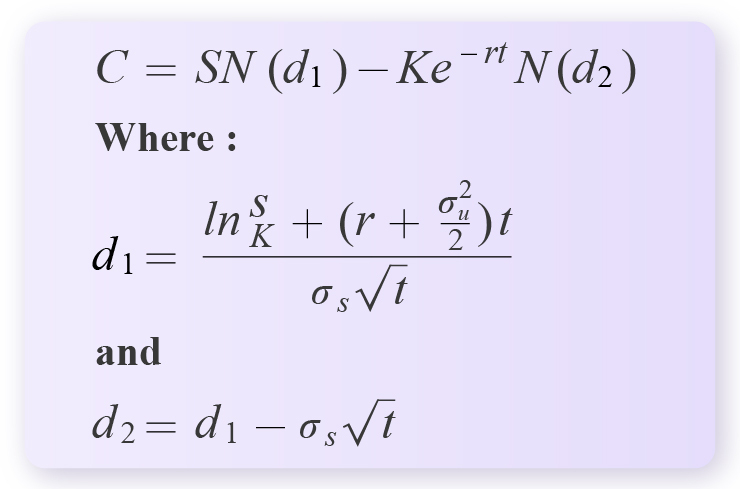
Here:
Suppose you have an option with a current stock price (S) of $60, a strike price (X) of $55, 45 days until expiration (t), a risk-free interest rate (r) of 2%, and implied volatility (σ) of 25%.
Therefore, based on the Black-Scholes model and the provided information, the theoretical option price (or fair value) for this call option is approximately $5.54. This represents the premium an option buyer would pay to the option seller.
Remember, the Black-Scholes model is a theoretical model. In practice, market prices can and do deviate from this theoretical price due to various factors like demand and supply imbalances, transaction costs, and market sentiment. Therefore, while the model provides a useful framework for understanding option pricing, it should not be relied upon as the sole determinant of an option's fair value.
You usually do not choose the strike price on employee stock options. To pick the right strike price in practice, compare your granted strike with the company's current FMV, calculate the spread on vested shares, and decide whether the exercise cost and likely tax bill still leave enough upside.
The real decision comes after grant. The useful task is evaluating the number you received against current value, cash outlay, and expected upside.
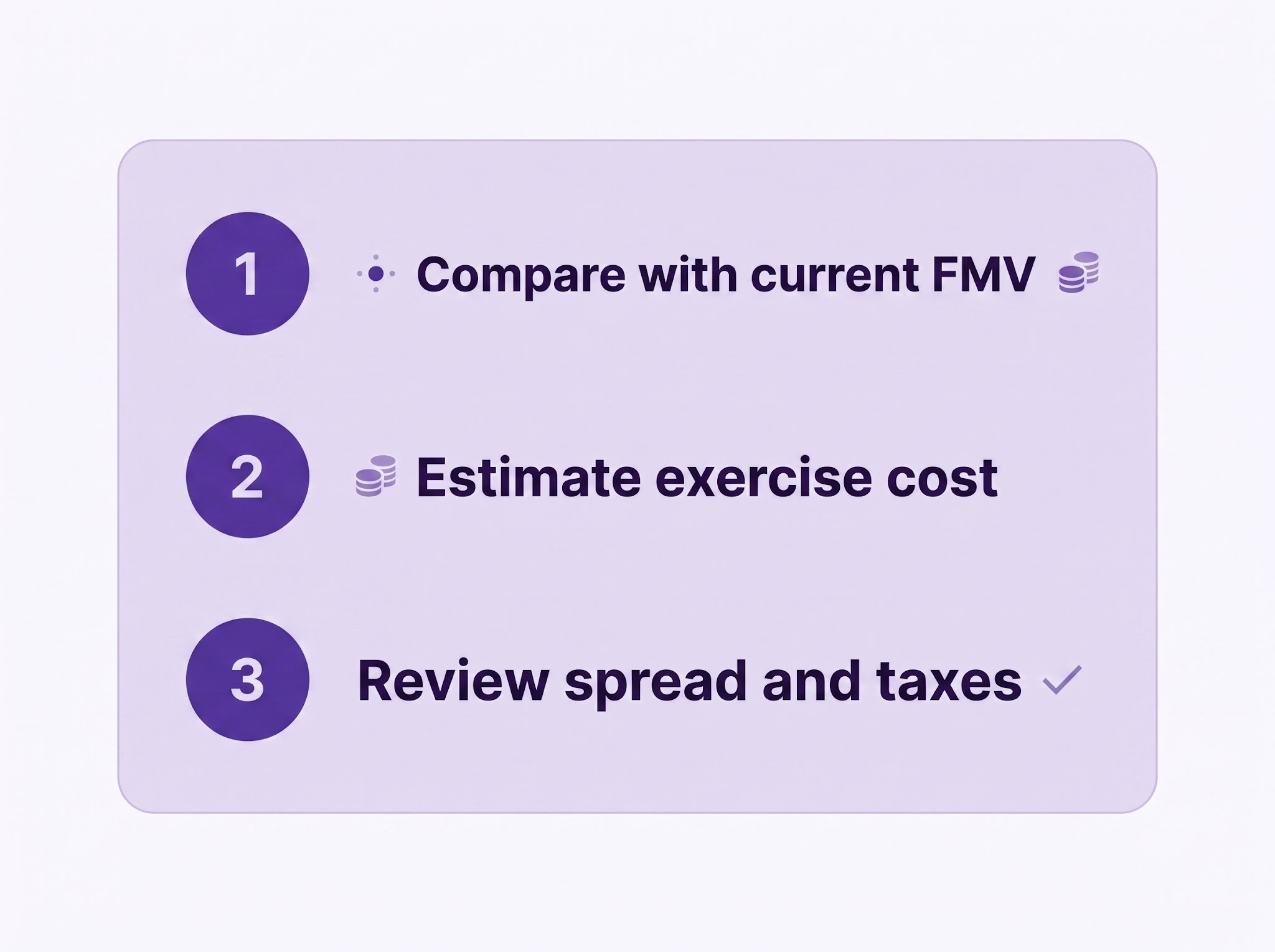
1.Compare your strike price with current FMV to see whether options hold built-in spread value.
2.Multiply vested shares by your strike price to estimate cash needed for an exercise.
3.Review spread, tax impact, and time horizon to decide if exercise risk matches expected upside.
To judge your strike, compare it to your company's current FMV. If today's FMV is above your strike price, your options are in the money, meaning there is built-in spread value. If today's FMV is below your strike price, your options are underwater, meaning exercising would cost more than the shares are currently worth.
A low strike from an early grant is a genuine advantage. As the company grows and FMV rises, that fixed strike becomes more valuable relative to what the shares are worth. That is the whole point of getting equity early.
Moneyness is classified into three categories based on the relationship between the strike price and the current trading price of the underlying asset. These categories are as follows:
1. In-The-Money (ITM): An option is considered ITM if the current price of the stock has already surpassed the strike price.
2. Out-of-the-Money (OTM): An option is considered OTM if the current stock price has not yet reached the strike price.
3. At-The-Money (ATM): An option is deemed to be ATM if the strike price equals the current market price of the underlying asset. ATM options may have a small amount of intrinsic value, but the premium is primarily based on time value.
Most employee stock options are nontransferable under the stock plan and grant agreement. Transfers may be allowed to a revocable trust, former spouse, or estate planning vehicle if the plan expressly permits them and the company approves the paperwork before any attempted transfer.
A stock split or reverse split usually adjusts the number of options and the strike price proportionally. The goal is to preserve the same overall economic value before and after the recapitalization, subject to the adjustment terms approved in the plan and board resolutions.
Yes. Employee stock options usually have a stated expiration date, often ten years from grant, even if employment continues [NEEDS CITATION]. An option also can terminate earlier if the plan says it ends after a merger, plan amendment, or other event defined in the grant terms.
Sometimes. Cashless exercises are common for public company options because shares can be sold immediately to fund the purchase. Private company options usually require cash, net exercise features, or tender offers because there is no open market to provide sale proceeds on demand.










.jpg)