


 Equity management

 Equity management
- Fund management

 Fund management
 - Fund managementFund management
- Fund managementFund management




A share certificate template is a preformatted document used to issue a stock certificate after shares have been validly allotted. It typically includes the company name, shareholder's name, number and class of shares, certificate number, issue date, and authorized signatures. The completed certificate serves as evidence of ownership, it doesn't create or authorize the shares by itself.
1. Board Authorization
The board of directors formally approves the issuance of shares via resolution. This is the legally operative step that creates the shareholder's ownership interest.
2. Stock Ledger Entry
The issuance is recorded in the company's stock ledger, the authoritative record of ownership. In the event of any discrepancy, the ledger governs over any certificate.
3. Evidence of Ownership
Under Delaware law (DGCL §158), companies may issue ownership evidence in one of two forms:
Both forms carry identical legal rights, shareholder rights are the same whether shares are represented by a certificate or held in uncertificated form.
A share certificate is more than a formality, it is the primary document a shareholder can point to as proof of ownership in a company. While the certificate itself does not create ownership (that happens through board authorization and the company's stock ledger), it serves as the tangible record most shareholders will actually see and rely on. Because of this, the information printed on a share certificate is not arbitrary, company law specifies certain details that must appear on it to make the document valid and legally meaningful. Below is a breakdown of what a properly issued share certificate typically includes.
Before completing a share certificate, confirm that the board has approved the issuance and that enough authorized shares are available.
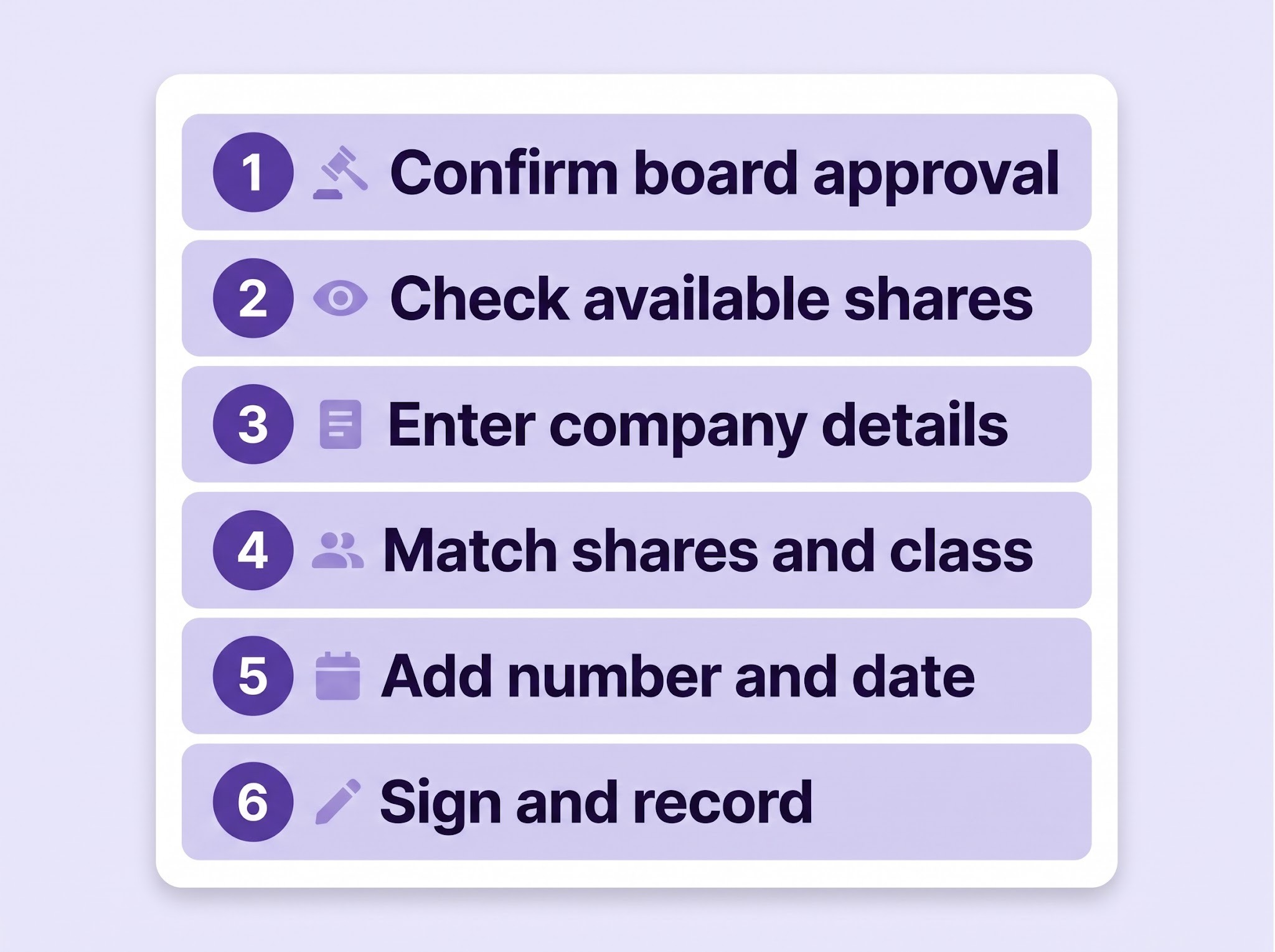
Then complete the certificate using the following steps:
You can create a share certificate using an editable word document, a printable PDF, or an equity management platform. While free templates work well for occasional issuances, they become harder to manage as your company grows and your cap table becomes more complex.
A share certificate template records a share issuance, it doesn't make one legally valid. A valid issuance depends on the required corporate approvals and an accurate entry in the company's stock ledger. For Delaware corporations, these requirements are governed by Delaware General Corporation Law (DGCL) §158. The certificate should always match those records, not replace them.
This matters most during due diligence. Investors rely on the stock ledger and supporting corporate approvals to verify ownership. If a certificate doesn't match the ledger or required approvals are missing, the company may need to correct its records or ratify the issuance under DGCL §204.
Likewise, losing a paper certificate doesn't mean ownership is lost. The company's stock ledger remains the official record of ownership, and a replacement certificate can generally be issued after the company verifies its records.
A share certificate's value is often perceived as legal, but in practice its true function is evidentiary, not authoritative. The certificate gives a shareholder something concrete to reference, while the actual protection of their ownership rests in the stock ledger. For an early-stage company with a handful of shareholders and a single financing round, this distinction rarely causes problems. As a company scales, though, it becomes the central one, every additional shareholder, instrument, and equity event widens the gap between what a certificate shows and what the ledger records. To fill the gap share certificates helps with accurate records, not a substitute for them, and to build that discipline before diligence forces the issue.
At Qapita, we help growing companies keep every share certificate, ledger entry, and cap table update reconciled in real time, no matter how many financing rounds, exercises, or transfers happen along the way. From your first issuance to your IPO, Qapita ensures your ownership records always tell the same story. Book a demo to see how it works.
A corporate seal is usually not required for a valid share certificate under Delaware practice unless a company's charter, bylaws, or internal policy says otherwise. Most private companies rely on authorized officer signatures and accurate ledger records rather than embossing or stamping a physical corporate seal.
Delaware law does not set a universal deadline to hand a share certificate to the holder after issuance. Timing usually follows board resolutions, financing documents, closing checklists, or internal policy. Companies should issue or confirm ownership promptly to avoid record gaps during audits or financing diligence.
A single share certificate can list joint owners if the corporation's records, purchase documents, and transfer rules allow joint registration. Companies should use the exact legal names and ordering for both holders, because inconsistencies can create transfer, voting, dividend, or estate administration problems later.
Companies should keep issued, canceled, replaced, and stub records for the full life of the corporation and any applicable record-retention period. Long-term retention supports audits, tax reviews, transfers, financings, mergers, and disputes, especially when old certificate numbers must be traced years later.









.png)