

 Equity management

 Equity management
- Fund management

 Fund management
 - Fund managementFund management
- Fund managementFund management




Form 1120-S is the U.S. Income Tax Return for an S Corporation. S-corps use it to report income, gains, losses, deductions, credits, and other required tax information for any year when a valid S-corporation election is in effect, per the 2025 IRS Instructions for Form 1120-S.
The return works primarily as an information and allocation document. The S-corp generally pays no federal income tax at the entity level, instead, the IRS uses Form 1120-S to verify that each shareholder correctly reports their share of the corporation's tax items on their own returns.
One thing to keep in mind before you begin: the IRS instructions state not to file Form 1120-S unless the corporation has already filed Form 2553, or is attaching it to elect S-corporation status.
S corporations elected under Subchapter S of the Internal Revenue Code are taxed as pass-through entities. Income, losses, deductions, and credits pass through to shareholders, who report them individually. The S-corp itself generally owes no federal corporate income tax.
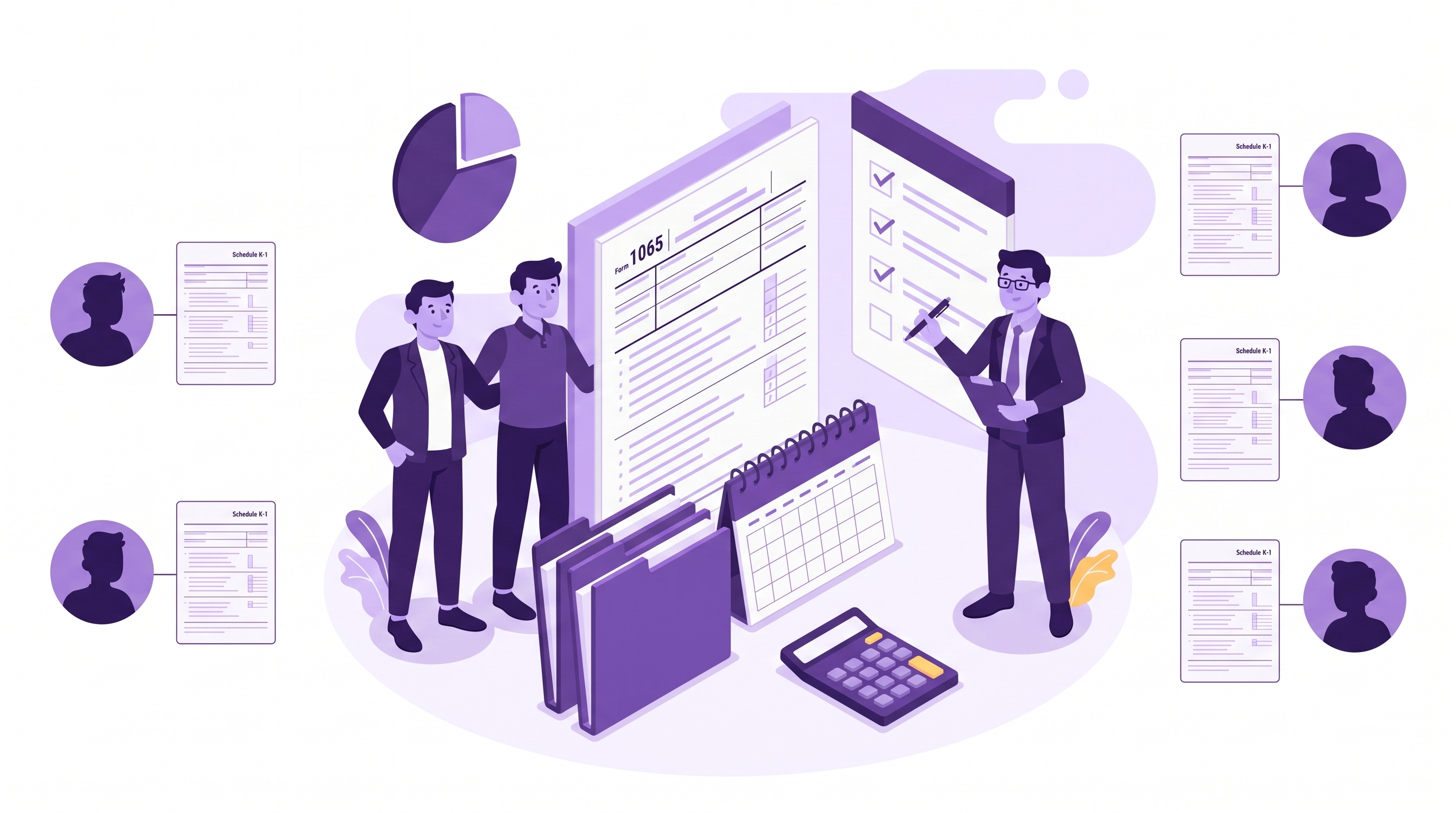
Form 1120-S holds the whole system together. It reports the corporation's overall financial results, aggregates tax items on Schedule K, and then splits each shareholder's portion on a separate Schedule K-1. Shareholders use those K-1 figures to prepare their individual returns.
The IRS is straightforward about the function: Form 1120-S is how it confirms that every shareholder reports the right share of the corporation's tax items.
Any domestic corporation or eligible entity with a valid S-corporation election in effect for the tax year must file Form 1120-S, per the 2025 IRS Instructions for Form 1120-S. This includes LLCs that have elected to be taxed as S-corps.
To qualify as an S-corp, an entity generally must:
When the S election covers any part of the tax year, the corporation must file Form 1120-S for that period. If the election terminates or is revoked, the entity becomes a C-corporation and must file Form 1120 for periods when the S election is no longer active.
An S corporation must file Form 1120-S by the 15th day of the third month after the end of its tax year, typically March 15 for calendar-year filers.
For the 2025 tax year (filed in 2026), the deadline was March 16, 2026, because March 15 fell on a Sunday, per the 2025 Instructions for Form 1120-S.
For the 2026 tax year (filed in 2027), the deadline returns to March 15, 2027, as March 15 falls on a Monday.
Fiscal-year S-corps follow the same 15th-day-of-the-third-month rule. A fiscal year ending June 30, for example, has a September 15 deadline, pushed to the next business day if that date falls on a weekend or holiday. A dissolved S-corp generally must file by the 15th day of the third month after the date it dissolved, per the same instructions.
File Form 7004 for an automatic six-month extension to file. The extension applies to the filing deadline only, it does not extend the time to pay any tax the S-corp owes, such as built-in gains tax.
Accurate entity and financial data needs to be in hand before completing the return. The IRS expects full books and records to support every line item. You can download the blank Form 1120-S directly from the IRS to follow along as you gather the below.
Core entity details for page 1:
Beyond these basics, you will need income and expense records, beginning and ending balance sheet data, shareholder names and tax IDs, ownership percentages (including any mid-year changes), and prior-year returns for Schedule M-2 reconciliation. Any foreign activity or foreign shareholders will also require additional information to determine whether Schedules K-2 and K-3 apply.
Several schedules are always required; others apply only in specific situations, per the 2025 IRS Instructions for Form 1120-S.
A series of questions about the corporation's entity type, stock ownership, and certain tax attributes. The IRS uses this to understand the S-corp's structure for the tax year.
Reports the shareholders' aggregate pro-rata share items, total income, deductions, credits, and other items at the entity level before amounts are divided among individual shareholders.
Prepared for each shareholder and filed with the IRS as part of every 1120-S tax return. It reports each shareholder's specific share of income, deductions, credits, and other items, and must be furnished to the shareholder directly.
Schedule K-2 covers international tax items, foreign income, foreign taxes, and foreign assets, at the entity level. Schedule K-3 provides the same information broken out at the shareholder level. These apply when an S-corp has foreign source income, foreign taxes paid or accrued, ownership in foreign entities, or shareholders who need foreign tax credit data.
A domestic-only exception may apply when the S-corp has no foreign activity and all shareholders are U.S. persons with no need for that information. Confirm eligibility with the current IRS instructions before skipping these.
The balance sheet per books, showing assets, liabilities, and equity at the start and end of the tax year. Smaller corporations that meet specific asset and income thresholds may qualify for relief from completing it.
Schedule M-1 reconciles book income with taxable income, explaining adjustments that cause them to differ. Schedule M-2 tracks changes in the accumulated adjustments account (AAA) and shareholders' undistributed taxable income over the year. Smaller corporations may also qualify for relief from these schedules.
Even well-run S-corps trip on the same handful of errors. Here are four that commonly trigger IRS notices and shareholder headaches.
Form 2553 generally must be filed within 2 months and 15 days after the start of the tax year, or any time in the preceding tax year, to be effective for the current year (per the 2025 Instructions for Form 2553).
Filing late, without qualifying for late-election relief, means the IRS treats the entity as a C-corporation. That entity must then file Form 1120 and pay entity-level tax.
The sum of all shareholders' K-1 amounts for each line item must equal the corresponding line on Schedule K. Mismatches usually come from:
Before filing, recompute each shareholder's pro-rata share using stock ownership percentages, then confirm the K-1 totals match Schedule K exactly.
An S election can terminate due to:
When that happens, the entity becomes a C-corporation and must file Form 1120 going forward. Continuing to file Form 1120-S can lead the IRS to reject or reclassify the returns and assess C-corporation tax, penalties, and interest.
A shareholder can deduct S-corp losses only up to their stock basis plus debt basis. Deducting losses beyond basis invites the IRS to disallow them and assess additional tax, penalties, and interest.
Tax items from the 1120-S return flow through to shareholders and adjust both stock basis and debt basis, which together determine how much loss each shareholder can actually deduct.
Each year, a shareholder's stock basis goes up with their share of taxable income, tax-exempt income, and additional capital contributions. It goes down with their share of deductible losses and deductions, nondeductible expenses, and distributions. The K-1 figures feed directly into that calculation.
The debt basis is separate. It arises when a shareholder lends money directly to the S-corp. Losses and deductions beyond stock basis can sometimes be claimed against debt basis, which increases when the shareholder makes loans and decreases when losses are applied against it or the loan is repaid.
Losses on Schedule K-1 face three limitations in sequence: the basis limitation under IRC § 1366(d), the at-risk rules under IRC § 465, and the passive activity loss rules under IRC § 469. The return determines the loss amount available at the entity level; each shareholder then applies these rules on their own return.
Equity records, Schedule M-2 and Schedule L, track changes in AAA and retained earnings. These correlate with aggregate shareholder basis, which is why clean and consistent ownership data matters. Fragmented spreadsheets are where basis and K-1 errors tend to start.
Both are corporate tax returns, they serve fundamentally different entities. The s corp 1120s form is an information and allocation return for pass-through entities. Form 1120 is an income tax return where C-corps compute and pay tax at the entity level.
The core difference is where the tax burden lands. S-corps pass it to shareholders in proportion to their ownership. C-corps pay tax at the company level, and shareholders pay again on any dividends received, what is generally called double taxation.
Most S-corp owners treat Form 1120-S as an annual tax obligation. It's also the document that determines how much loss each shareholder can deduct, whether distributions are taxable, and how clean the audit trail looks if the IRS questions an ownership change or a basis claim. A return filed with rounded ownership percentages or a cap table that hasn't been updated since a share transfer can trigger penalty assessments at the shareholder level that have nothing to do with the S-corp's actual tax liability.
What most owners don't account for is the compounding effect of basis errors. A mistake in year one carries into year two because each year's opening basis depends on the prior year's closing balance. By the time the discrepancy surfaces, typically during a sale, a buyout, or an IRS inquiry, unwinding it means reconstructing years of K-1 history, often at significant cost.
Qapita's cap table management keeps shareholder records, stock plan activity, and ownership changes in one place, so reconciling Schedule K with every K-1 takes minutes rather than days. When an option vests or a transfer occurs mid-year, the cap table updates and your shareholder allocation data stays current.
On the reporting side, Qapita's ASC 718 financial reporting services cover compliance and equity record maintenance so your books are filing-ready before tax season starts.
Book a demo to see how both work together across every filing and fundraise.
The IRS charges a monthly penalty per shareholder for each month or partial month the return is late, up to 12 months. The penalty applies even when the S-corp owes no tax, so a company with several shareholders can accumulate a significant liability from a filing delay alone. If the return is more than 60 days late, a separate minimum penalty also kicks in. When tax is owed, an additional 5% of the unpaid amount per month applies, capped at 25%.
Yes. The return can be filed through approved business tax software or an authorized IRS e-file provider. S-corporations that file 10 or more returns of any type during the calendar year, including payroll, excise, and information returns, are generally required to e-file. Those that do not meet that threshold can still e-file voluntarily. Hardship waivers are available for corporations that cannot comply with the electronic filing requirement.
Yes. File a corrected Form 1120-S and check the amended return box on page 1. Attach a statement identifying each amended line, the corrected amount, and the reason for the change. If any shareholder's K-1 figures change as a result, issue corrected K-1s promptly, shareholders will need them to amend their own returns if they have already filed.
The return must be signed by an authorized corporate officer, the president, vice president, treasurer, assistant treasurer, or chief accounting officer. If the corporation uses a paid preparer, the preparer signs separately in the designated section and must include their preparer tax identification number (PTIN). An unsigned return is considered invalid by the IRS and treated as if it was never filed.