


 Equity management

 Equity management
- Fund management

 Fund management
 - Fund managementFund management
- Fund managementFund management




Form 1065 is the annual partnership tax return that most partnerships and multi-member LLCs must file with the IRS to report income, deductions, and each partner's share. Even if the business earns no income, the filing requirement usually still applies. According to the IRS, Returns due after December 31, 2025 can trigger a $255 per partner per month late filing penalty for up to 12 months.
Form 1065 is the annual information return a partnership files to report its income, gains, losses, deductions, credits, and other operating details to the IRS. The partnership generally does not pay federal income tax at the entity level. Instead, those items pass through to the partners, who report their share on their own returns.
That structure is called pass-through taxation, and it's the defining feature of how partnerships interact with the IRS.
Pass-through taxation means the entity reports the income but does not pay tax on it. The tax liability passes through to the owners. As per the Instructions for Form 1065 on IRS.gov, each partner reports their distributive share using the Schedule K-1 the partnership provides.
This is what separates a partnership return from a corporate return. A C corporation computes and pays its own tax on Form 1120. A partnership reports the numbers, allocates them, and hands the tax bill to its partners.
By default, the IRS treats any LLC with two or more members as a partnership for federal tax purposes. No special election is needed for this classification to apply. That default treatment means the LLC must file Form 1065 every year, even in years where the business earned little or nothing.
So a standard multi-member LLC reports its activity on Form 1065 and issues a Schedule K-1 to each member. This default classification is exactly why so many LLCs end up here: the structure gives owners liability protection while keeping the simpler pass-through tax treatment.
According to IRS Statistics of Income data for partnership returns, LLCs make up 72.7% of all partnerships of all partnership filings, which shows how common this structure has become.
Keeping that ownership record clean from day one makes K-1 season far simpler. A well-maintained cap table management system helps you track the ownership and capital data that inform each partner's allocation.
A pass-through entity is a business structure where the entity itself is not subject to federal income tax on its earnings. The business does not keep its tax obligations at the company level. Instead, all profits, losses, deductions, and credits flow directly to each member or partner, who then reports their allocated share on their personal Form 1040 or applicable individual tax return using the information from their Schedule K-1.
This setup is a meaningful advantage over C corporations. With a C corp, income gets taxed twice: once at the corporate level, and again when profits are distributed to shareholders as dividends. Pass-through structures sidestep that entirely, with the tax obligation landing only once, at the individual owner level.
For partnerships specifically, every partner owes tax on their share of net income for the year, regardless of whether the business actually distributed cash to them. The allocation, not the distribution, determines what each partner reports.
The simplest way to keep them straight: Form 1065 reports the partnership's results to the IRS, while Schedule K-1 reports each partner's slice of those results to that partner.
The IRS requires the following entity types to file Form 1065 each year:
Form 1065 reports the partnership's totals. Schedule K-1 reports each partner's individual share of those totals. The partnership files one Form 1065 with the IRS, then issues a separate Schedule K-1 to every partner so each can report their share on their own return.
An example: A two-member LLC taxed as a partnership earns $100,000 of ordinary business income. The operating agreement gives Partner A 60% and Partner B 40%.
Individual partners report their K-1 amount on Schedule E of Form 1040 and pay tax on their own share. Depending on each partner's role and the nature of the income, qualified business income deduction and self-employment tax may also apply, both computed at the partner level, not on Form 1065 itself.
Allocations must follow the partnership agreement, and allocations that lack substantial economic effect can be reallocated by the IRS, which is an advanced area worth reviewing with a CPA.
A calendar-year partnership must file Form 1065 by March 15 of the following year, the 15th day of the third month after the tax year ends. If the 15th falls on a weekend or holiday, the due date moves to the next business day. Filing Form 7004 by that date grants an automatic six-month extension, typically pushing the deadline to mid-September.
For tax year 2025 returns, March 15, 2026 falls on a Sunday, so the Instructions for Form 1065 confirm calendar-year partnerships may timely file by March 16, 2026. An extension to file is not an extension for partners to file their own returns, so coordinate K-1 delivery with your partners' personal deadlines.
The penalty math is straightforward once you apply the per-partner, per-month rule. The figures below are illustrative calculations using the $255 rate from the Instructions for Form 1065 for returns due after December 31, 2025.
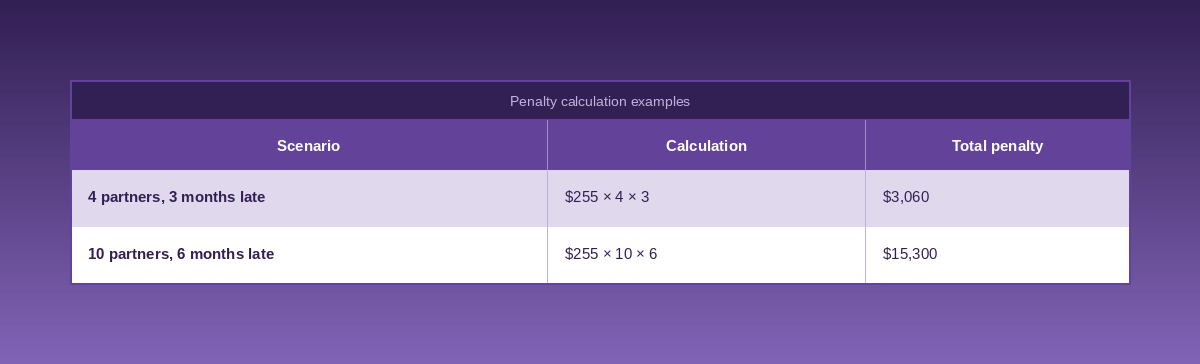
Notice that even a 4-partner LLC with zero income for the year faces a $3,060 penalty after just three months. That is the strongest reason to file on time or file Form 7004 before the deadline.
Clean ownership records and accurate partner allocations are what keep K-1 season calm rather than chaotic. Qapita offers an equity management platform that helps teams keep cap tables and ownership records organized before the numbers ever hit a Schedule K-1. Qapita reports that it serves more than 2,800 customers globally and added 100+ U.S. customers within its first year in the U.S. market.
See how your partner allocations can stay accurate before K-1 season → Book a Demo
Form 1065 is built from a page-1 income statement plus several schedules:
Each section captures a different slice of the partnership's financial picture.
Mapping your financials to the form makes preparation far less intimidating. The table below shows where your common figures land.
Schedule M-1 reconciles your financial accounting income with your tax income, and Schedule M-2 rolls forward total partners' capital accounts through contributions, income, and distributions. Per the Instructions for Form 1065, Schedule B also asks structural questions about ownership, accounting method, and foreign partners that help the IRS understand your entity.
Form 1065 runs 5 pages, and it helps to know what each section asks for before you start. Here is a walkthrough of the key parts:
It mirrors Schedule K but shows only that partner's allocated portion, using ownership percentages and any special allocations specified in the partnership agreement.
The three returns differ mainly in who files and who pays the tax. Form 1065 is for partnerships and is a pass-through. Form 1120 is for C corporations, which pay tax at the entity level. Form 1120-S is for S corporations, which also pass income through to shareholders.
Accurate K-1 allocations require clean, up-to-date records of who owns what, at what percentage, from day one. That's where disorganized cap tables turn a routine filing into a scramble. Qapita's equity management platform gives startup founders a single source of truth for partner ownership data, so when K-1 season arrives, the numbers are already there.
See how Qapita helps startup founders keep their cap tables and partner allocations clean year-round. Book a demo.
No. Only multi-member LLCs taxed as partnerships, the default classification, must file Form 1065. A single-member LLC is a disregarded entity and does not file 1065. Any LLC that has elected corporate treatment files Form 1120 or Form 1120-S instead. So the answer depends entirely on how many owners you have and which tax classification you have chosen.
In most cases, yes. If your entity is classified as a partnership and is required to file, the obligation does not disappear in a zero-income year. The late-filing penalty is assessed per partner per month regardless of profit, so a no-activity return filed late still triggers a real penalty unless a specific IRS exception applies. When in doubt, file.
For returns due after December 31, 2025, the penalty is $255 per partner, per month or part of a month, up to 12 months, per the Instructions for Form 1065 and the IRS failure-to-file penalty page on IRS.gov. A four-partner LLC three months late would owe $255 × 4 × 3, or $3,060. The penalty applies even when the partnership had no income.
No. By default, a single-member LLC is a disregarded entity and does not file Form 1065. Its income is reported on the owner's return, usually on Schedule C, E, or F of Form 1040. The only way a single-owner LLC reaches a corporate return is by electing corporate treatment, in which case it files Form 1120 or Form 1120-S, not 1065.
Form 1065 reports the partnership's overall income, deductions, and other items to the IRS. Schedule K-1 reports each individual partner's share of those items, which the partner then uses to complete their own tax return. One Form 1065 covers the whole entity. One Schedule K-1 goes to each partner.
A calendar-year partnership files its 2025 Form 1065 by March 16, 2026, since March 15 falls on a Sunday that year, per the Instructions for Form 1065. Filing Form 7004 by that date grants an automatic six-month extension to file, typically pushing the deadline to mid-September 2026. The extension covers filing only, not your partners' personal return deadlines.
Yes. The IRS supports e-filing through approved software and tax preparers, and many partnerships are required to e-file. Partnerships with 100 or more partners must e-file Form 1065, and broader IRS electronic-filing rules require e-filing when an entity files a certain volume of returns in a year. Confirm with your tax advisor whether your partnership falls under the mandate.