


 Equity management

 Equity management
- Fund management

 Fund management
 - Fund managementFund management
- Fund managementFund management




Entrepreneurs and professionals are increasingly seeking business structures that offer both operational flexibility and personal asset protection. Among the various options available, the Limited Liability Partnership (LLP) has become a preferred choice for many businesses, especially professional service firms.
But what exactly is a limited liability partnership, and why are so many businesses choosing this model? In this comprehensive guide, we'll break down the essentials, advantages, and key differences between LLPs and other business entities.
A Limited Liability Partnership (LLP) is a business structure where two or more partners manage a company collectively, while enjoying limited personal liability. Each partner is protected from the actions or debts of the other partners, with their liability typically limited to their capital contribution.
Here's a closer look at how an LLP operates on a day-to-day and structural level:
To set up an LLP, at least two partners are required. These can be individuals or corporate entities. Most LLPs are formed by professionals who want to combine resources and skills to run a common business. While the minimum is two, there's no cap on how many partners an LLP can have.
Each partner can take part in managing the LLP, but their personal assets are shielded from business debts and from liabilities arising due to other partners' misconduct or negligence. This limited liability feature is what distinguishes LLPs from traditional partnerships.
Every LLP is governed by a formal LLP agreement. This document clearly lays out each partner's role, contribution, profit-sharing ratio, dispute resolution methods, and exit clauses. It ensures smooth operations and provides a legal fallback in case of disagreements or partner exits.
Unlike a traditional partnership where roles are often blurred, LLPs allow for well-defined decision-making. Most LLPs are member-managed, meaning all partners actively participate in day-to-day decisions. However, roles can be distributed to play to each partner's strengths, creating operational flexibility while maintaining accountability.
A key reason many professionals opt for an LLP is the ability to share operational costs and resources. Whether it's hiring shared staff, using common office space, or investing jointly in technology, partners can run leaner and more efficiently than if they were operating alone. This also allows them to focus on scaling their services while minimizing overheads.
LLPs enjoy pass-through taxation, which means the LLP itself doesn't pay income tax. Instead, profits (or losses) pass directly to the partners, who then report them on their personal tax returns. This avoids the double taxation commonly associated with corporations and makes LLPs more tax-efficient for many service businesses.
In most countries, LLPs are regulated under dedicated legislation. These laws define rules around formation, compliance, record-keeping, partner duties, and annual filings. While not as compliance-heavy as corporations, LLPs still need to adhere to legal formalities to maintain good standing.
LLPs offer several advantages that make them attractive for professionals and business owners:
Partners are not held personally liable for the firm's debts or for the actions taken by their fellow partners. Their exposure is generally limited to their capital contribution.
LLPs offer operational flexibility with no mandatory board meetings or shareholder protocols. Partners can define roles through an internal agreement.
Profits are taxed only once at the individual partner level, avoiding corporate tax and simplifying the tax structure.
Compared to private or public limited companies, LLPs face fewer statutory filings and reporting requirements.
LLPs can be formed without a fixed minimum capital, offering ease of entry for new or lean businesses.
Failure to meet annual filing or regulatory requirements can result in significant penalties, even if the LLP is inactive. For dormant or low-revenue LLPs, these penalties can outstrip the business's earnings entirely.
LLPs cannot raise funds through equity markets, which may restrict their ability to scale compared to private or public companies. Because LLPs cannot issue shares, venture capital and institutional investors have no standard equity instrument to acquire, effectively closing off the most common growth-funding routes.
LLPs may face dissolution if the number of partners drops below two for more than six months or if the business encounters severe financial distress. This structural vulnerability is particularly acute for two-partner LLPs: the departure, incapacity, or death of one partner, without a timely replacement, can trigger an involuntary wind-up, disrupting client relationships and ongoing contracts at precisely the wrong moment.
Choosing a business structure is rarely a straightforward decision. An LLP sits in a distinct position, offering more protection than a general partnership, more flexibility than a corporation, and a different risk profile than an LLC or limited partnership.
Here's a closer look at how an LLP stacks up against the three structures founders most commonly weigh it against.
The names sound almost identical, which causes genuine confusion,but the differences matter. Here's how the two structures compare across the dimensions that most affect day-to-day operations and long-term planning:
Verdict: If you operate in a licensed profession and want a collaborative structure with liability protection, an LLP is a natural fit. If you need investor-readiness, single-founder flexibility, or cross-industry applicability, an LLC is the stronger choice.
One of the most common questions about an LLP is how it differs from a plain general partnership,and the answer is significant enough to affect whether personal assets are ever at risk.
The practical implication is straightforward: a general partnership offers no meaningful liability buffer, while an LLP provides a formal legal structure that protects personal assets without the full compliance burden of a corporation.
An LLP and a limited partnership share the word "limited" but describe a different kind of limitation,and understanding the distinction matters before choosing a structure.
In short, if you need a structure that separates active management from passive investment, a limited partnership may be appropriate. If all partners are working professionals who want equal footing and liability protection, an LLP is the cleaner fit.
Tax treatment is one of the most practical factors in choosing a business structure. Here's a closer look at how an LLP is taxed,and where jurisdiction makes a meaningful difference.
In most common-law jurisdictions, including the United States, an LLP is treated as a pass-through entity for tax purposes. The LLP itself pays no federal income tax. Instead, profits and losses flow through to each partner in proportion to their ownership or profit-sharing ratio, and partners report that income on their individual tax returns. This avoids the double taxation that affects C-Corporations, where the company pays corporate tax on profits and shareholders pay personal income tax again on dividends.
Pass-through treatment is advantageous, but it comes with a nuance: active partners in an LLP are generally subject to self-employment tax on their share of the profits. In the U.S., this means partners pay both the employer and employee portions of Social Security and Medicare taxes,a meaningful cost that partners in corporations receiving a salary and dividends can sometimes reduce through careful structuring.
Tax rules for LLPs vary materially by country. Before choosing the structure, consult a tax adviser familiar with the specific rules in your jurisdiction, particularly if partners are based in different countries, which can trigger additional cross-border tax considerations.
Formation requirements vary by state, since LLPs in the US are registered and governed at the state level, not federally. Here's the core sequence most states follow, along with where the process tends to differ.
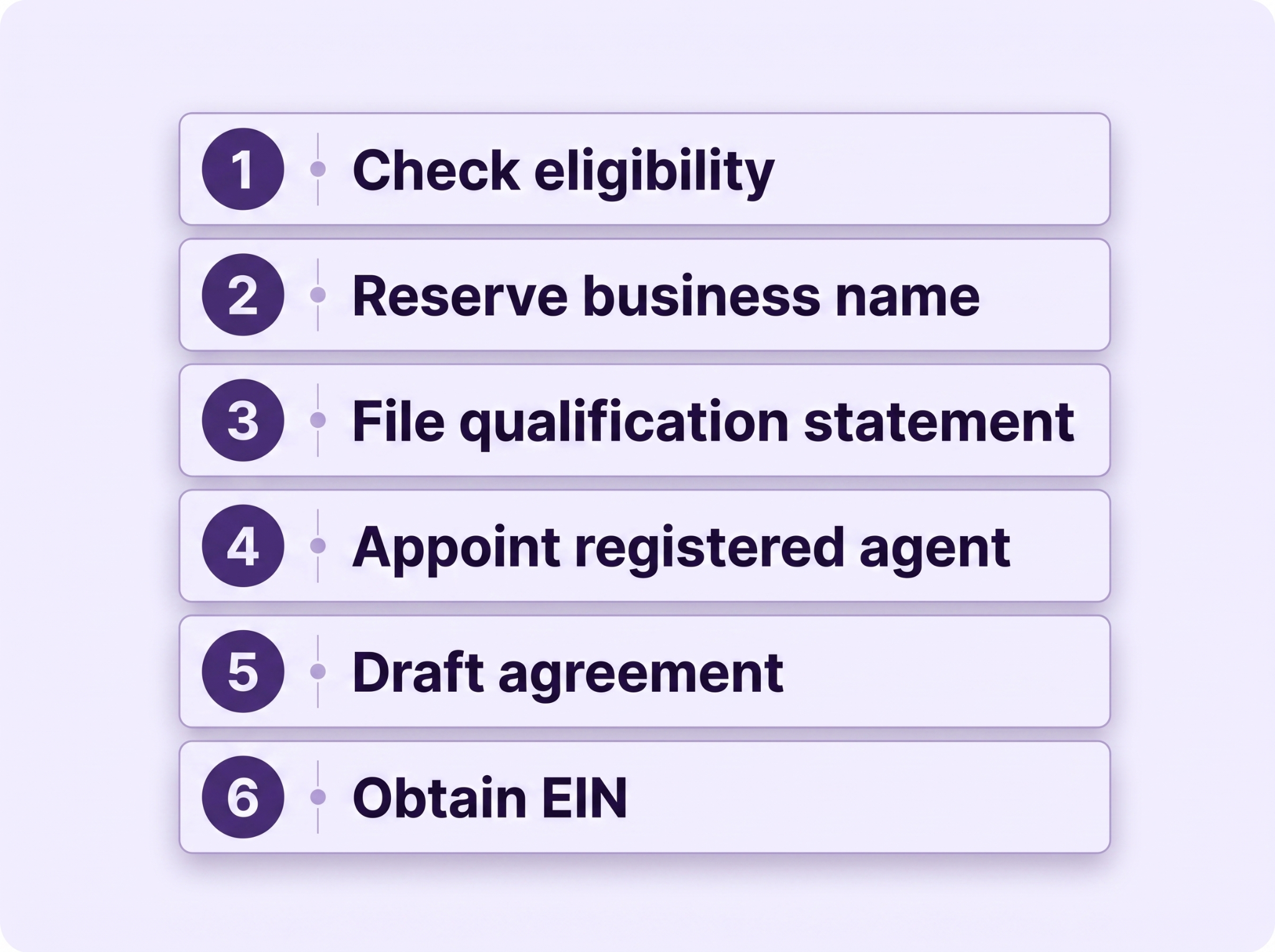
Many states restrict LLPs to licensed professionals such as typically attorneys, certified public accountants, and in some states, healthcare providers or architects. Before filing anything, check your state's requirements. If your business doesn't qualify, you'll likely need an LLC or corporation instead.
Your LLP's name must be unique within the state and usually must include "LLP" or "Limited Liability Partnership" in the title. Most Secretary of State offices let you search name availability online, and many allow you to reserve a name for a set period before filing.
This is the core registration document, filed with the Secretary of State (the exact name varies. Some states call it a "Certificate of Registration" or "Application for Registration"). It typically requires the business name, principal address, registered agent details, and the names of the partners.
Most states require an LLP to designate a registered agent. This is a person or entity authorized to receive legal documents on the LLP's behalf, with a physical address in the state of formation.
While not always legally required to file, a written partnership agreement is essential. It should define each partner's contribution, profit-sharing ratio, management roles, and exit or dissolution terms. Without one, state default rules apply, which may not reflect what the partners actually intended.
Apply for an Employer Identification Number (EIN) from the IRS. This is required for opening a business bank account, filing taxes, and hiring employees.
Depending on your state and industry, this may include obtaining a business license, professional licensing board approval, workers' compensation insurance, and any required state tax registrations.
Filing fees and processing times vary widely by state. You can expect the fees to range anywhere from $100 to a few hundred dollars in state fees, with most filings processed within one to four weeks. Some states also require an annual report and renewal fee to keep the LLP in good standing.
Here are some of the key clauses every LLP agreement should address.
The agreement should specify how much each partner is contributing at formation, in what form (cash, property, services), and what happens if additional capital is needed later. It should also address whether partners are obligated to make further contributions and on what terms.
Profit (and loss) distribution does not have to mirror capital contribution percentages. The agreement should state the exact ratio in which profits and losses are shared, and specify whether any partner receives a fixed remuneration or interest on capital before the remaining profit is split.
Each partner's operational role, authority limits, and areas of responsibility should be clearly defined. This prevents disputes over who has the right to commit the LLP to contracts, hire staff, or make significant financial decisions.
The agreement should distinguish between day-to-day decisions (which designated partners can make independently) and major decisions (which require a vote or unanimous consent). Quorum requirements and voting thresholds protect minority partners and create accountability.
The process for admitting a new partner,including due diligence, approval thresholds, and the effect on profit-sharing ratios,should be agreed upon at formation, not improvised when the situation arises.
Disagreements between partners can stall a business. The agreement should specify a structured resolution process,starting with internal negotiation, escalating to mediation, and then to arbitration if needed,before any litigation is contemplated.
The agreement should set out the circumstances under which the LLP can be voluntarily wound up, the process for distributing remaining assets, and how partner obligations are settled on exit or dissolution.
Partner entry and exit are two of the most practically important,and most often overlooked,aspects of running an LLP.
Admitting a new partner requires the consent of existing partners as specified in the LLP agreement. Once approved, the incoming partner must be registered with the RoC by filing Form 4 (Notice of Appointment, Cessation, Change in Name/Address/Designation of a Designated Partner or Partner) within 30 days of the change. The LLP agreement should also be updated to reflect the new partner's capital contribution, profit-sharing ratio, and role.
Exiting a partner does not automatically dissolve the LLP, provided at least one other partner remains and the agreement provides for continuity. A departing partner must give notice as specified in the agreement, settle any outstanding capital or loan obligations, and be removed from the register via Form 4. If the exiting partner is a designated partner, a replacement designated partner must be appointed simultaneously to maintain the minimum requirement.
Designated partner obligations on change are particularly important: designated partners are legally accountable for regulatory compliance. Any change in designated partner status must be reported promptly to the RoC. Failure to maintain at least two designated partners,or to file the required notices on time,can expose the remaining partners to penalties under the LLP Act, 2008 (as amended by the LLP (Amendment) Act, 2021).
Exit and entry mechanics should be addressed in the LLP agreement before they become urgent. An agreement that is silent on these points defaults to the Act's provisions, which may not align with what partners actually want.
An LLP carries a lighter compliance load than a corporation, but "lighter" doesn't mean nothing. Here's what most US LLPs need to maintain and file to stay in good standing.
There's no federal requirement for an LLP to prepare a formal statement of accounts, but partners typically maintain records of income, expenses, capital contributions, and profit distributions, both for internal transparency and to support each partner's individual tax filing.
Most states require LLPs to file an annual (or biennial) report with the Secretary of State to remain in good standing. This report typically confirms the business address, registered agent, and partner information. Many states also charge an annual franchise tax or renewal fee, separate from income tax. The amount and due date vary by state, and missing the deadline can result in the state administratively dissolving the LLP.
Even though the LLP itself doesn't pay federal income tax, it must file an informational return using the Form 1065 (U.S. Return of Partnership Income) with the IRS each year. The LLP also issues a Schedule K-1 to each partner, showing their share of income, deductions, and credits to report on their personal return.
Depending on the state, an LLP may owe state-level filing fees, franchise taxes, or gross receipts taxes, even though profits pass through for income tax purposes. A few states (like California) impose a flat annual LLP fee regardless of profitability.
Since most states restrict LLPs to licensed professions, partners often need to maintain their individual professional licenses in good standing as a condition of the LLP's continued registration.
Compared to a corporation, an LLP has no requirement to hold board meetings, keep shareholder minutes, or comply with the extensive governance rules under state corporate law. There's no need to appoint a corporate secretary or follow formal bylaws. That said, annual state filings and franchise tax deadlines are firm, and missing them can lead to penalties or loss of good standing, which can jeopardize the liability protection the structure is meant to provide.
An LLP offers a compelling combination of flexibility, protection, and simplicity,especially for professionals who want to retain partner-level control while limiting personal risk. It delivers the best of both partnership and corporate worlds: pooling talent, shielding personal assets, and passing profits through efficiently, all within a recognized and respected legal structure.
However, certain drawbacks,such as personal exposure to your own negligence, compliance paperwork, dissolution risks, and limits to raising capital,mean it's not ideal for every type of business. Always compare it with other structures like LLCs, especially if you're pursuing broader industries or outside funding.
In a general partnership, partners bear joint and several liability for all business debts and the negligence or misconduct of other partners. An LLP provides limited liability protection by shielding each partner from the actions and debts of co-partners. Individual partners remain liable only for their own professional negligence and their capital contribution.
An LLP requires a minimum of two partners to maintain good standing. If the partner count drops below two, the business enters a grace period, typically six months, varying by state, to recruit a replacement partner or restructure the entity.
State penalties for missed LLP annual reports, franchise tax filings, or regulatory submissions typically range from $100 to $500 per day. A 60-day filing lapse can accumulate $6,000 to $30,000 in penalties alone. For low-revenue or dormant LLPs, accumulated penalties frequently exceed annual profits.
LLPs cannot issue equity shares or membership interests to outside investors. The structure lacks a standard mechanism for venture capital, private equity, or institutional investment. Professional service firms seeking growth capital beyond partner contributions and bank financing must eventually convert to a private limited company or corporation.
LLPs are taxed as pass-through entities, meaning profits pass directly to partners' personal tax returns without corporate-level taxation. However, active partners pay self-employment tax (15.3% combined Social Security and Medicare) on their entire profit share. Corporations allow for salary and dividend structuring that can reduce overall self-employment tax burden through strategic income allocation.