


 Equity management

 Equity management
- Fund management

 Fund management
 - Fund managementFund management
- Fund managementFund management



Equity agreements become important when a company grants ownership, future ownership, or ownership-linked rights to founders, employees, advisors, contractors, or investors. For startups and private companies, these agreements define who receives equity, what type of equity they receive, when they earn it, and what restrictions apply.
The term can be confusing because there is no single document called an “equity agreement contract.” Depending on the situation, it may refer to a founder stock purchase agreement, an employee stock option agreement, a SAFE, a convertible instrument, a shareholder agreement, or a phantom equity agreement.
This guide is for founders, finance teams, legal teams, and people teams that need to understand which equity agreement applies, what clauses to review, and how these agreements affect ownership records, cap tables, employee grants, valuations, and future funding rounds.
An equity agreement contract sets the terms of a company’s ownership grant.
It starts with the company’s decision about who should receive equity, what they should receive, and which approvals are required before the grant or issuance.
Once the agreement is prepared, it records the commercial terms behind the equity. These usually include the grant size, share or option type, vesting schedule, exercise or purchase price, transfer rules, repurchase rights, and exit treatment.
After signing, the agreement becomes part of the company’s ownership records. The cap table, grant register, vesting schedule, valuation records, and compliance documents must reflect the same terms.
The agreement also continues to matter after the signing date. Vesting, option exercises, share transfers, repurchases, funding rounds, secondary sales, and exits can all change how the equity is treated.
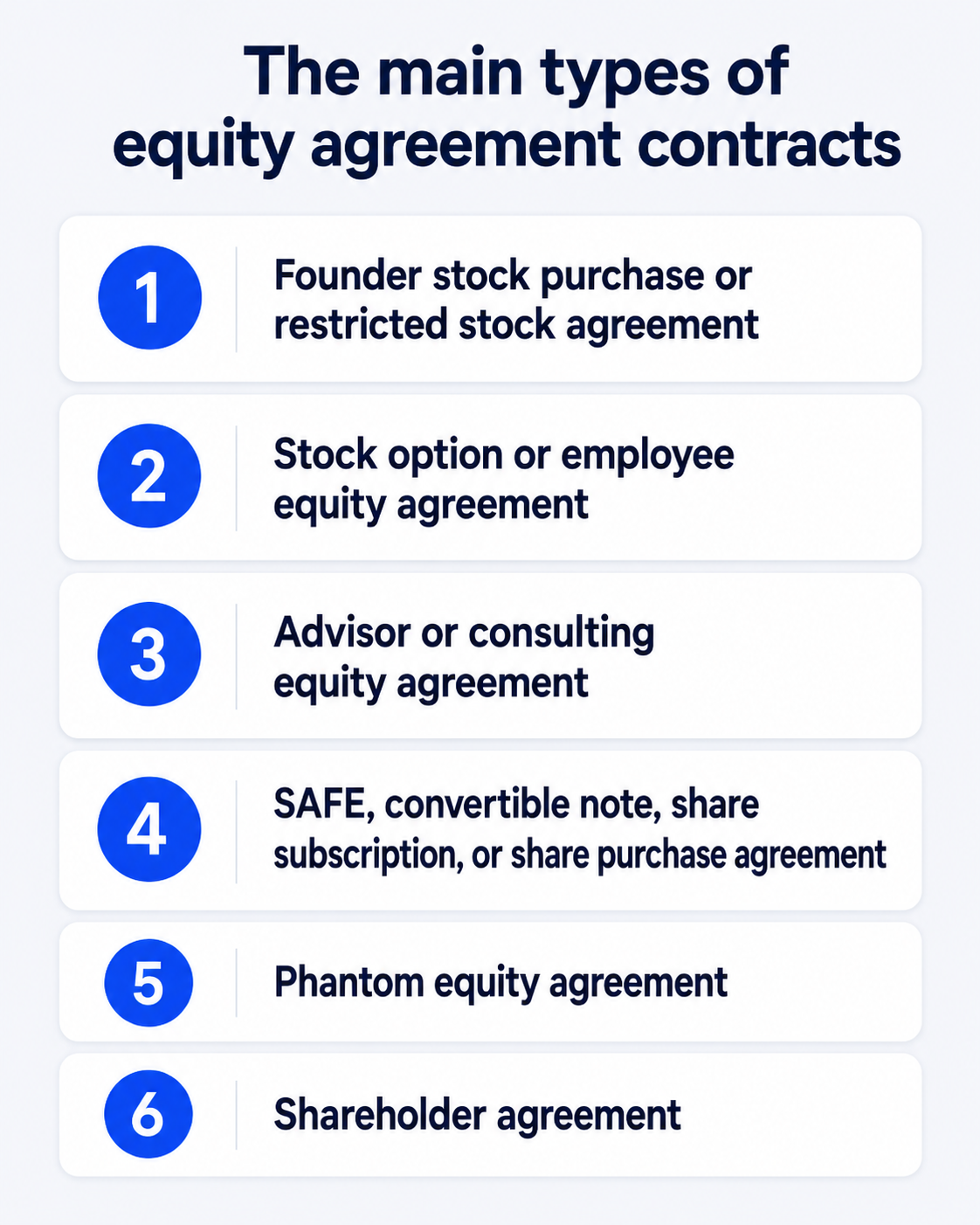
Companies use different equity agreements for different ownership situations. Founders' shares, employee options, advisor grants, investor SAFEs, and phantom equity arrangements each need separate terms because the recipients and ownership outcomes are different.
Here is a simple way to understand the difference:
An equity agreement records the grant, purchase, or future issue of equity.
A shareholder agreement sets the rules between people who already hold shares.
Let us understand the core differences between them below:
A startup may use both documents.
For example, a founder may sign a stock purchase agreement to receive shares.
The same founder may also sign a shareholder agreement that explains voting rights, transfer restrictions, and exit rules.
One document explains how equity is received, while the other explains how ownership is governed after shares exist.
Equity agreement contract is the broad category. A stock option agreement and a SAFE are specific equity-related documents used in different situations.
The table below explains the three in detail.
A company may use all three terms across its equity program.
Employee grants may be structured as stock option agreements. Investor funding may use SAFEs. The broader equity agreement category covers these documents and other ownership-related contracts.
Equity agreement clauses decide how the grant works, when the equity is earned, and what happens during major events such as resignation, fundraising, transfer, or exit.
A company can add additional clauses based on the type of agreement. Founder agreements may need stronger repurchase and IP assignment clauses. Employee option agreements may need an exercise window and tax language. Investor agreements may need conversion, anti-dilution, information rights, and approval terms.
Vesting spreads the equity grant over a timeline or set of milestones. A four-year vesting schedule means the recipient earns the grant gradually. A one-year cliff means the first portion vests only after one year of service.
This helps the company link ownership to continued contribution.
In a stock option agreement, the recipient usually has the right to buy shares at a fixed exercise price at a later date. The lower the exercise price compared with the future share value, the higher the potential gain.
Exercise price matters because options create value only when the underlying share price rises above the exercise price.
Transfer restrictions define when shares can be sold, gifted, assigned, or moved to another person or entity.
These rules help the company manage who enters the shareholder base and how ownership changes outside funding rounds or exits.
Repurchase rights allow the company to buy back shares under defined conditions. This is common in founder and early employee arrangements where equity is tied to continued service.
The clause becomes important when someone leaves, misses milestones, or exits the business before the agreed timeline.
Leaver clauses explain how vested and unvested equity is handled after resignation, termination, removal, or role change.
A clear leaver clause helps avoid disputes because the agreement already explains what happens to earned equity, unearned equity, exercise windows, and company buyback rights.
Exit treatment covers events such as acquisitions, IPOs, secondary sales, buybacks, or liquidation.
This clause helps the company and recipient understand how shares, options, SAFEs, convertible instruments, or phantom equity may convert, accelerate, pay out, or lapse during a major company event.
Equity agreements create problems when the terms of the document and ownership records do not match. These are the mistakes companies should catch early:
A simple way to avoid confusion is to check three things before signing: the type of agreement, the key clauses, and the ownership record that needs to be updated after signing.
Equity agreements can create tax, valuation, and securities compliance work. The exact requirements depend on the country, company structure, equity type, and recipient.
For US startups, these are the common areas to check:
Tax outcomes can differ by event. A grant, vesting event, option exercise, share transfer, repurchase, or sale may each create separate tax or reporting requirements.
Companies should involve legal and tax advisors when equity agreements involve founders, executives, cross-border recipients, investor rights, custom vesting, or unusual repurchase terms.
Every equity agreement creates an ownership event that must be reflected in the company’s records.
A founder share issuance changes the shareholder base; an employee option grant affects the option pool; a SAFE or convertible instrument can convert into shares during a future funding round; and a repurchase, transfer, exercise, or secondary sale can also change ownership.
That means the agreement and the cap table should stay aligned across:
When these records are scattered across spreadsheets, signed PDFs, email threads, and disconnected systems, ownership data becomes harder to verify during audits, fundraising, employee queries, and exits.
Equity agreements shape how ownership moves as a company grows. When the agreement terms, approvals, grants, valuations, and ownership records stay aligned, teams can answer employee questions faster, support investor diligence with confidence, and reduce cleanup before audits, fundraises, or exits.
For founders, finance teams, legal teams, and people teams, the goal is simple: make every equity decision easy to verify later.
Qapita helps startups and private companies manage cap tables, valuations, and equity workflows on a single platform, ensuring ownership records stay accurate from the first grant through future funding rounds.
Book a demo to see how Qapita helps your team keep equity records clear, accurate, and ready for every stage of growth.
A percentage can mean different things depending on whether it is calculated before or after dilution, on a current or fully diluted basis, and before or after a new option pool or funding round.
The mismatch can create confusion during audits, employee queries, fundraising, or exits. Companies should reconcile signed agreements with cap table records, grant registers, vesting schedules, and valuation documents.
Yes. Missing approvals, unclear vesting terms, side letters, outdated cap tables, or inconsistent grant records can delay investor diligence. Clean equity documentation helps investors understand ownership faster.
Equity agreements should stay connected to grants, vesting, exercises, valuations, and ownership changes. Equity management platforms like Qapita help companies keep these records aligned as the company grows.








.jpg)
.png)