


 Equity management

 Equity management
- Fund management

 Fund management
 - Fund managementFund management
- Fund managementFund management




Your strike price is the fixed price you pay per share when you exercise your stock options. You do not get to choose it, your company sets it based on a 409A valuation completed on your grant date. Two employees hired just months apart at the same company can hold very different strike prices, because the fair market value (FMV) of the company's stock shifts over time.
This guide breaks down what a strike price is, how to read it against your company's current FMV, and what to consider before you exercise.
A strike price is the fixed per-share amount written into an option contract, it is the price you pay to buy company shares when you exercise your options. For employee stock options, this number is set on your grant date and stays the same for the entire life of the grant.
The strike price does not move. What moves is the value of your company's stock over time. That gap between what you pay (your strike) and what the shares are worth today is where the potential value of your options lives.
For employee stock options, the strike price is your per-share purchase cost at exercise. When your vested options convert into shares, you pay the strike price for each share, and that amount stays fixed for the full life of the grant.
For example, if your grant lists a $2 strike price on 1,000 options, exercising all of them means paying $2,000 to own those 1,000 shares. That $2 per share does not change no matter how much the company grows in value.
The strike price is set at the fair market value (FMV) of your company's common stock on your grant date. For private companies, this FMV is determined through a 409A valuation under IRC Section 409A. The company must establish FMV first, then issue options with a strike price at or above that value.
You did not choose your strike price, it is a formal valuation produced by it. That is also why two people hired months apart at the same company can hold very different strike prices, the FMV of the company's stock moved between their grant dates.
A 409A valuation is the process a private company uses to estimate the fair market value of its common stock for equity compensation purposes. That FMV becomes the reference point for your strike price on the day your options are granted.
Employees often see strike prices that sit well below what investors paid in the last funding round. This is normal. A 409A values common stock, which typically carries a lower price than preferred stock because preferred shares come with additional rights and protections that common stock does not have.
Companies must set strike prices at or above FMV. If a strike is set below FMV, the options are treated as discounted, and that triggers serious tax penalties for the employee under IRC Section 409A, including immediate taxation on the spread and an additional 20% penalty tax.
For a grant you already hold, the strike price does not change once your options are issued. A 409A valuation stays valid for approximately 12 months or until a material event occurs, whichever comes first.
Future grants can carry different strike prices if the company has completed a fresh 409A valuation in the interim. A new financing round, a significant change in the business, or the 12-month validity period expiring all trigger a new valuation. Your grant date is what determines your strike, the FMV in effect on that specific day is the number locked into your grant.
Yes. Strike price and exercise price are two names for the same number, the per-share amount you pay when you exercise your options. Whether your plan document, grant notice, or offer letter uses either term, both refer to the same figure.
Some documents use exercise price because it describes the action of paying to buy shares. Others use strike price because it is the more widely recognised market term. There is no difference between them.
The preferred share price is what investors pay for preferred stock in a financing round. The strike price is what you pay as an employee to exercise your common stock options. They are different numbers because preferred and common shares carry different rights and economics.
This matters when you evaluate your equity. A company's headline valuation from its last funding round reflects preferred pricing, not your strike. Your strike is typically well below that figure, tied to the common stock FMV from the 409A valuation.
The three prices you will see most often line up like this.
You do not choose the strike price on employee stock options, it is set for you. The real decision comes after grant: whether the strike price you received still makes exercising worthwhile given where the company stands today.
To evaluate your strike price properly, work through these variables:
The simplest way to judge your strike price is to compare it against your company's current FMV. There are three possible outcomes:
A low strike price from an early grant is a genuine advantage. Your strike stays fixed while the company's FMV grows around it, the earlier your grant, the greater the potential spread over time. That is the core reason early employees negotiate for equity.
You can only exercise options that have vested. Your vesting schedule controls how many shares you can buy at your strike price at any given point, and your out-of-pocket cost is straightforward: vested shares multiplied by your strike price.
A one-year cliff means no options are exercisable until you reach that date. Before the cliff, your strike price is effectively irrelevant, you have nothing to exercise yet.
If you leave the company, your post-termination exercise period (PTEP) sets the window you have to act. Most plans allow around 90 days. After that, unexercised vested options are cancelled, regardless of how favourable your strike price is.
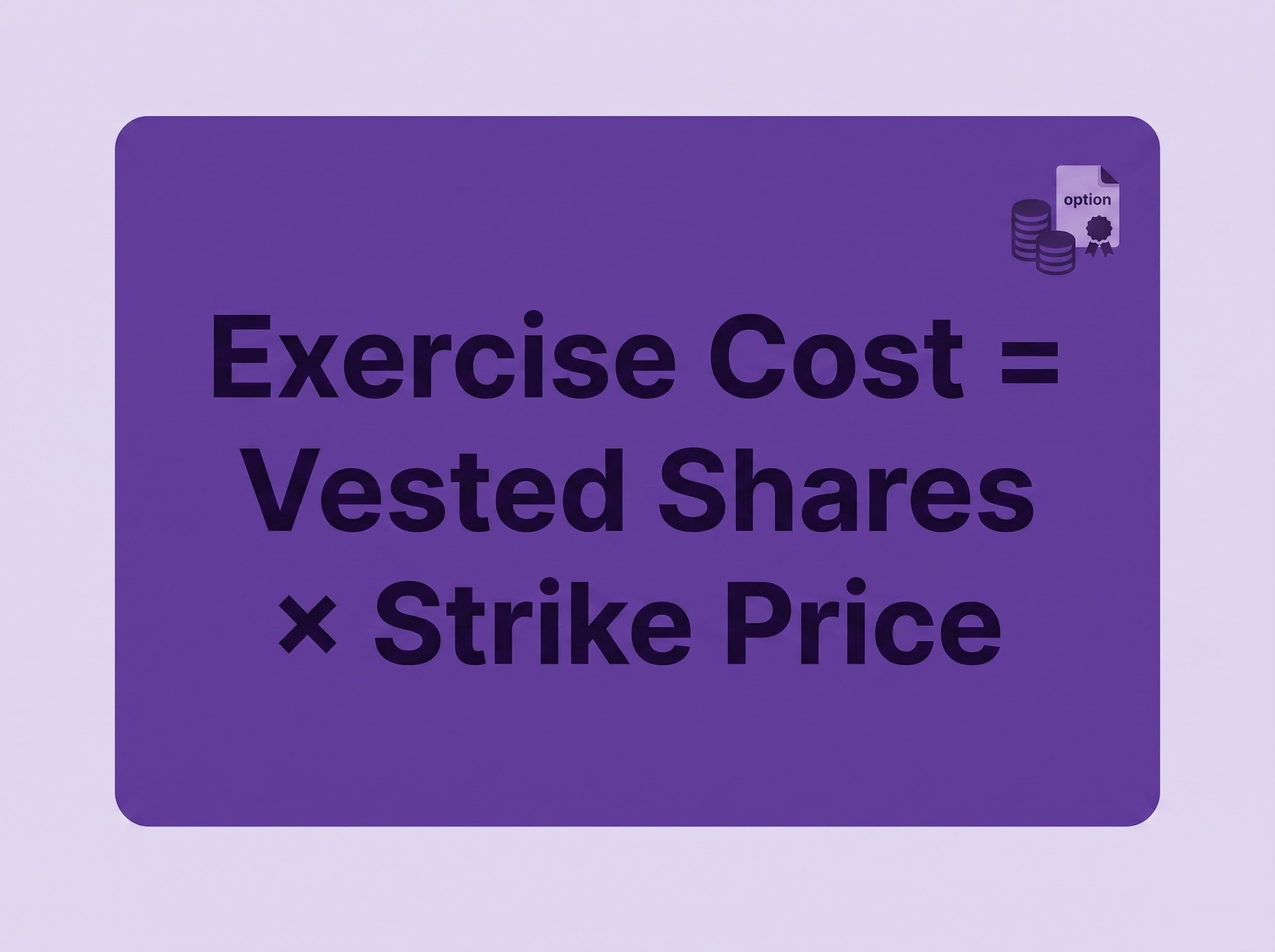
Say you have 1,000 vested options with a $2 strike price. Your exercise cost to buy all of them is $2,000, fixed, regardless of what the shares are worth on the day you exercise. Here is how two different outcomes look:
The money scenario is where your early, low strike price pays off. The underwater scenario is where waiting makes more sense than paying $2,000 for shares currently worth less.
Your strike price is only one number, but it sits at the centre of every exercise decision you will make. Three checks tell you most of what you need to know.
Compare your strike against the company's current FMV to see whether your options are in the money, at the money, or underwater. Multiply your vested shares by your strike price to understand the cash an exercise would require. Then weigh that cost against the tax impact and the upside you realistically expect before the grant expires.
An early, low strike price is a genuine advantage, your strike stays fixed while the company's FMV grows around it. The wider that gap becomes over time, the more valuable your options are. Getting comfortable reading your strike against today's FMV is the foundation of every sound exercise decision.
Your strike price is only as defensible as the 409A behind it. Qapita's independent 409A valuation is completed by qualified analysts reviewing your financials and conducting industry research to reflect your company's specific stage and characteristics. Every report is audit-ready and IRS-compliant, so when your strike price is questioned by auditors or employees, you have a valuation that stands up. Book a demo
Your existing strike price does not change. However, if the company's FMV drops below your strike, your options move underwater. New grants issued after the down round will carry a lower strike price reflecting the new FMV, but any grants you already hold stay at the strike set on your original grant date.
Yes, but it is entirely at the company's discretion. Repricing resets the strike price on existing underwater options to the current FMV, restoring spread value. It requires a fresh 409A valuation, board approval, and in some cases employee consent. Employees cannot request or demand a reprice.
There is no difference. Strike price, grant price, and exercise price all refer to the same number, the fixed per-share amount you pay to exercise your options. Different companies use different terms in their documents, but they all mean the same thing.
You are taxed on the spread, the difference between your strike price and the FMV at exercise, not the strike price itself. For NSOs, that spread is taxed as ordinary income in the year you exercise. For ISOs, it is not taxed as ordinary income but may trigger AMT. Speaking with a tax advisor before exercising is recommended.
Your strike price stays fixed, but without an IPO, acquisition, or secondary sale, there is no market to sell your shares after exercising. If the company is acquired, your options may be cashed out or cancelled depending on deal terms. If it shuts down without a liquidity event, even a favourable strike price may result in no return.
Your strike price is stated in your grant agreement or grant notice issued when your options were granted. If you cannot find that document, check your equity management platform or ask your HR or finance team. It should also appear in your employee equity portal if your company uses one.









%20(1).png)