


 Equity management

 Equity management
- Fund management

 Fund management
 - Fund managementFund management
- Fund managementFund management




Large funding totals can give founders an incomplete picture of their chances of raising money. A venture capitalist still selects investments against a particular fund’s strategy and return requirements.
Cooley reported $39.9 billion across 165 financings in Q1 2026, with a single large late-stage technology deal contributing to the increase in invested capital.
For a founder approaching investors, the useful question is how the company fits the fund. Its stage and capital requirements matter, as does the potential outcome for an investor buying in at the proposed valuation. An impressive market total offers limited guidance on those individual decisions.
The guide explains how venture funds operate, what investors evaluate, and how founders can prepare for a financing round.
Venture capital is private investment in companies with potential for substantial growth. A priced financing often involves preferred shares. Earlier rounds may use instruments designed to convert into equity later.
The investor accepts the possibility of losing the investment in exchange for the opportunity to earn a large return. Equity funding generally does not require scheduled principal and interest payments like a conventional loan.
Portfolio economics shape the model. A small number of successful investments may account for a large share of a fund’s returns, while other investments produce limited proceeds or losses.
This makes business fit important. A profitable local company can be an attractive business without offering the scale of outcome a particular venture fund needs. Founders should assess whether the investor’s growth and liquidity expectations match the company they want to build.
A venture capitalist is an investor who evaluates and invests in growth-oriented businesses, commonly through a professionally managed fund.
The role can extend beyond selecting companies. Depending on the firm and individual partner, activities may include:
The extent of support varies. A partner’s reputation or firm brand does not establish how much time they will spend with your company.
Ask founders in the investor’s existing portfolio about the partner’s involvement during difficult periods, including missed targets, leadership changes, and financing shortfalls.
Taking venture capital introduces another owner with financial objectives and negotiated rights. The practical effects depend on the size of the investment and the terms attached to it.
The capital may let you hire, build, or expand earlier. The investor will also expect progress against the business plan used to justify the investment.
New share issuance changes ownership percentages. Board seats and protective provisions can affect how major decisions are approved. Investors may have information rights, participation rights in future rounds, and preferences governing exit proceeds.
The relationship can continue through several financing rounds. Evaluate the person who will represent the investment, the fund’s remaining investment period, and its capacity to support future rounds.
A conventional venture fund raises commitments from investors, deploys capital into companies, and seeks to realize proceeds over time. Those proceeds return to the fund and are distributed under its governing agreement.
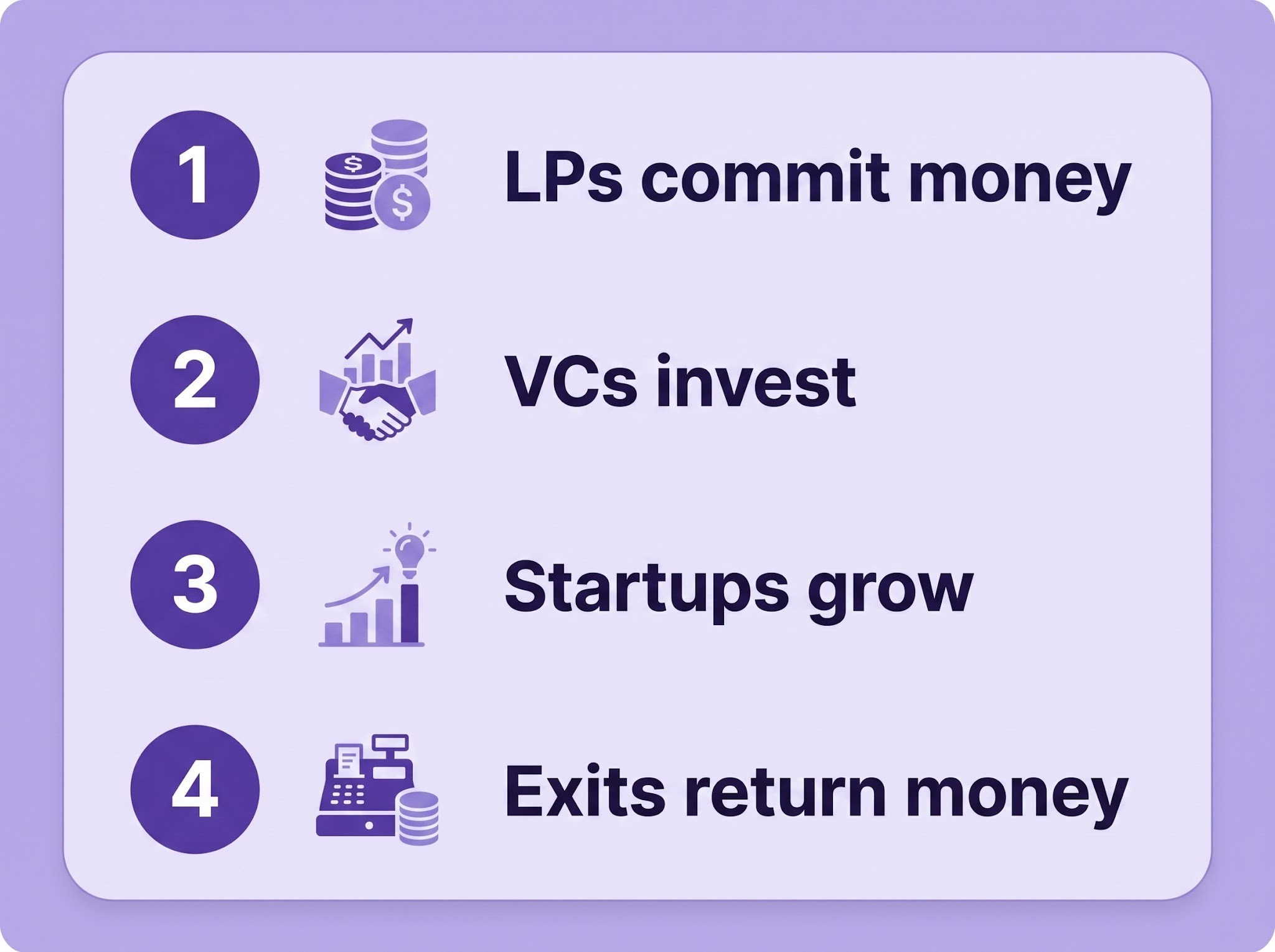
The main stages are:
Acquisitions and secondary sales can generate liquidity. An initial public offering (IPO) creates publicly traded shares but does not necessarily produce immediate cash for every existing investor. Lockups, sale restrictions, and distribution decisions can delay realization.
Investor and founder interests overlap in building company value. Their preferred timing and acceptable outcomes may still differ because of ownership rights and fund-level obligations.
Conventional venture funds raise commitments from LPs such as pension funds, endowments, family offices, institutions, and high-net-worth individuals.
A commitment is a promise to supply capital when called under the agreement. The fund usually draws capital over time rather than receiving every commitment in cash at its first closing.
Venture investors are therefore accountable to their own backers. The fund’s strategy, investment limits, time horizon, and reporting commitments influence which companies it can support.
Some investors use different structures. Corporate venture teams may invest from a corporate balance sheet, and other vehicles may have different funding or duration arrangements.
The firm is the ongoing management business. A fund is a particular investment pool managed by the firm. One firm may operate several funds with different vintages, strategies, or stages.
Traditional venture funds commonly have a term around ten years, with extensions possible. A fund’s remaining life can influence its investment and liquidity decisions.
Roles commonly include:
Titles vary across firms. Ask who can approve the investment and what process follows the first meeting.
Fund managers commonly receive management fees and carried interest. These payments serve different purposes and follow the fund’s negotiated terms.
Management fees pay the management business for operating the fund. They can support salaries, sourcing, diligence, and other agreed activities. The rate and calculation base may change over the fund’s life. Fees are business revenue and can contribute to the manager’s profit after expenses.
Carried interest is the manager’s contractual share of investment profits. Its payment depends on the distribution waterfall, including capital-return requirements and any applicable hurdle, catch-up, or clawback provisions.
As an illustration, a 2% fee on $100 million of committed capital equals $2 million annually while that rate and base apply. A 20% carry would allocate $4 million of $20 million in distributable profit to the carry recipient under a simplified calculation. These figures illustrate the mechanics rather than establish universal fund terms.
Financing stages describe a company’s development and the purpose of the round. They are not standardized tests. Expectations vary by sector, business model, market conditions, and investor strategy.
Early-stage investors may have limited operating data to assess. They examine the founders’ understanding of the problem, product progress, initial customer behavior, and the size of the opportunity.
A simple agreement for future equity (SAFE) provides contractual rights to future equity or other treatment under specified events. A convertible note is debt and commonly includes interest and a maturity date. Both may use a valuation cap or discount, so deferring a priced round does not eliminate pricing economics.
A priced seed round establishes a share price and issues equity at closing. Compare the instruments’ conversion, dilution, maturity, and exit provisions before choosing.
Investors at these stages usually expect stronger evidence of demand and the ability to grow the business. For a revenue-generating software company, this may include retention, sales efficiency, and customer expansion.
Series B discussions often place more weight on organizational capacity, predictable execution, and the economics of expansion.
The evidence differs by sector. A biotechnology company may be evaluated through scientific and clinical milestones rather than recurring revenue. Explain progress using measures appropriate to the business.
Later-stage financing may fund geographic expansion, new products, acquisitions, or preparation for a strategic transaction. Investors examine the company’s operating record, capital needs, and potential liquidity routes.
Secondary sales and tender offers may also arise as existing holders seek liquidity. These transactions can be separate from primary capital raised for the company.
Later rounds do not guarantee an approaching exit. The company’s readiness, investor expectations, and market conditions still determine whether an IPO, acquisition, or continued private ownership is practical.
Investors assess whether the opportunity can produce an attractive return for their particular fund. They connect the business case with entry valuation, expected ownership, future dilution, and possible exit outcomes.
Common evaluation areas include:
An attractive business may still fall outside a fund’s mandate or return requirements.
Fund size helps explain investor behavior. An investment must have the potential to contribute meaningfully to the fund’s results.
Consider a simplified $100 million fund holding 10% of a company at exit. A $1 billion equity-value exit would produce $100 million for that stake before fees, carry, preference effects, or other adjustments.
The example shows why company value and investor proceeds must be distinguished. If future rounds reduce the fund’s ownership, the company would need a larger exit to generate the same proceeds.
Founders should show a credible route to the relevant market rather than relying only on a large industry total.
Traction means evidence of demand, but the most useful measures depend on the model.
For software-as-a-service (SaaS) companies, investors may examine annual recurring revenue (ARR), customer retention, churn, gross margin, and customer acquisition cost (CAC) payback.
For marketplaces, measures may include gross merchandise value (GMV), take rate, repeat usage, and the ability to match buyers and sellers.
Explain the definitions and underlying data. Rapid growth caused by a short promotion or one large customer carries different implications from repeatable demand across a broader base.
Early investors often evaluate the team before the business has a long operating history. They look for knowledge of the customer problem, evidence of execution, and the ability to adapt.
Relevant experience can help, but it does not guarantee success. Demonstrate how the team learns, makes decisions, recruits, and handles gaps in its capabilities.
References can matter alongside the pitch. Investors may speak with former colleagues, customers, or other people able to assess the team’s work.
A financing process often progresses from initial interest to deeper review, proposed terms, and definitive documents. The sequence can overlap, and some diligence continues after a term sheet is signed.
Alt text: Venture investment process.
Caption: Investor discussions typically progress through review, proposed terms, and closing.
Common steps include:
The timetable can range from a short competitive process to several months. Ask the investor about its approval process, outstanding questions, and expected closing conditions.
Investors verify the claims supporting the proposed investment. The review may cover financial statements, customer contracts, intellectual property (IP), litigation, employment arrangements, and the capitalization table.
They will also examine outstanding SAFEs, notes, warrants, employee awards, approvals, and side letters. Missing records can affect share calculations or reveal rights absent from the financing model.
Some transactions require additional regulatory analysis. Foley’s October 2025 discussion of venture-financing documents highlights national-security, data, and capital-flow considerations reflected in the updated model documents.
Prepare a data room with consistent versions and owners for follow-up questions. Qapita can support the ownership-data portion of this work, while counsel and the finance team resolve legal and accounting issues.
A term sheet outlines the proposed deal. Many commercial provisions are nonbinding until definitive documents are signed, while provisions such as confidentiality or exclusivity may be binding.
Review:
The National Venture Capital Association’s October 2025 model-document release includes separate documents covering share purchases, investor rights, voting, and other matters. The structure reflects how financing rights extend across several agreements.
Review the package together. The valuation cannot explain the deal’s full effect on ownership and control.
Assume a startup raises $2 million at an $8 million pre-money valuation in a primary equity financing. Ignoring other securities, fees, and pool changes, the post-money valuation is $10 million.
The new investor’s ownership is:
$2 million ÷ $10 million = 20%.
Existing holders collectively retain 80%. The company issues new shares, increasing the total share count and reducing existing holders’ percentage ownership.
Table: Simplified ownership after a $2 million investment at an $8 million pre-money valuation.
The calculation assumes the investment goes into the company. A secondary purchase from an existing shareholder sends the payment to the seller and changes the ownership analysis.
Investors may require an employee option-pool increase as part of the round. If the increase is included in the pre-money capitalization used to determine the share price, existing holders generally bear the associated dilution.
The amount matters, but so does the definition. Determine whether the requested pool refers to the total reserve or the unallocated reserve available for future grants.
Compare round size, valuation, existing grants, outstanding convertibles, and the proposed pool together. A higher valuation with a larger pre-money pool can leave founders with less ownership than another offer.
Qapita’s cap table management software supports financing and option-pool scenarios so founders can examine those trade-offs using their actual capitalization.
A liquidation preference gives preferred shareholders specified rights to proceeds in an exit or other covered event. With a 1x nonparticipating preference, an investor generally receives the greater of the original investment amount or the proceeds available on an as-converted basis, subject to the documents.
In the simplified example, the investor contributed $2 million and owns 20%. If $8 million is available for shareholders after debt and transaction costs, the investor would choose the $2 million preference over a $1.6 million as-converted payout.
If $100 million is available, the investor would choose the $20 million as-converted payout. Other preferences, dividends, participation rights, or senior securities could change these results.
Cooley’s Q1 2025 financing report found 1x preferences and nonparticipating preferred stock common in its reported transactions. That provides context, but the negotiated documents determine your company’s outcome.
The main distinction is usually the source of capital and investment structure. An angel often invests personal money, while a conventional venture investor deploys capital through a managed fund.
Table: Common differences between angel and venture investment, with terms varying by investor.
Angels may suit early product experiments, smaller capital needs, or companies still developing the evidence required by institutional investors.
An angel with relevant operating experience may also provide focused help in a particular market or function.
The financing still needs proper documentation. Multiple small investments can create a complicated set of SAFEs, notes, and side letters. Track their conversion terms and rights from the start.
Venture capital may suit companies with a large addressable opportunity, substantial capital needs, and a business model capable of supporting rapid expansion.
Institutional investors may also bring follow-on capacity and support across later financing rounds. Verify the specific fund’s ability and willingness to provide that support.
Expect the growth plan, reporting, and governance to reflect the investment. Evaluate whether the resulting obligations fit the company’s operating capacity.
Venture financing can fund opportunities the business could not pursue as quickly through revenue alone. It also changes ownership and can influence the company’s strategic direction.
The principal benefits depend on how the company uses the capital and which investor joins.
Investor involvement creates value when it addresses a specific company need. Ask for examples and portfolio references.
The costs extend beyond the percentage sold in the current round.
Model these consequences under both successful growth and a slower operating case. A plan dependent on favorable future rounds deserves particular scrutiny.
Founders generally do not personally repay an ordinary equity investment solely because the company fails. Investors accept the risk associated with owning the securities.
The instrument still matters. Convertible notes are debt and can carry repayment or maturity obligations. Venture debt is also borrowed money. SAFEs have their own conversion, liquidity, and dissolution provisions.
Preferred shares may contain negotiated redemption rights, subject to the documents and applicable law. Fraud, contractual breaches, and personal guarantees can create separate liability.
Review the actual obligations rather than assuming every instrument used by a venture investor behaves like common equity.
Other financing routes may better match the company’s cash flows, control preferences, or pace of growth.
Each option has constraints. Bootstrapping limits spending to available resources, debt creates repayment obligations, and strategic investment may introduce commercial restrictions or conflicts.
Start with the operating plan. Determine how much capital is needed, what it should accomplish, and whether the expected outcome could support an investor’s return requirements.
Then examine ownership and governance. Decide how much dilution and shared decision-making you can accept.
A steady, profitable business may be better served by a financing structure with less pressure for a large exit. A company pursuing a capital-intensive opportunity in a large market may benefit from venture funding.
Choose the financing structure for the business’s needs and the founders’ objectives.
Preparation improves the quality of the discussion and helps expose problems before they become closing conditions. Focus on the ownership record, financing model, investor materials, and partner criteria.
Reconcile the capitalization table with the documents authorizing each security or promise of equity.
Check:
Resolve missing signatures, inconsistent dates, and undocumented promises with counsel. A correct spreadsheet cannot substitute for an unapproved grant or incomplete issuance.
Keep the historical financing record so investors can understand how the current ownership arose.
Build financing scenarios before focusing on the highest valuation offered. Include the securities and rights already outstanding.
Test:
A financing offer may preserve more headline ownership while introducing stronger investor rights. Separate percentage dilution, governance effects, and potential distributions so each can be assessed clearly.
Investors should be able to trace the pitch’s material claims to supporting information.
Prepare:
Maintain consistent definitions across the deck, model, and underlying reports. If recurring revenue or customer counts differ between materials, explain the reason before the investor has to ask.
Rank the factors affecting your decision. These may include partner quality, financing certainty, ownership retained, governance terms, sector knowledge, or follow-on capacity.
Set minimum requirements for the terms the company can accept. Identify which issues can be negotiated and which would undermine the operating plan.
A partner’s references and behavior during diligence can reveal how the relationship may work later. Evaluate those signals alongside the economics.
A venture round should fund a defined next stage and leave the company with workable ownership and governance.
Before signing, connect the capital raised to operating milestones, future financing assumptions, and downside scenarios. Understand how preferences and later dilution could affect both founders and employees.
Compare offers using the full terms and the investor relationship. The best choice is the one the company can execute against with a clear understanding of its obligations.
A venture round changes more than the investor column in your cap table. Convertibles may convert, an option pool may expand, and new rights may affect future financing or exit proceeds. Qapita helps founders connect those decisions with the underlying ownership records and maintain the resulting capitalization after closing.
Relevant capabilities include:
Book a demo to learn more about modeling your venture round and maintaining ownership records as financing terms change.
Venture capital is investment in companies with potential for substantial growth. Investors receive equity or related contractual rights and seek returns through future liquidity. Because investments can fail, funds often depend on a small number of strong outcomes to contribute substantially to returns.
A venture capitalist is an investor who evaluates and funds growth-oriented businesses, commonly through a managed fund. The role may also include governance, recruitment support, introductions, and later fundraising. Authority and involvement vary by individual, firm, and investment.
Fund managers commonly receive management fees and carried interest. Fees compensate the management business for operating the fund. Carry provides a contractual share of investment profits under the fund’s distribution rules. The rates, calculation bases, and payment timing vary by fund.
Ordinary equity usually has no scheduled repayment obligation comparable to a loan. Convertible notes, venture debt, preferred-share redemption provisions, and other contractual terms require separate review. Founders do not generally become personally liable simply because an equity-funded company fails.
There is no fixed percentage. In a simplified primary equity round, new investor ownership equals the investment divided by the post-money valuation. A $2 million investment at a $10 million post-money valuation equals 20%. Pool increases and convertible securities can change the calculation.
They examine the market, team, traction, business economics, competitive position, and likely investment returns. Expectations vary by stage and sector. The opportunity must also fit the fund’s mandate, investment amount, ownership objectives, and time horizon.
Neither is universally better. Angels may fit smaller, early-stage needs and provide individual expertise. Venture funds may offer larger investments and institutional resources. Compare the specific investor’s terms, decision process, support, and capacity to meet the company’s needs.
A primary equity financing usually issues new shares and reduces existing holders’ ownership percentages. Option pools, convertible securities, and later rounds may add dilution. Investor rights can also affect control and exit proceeds independently of percentage ownership.
Consider it when the business has a credible growth opportunity, a defined use for substantial capital, and potential outcomes compatible with venture returns. The founders should also accept the ownership, governance, and liquidity expectations attached to the proposed investment.
Reconcile the cap table, organize supporting documents, prepare a financial model, and explain the intended use of capital. Model dilution and key term-sheet provisions. Define the investor qualities and financing conditions the company needs before comparing offers.