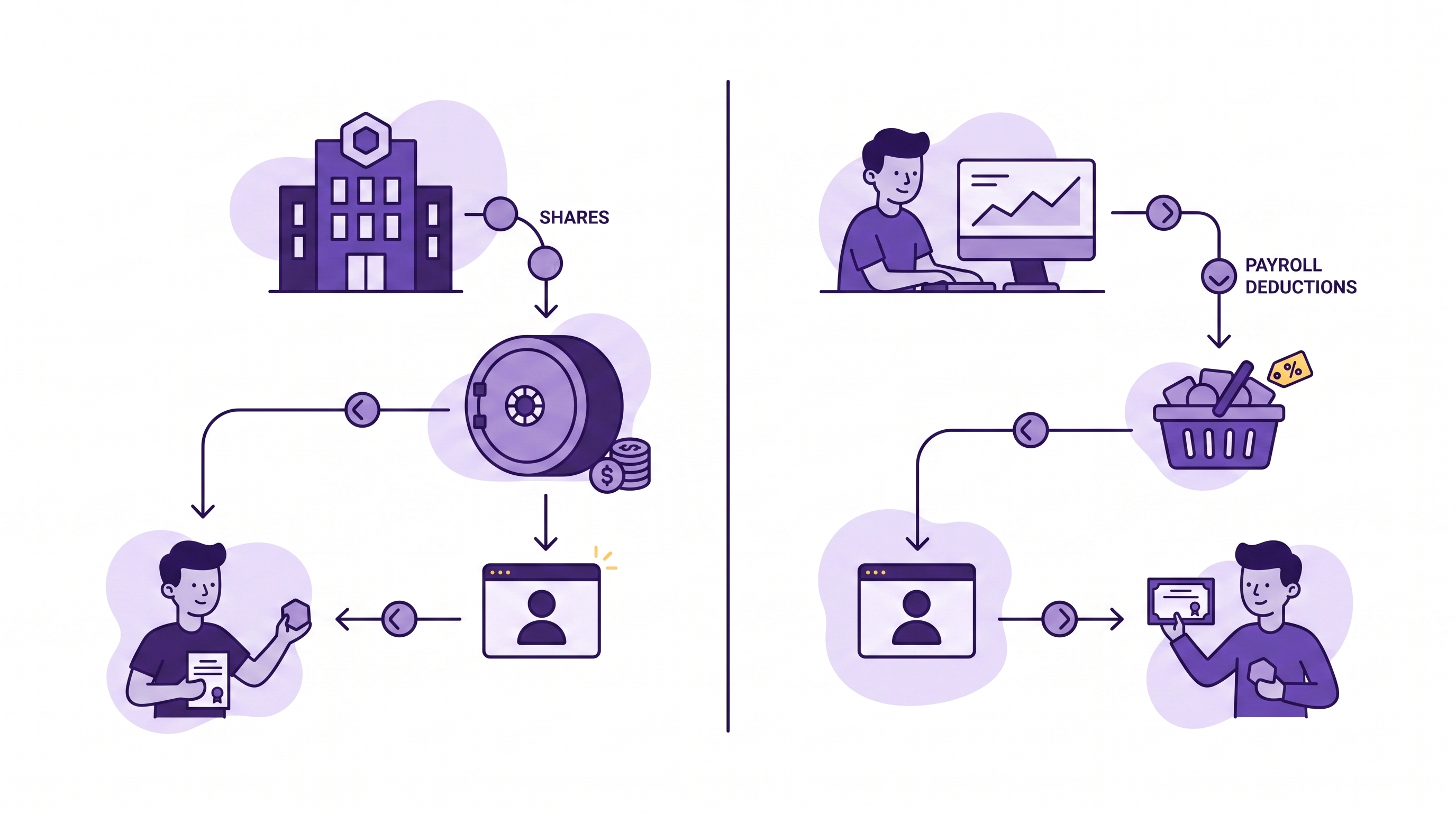


 Equity management

 Equity management
- Fund management

 Fund management
 - Fund managementFund management
- Fund managementFund management




A stock split happens when a company divides its existing shares into a larger number of shares. Each shareholder ends up holding more shares, but the price of each share drops proportionally, so the total value of their holding stays exactly the same. The company's market capitalization does not change either.
Stock splits are approved by a company's board of directors and announced publicly before they take effect. They are most common among companies whose share prices have climbed significantly, often after years of strong growth. Nothing about the underlying business changes when a stock splits. Revenue, earnings, debt, and ownership percentages all remain untouched.
For example, in a 2-for-1 stock split, an investor with one share priced at $100 would end up with two shares priced at $50 each, maintaining the total investment value at $100.
New shares = Old shares × split numerator ÷ split denominator
New per-share amount = Old per-share amount × split denominator ÷ split numerator
A forward split changes the share count and the corresponding per-share figures. A reverse split does the same in the opposite direction.
The split ordinarily changes:
The number of outstanding shares changes. Applying the ratio raises zero cash and transfers zero economic ownership.
Assuming every relevant share receives the same economic treatment and ignoring market movement, these items stay the same:
Dilution from an earlier financing remains in place. The distinction between basic and fully diluted shares also remains, although both counts need proportionate updates.
The mechanics are simple. When a company splits its stock, it multiplies the number of outstanding shares by the split ratio and divides the share price by the same ratio.
After the split, shareholders receive additional shares according to this ratio. The share price is revised downward to reflect the increased number of shares. Importantly, as the number of shares rises and the share price falls, the total value of the investment stays the same.
Here is a working example. Suppose you hold 100 shares of a company trading at $150 per share, a position worth $15,000. The company announces a 3-for-1 split. On the effective date:
The adjustment happens automatically. Your brokerage credits the additional shares to your account, and no action is required on your part. Your total cost basis stays the same too, though your per-share cost basis drops by the split ratio, which matters when you eventually sell and calculate gains.
Dividends adjust the same way. If the company paid $3 per share before a 3-for-1 split, it will pay $1 per share afterward. Your total dividend income does not change.
If a split does not change a company's value, why split shares at all? There are four main motivations.
1. Making shares more accessible. A stock trading at $1,000 or more can feel out of reach for everyday investors, even though fractional share investing has softened this barrier. A lower post-split price makes it easier for retail investors to buy whole shares and build balanced positions without overweighting a single stock.
2. Improving liquidity. More outstanding shares at a lower price can mean more buyers and sellers in the market, tighter bid-ask spreads, and smoother trading. This benefits both investors and the company.
3. Signaling confidence. Companies typically split their stock after a sustained run-up in price. The decision often communicates that management expects continued growth, which is one reason split announcements sometimes generate short-term positive sentiment.
4. Maintaining an Optimal Trading Range: Companies seek to maintain their stock price within a certain range to ensure it remains attractive and manageable for trading.
Some of the biggest names in the US market have split their shares repeatedly:
A stock split can happen in almost any ratio, and the ratio is what tells you exactly how the math plays out. It defines how many new shares you receive for each share you already hold, and by extension, how much the price per share adjusts.
The most familiar ratios in the US market are 2-for-1, 3-for-1, and 4-for-1. The mechanics differ from one ratio to the next, yet the outcome never changes: more shares, a lower per-share price, and the same total market value.
When a company announces a split, four dates matter. Understanding the stock split record date and ex date sequence helps you know exactly what happens to your shares and when. The four dates are:
Announcement date. The company publicly declares its intention to split, along with the ratio and timeline. This is often when the market reacts.
Record date. The date on which the company reviews its shareholder records to determine who is entitled to receive the additional shares. You must own the stock by this date to be included in the split distribution.
Payable date (distribution date). The date the new shares are actually credited to shareholder accounts.
Effective date (ex-date). The date the stock begins trading at its new split-adjusted price. For splits, the ex-date typically falls after the record date, which is the reverse of how dividend ex-dates work.
There are two types of splits, and they send very different signals.
1. Forward stock split- This is the most common type, where a company increases the number of shares and reduces the price per share proportionally.
For example, in a 2-for-1 stock split, shareholders get one extra share for every share they own, and the price of each share is reduced by half.
2. Reverse Stock Split- In this less common scenario, a company reduces the number of its outstanding shares, increasing the price per share proportionally.
In a 1-for-2 reverse stock split, shareholders get one new share for every two shares they currently own, which effectively doubles the share price.Companies may implement reverse splits to meet minimum price requirements for stock exchanges or to improve the stock's image.
A forward split creates more shares at a lower per-share amount. A reverse split creates fewer shares at a higher per-share amount. Both preserve proportional ownership when applied consistently.
Table: Forward and reverse stock splits compared by mechanics and investor considerations.
Stock splits can offer strategic advantages to both the company and its shareholders, even though they create no new value on paper. Here is where the upside comes from:
For all the enthusiasm splits generate, they come with real drawbacks that investors and companies should weigh:
A stock split leaves the economic substance of an investment unchanged while altering nearly every number attached to it. On the effective date, the share count in a shareholder's account rises by the split ratio, and the share price, per-share cost basis, and per-share dividend fall by the same proportion.
Total position value, aggregate cost basis, ownership percentage, and voting rights are all preserved, and because no value changes hands, the IRS does not treat a standard split as a taxable event. Brokerages handle the entire adjustment automatically, so no action is required from the shareholder.
The one figure with lasting significance is the reduced per-share cost basis, which determines reported capital gains when the shares are eventually sold.
A stock split is one of the most visible corporate actions in the market and one of the most misunderstood. It multiplies a company's shares, divides its price, and changes absolutely nothing about the underlying business. For existing shareholders, the total value of the position before and after is identical.
That does not make splits meaningless. They can improve liquidity, widen the investor base, and signal that management expects continued growth. Reverse splits, by contrast, often flag a company fighting to stay listed.
Investors should consider stock splits as part of a company's overall strategy and assess them alongside other financial metrics when making investment decisions. Instead, focus on fundamental factors like company performance, growth prospects, and overall market conditions.
Yes. It must follow applicable corporate law and its charter, bylaws, equity plans, and security agreements. Approval and filing requirements depend on the jurisdiction and transaction structure.
The 2-for-1 split is historically the most common ratio in the US market, followed by 3-for-1 and 3-for-2. The ratio a company chooses generally depends on how far its price has climbed and where management wants the post-split price to land.
A reverse split is the opposite of a standard forward split. The company consolidates multiple shares into one, reducing the share count and raising the price per share proportionally. In a 1-for-5 reverse split, 500 shares at $2 become 100 shares at $10. Companies most often use reverse splits to keep their share price above exchange minimums and avoid delisting, which is why the market frequently interprets them as a warning sign.
Neither, on its own. A split is value-neutral: it does not make a company more or less valuable, and it does not make your shares worth more or less. Forward splits tend to carry positive associations because they usually follow strong price performance and can signal management confidence. Reverse splits tend to carry negative associations because they often follow steep declines. In both cases, the split is a symptom of what the stock has already done, not a predictor of what it will do.
In a 2-for-1 split, every share you own becomes two shares, and the price of each share is cut in half. If you hold 50 shares at $80 (a $4,000 position), you will hold 100 shares at $40 after the split, still worth $4,000. Your total cost basis stays the same, your per-share cost basis halves, and any dividend per share is also halved so your total dividend income is unchanged.