


 Equity management

 Equity management
- Fund management

 Fund management
 - Fund managementFund management
- Fund managementFund management



Most investors avoid companies in financial trouble. Distressed debt investors look for it. Distressed debt investing means buying the bonds or loans of a struggling company at a fraction of their original value. If the business survives, investors profit when that debt recovers in price, gets repaid, or is exchanged for equity during a restructuring. Sometimes, this process can turn a lender into an owner.
Distressed debt sits at the intersection of credit investing, bankruptcy law, and corporate turnarounds. This guide explains how it works, the strategies investors use, and why it remains one of the most specialized corners of the financial markets.
Distressed debt is the debt of a company in or near financial trouble, trading far below its face value, typically under 70 cents on the dollar.
Say a retail chain issues bonds. Sales collapse. The market decides the company will likely default. A bondholder who paid $10 million can now only sell for $4 million and takes the loss to exit cleanly.
If a distressed debt fund buys that $10 million claim for $4 million, two outcomes follow:
Not every struggling company qualifies. Most investors look for corporate debt rated CCC or lower, indicating the issuer is highly vulnerable to default, with yields at least 1,000 basis points above comparable US Treasury bonds. Those high yields reflect the market's belief that repayment is far from certain.
Unlike most bond investors, the goal isn't simply to collect interest payments. The real opportunity lies in influencing what happens next, whether the company recovers, restructures, or emerges from bankruptcy with a new set of owners.
Everything depends on the company's capital structure, the hierarchy of loans, bonds, and equity that determines who gets paid first if the business runs into trouble. Investors spend months analyzing this structure to identify where value is likely to accrue in a restructuring. By accumulating a meaningful position in a particular class of debt, they can often gain a seat at the negotiating table and influence the outcome.
There are three primary ways investors make money:
There are several ways to gain exposure to distressed debt, ranging from specialist private funds to publicly traded investment vehicles. The level of involvement, accessibility, and risk varies depending on the route you choose.
Debt becomes distressed when investors believe there is a significant chance the issuer will fail to meet its financial obligations. As that risk increases, bond prices fall, yields rise, and credit ratings deteriorate.
1. High leverage and weak cash flow: Companies that take on too much debt can struggle to service it when earnings decline. WeWork expanded rapidly on borrowed capital, but mounting losses and slowing demand left it unable to cover interest payments. By the time it filed for Chapter 11 in 2023, the company had lost around $15 billion since 2017 and could no longer sustain its debt load.
2. Covenant breaches and liquidity pressure: Loan agreements often require borrowers to maintain certain financial ratios or meet performance targets. If these covenants are breached, lenders can demand renegotiation or immediate repayment. Cineworld, the world's second-largest cinema chain, accumulated around $5bn in debt and when pandemic-era closures crushed revenues, the company could no longer sustain it. It filed for Chapter 11 bankruptcy in 2022, with shareholders ultimately wiped out under the reorganisation plan while creditors negotiated the terms of the restructured business.
3. Maturity walls and refinancing risk: Even profitable companies can face distress if a large amount of debt comes due at the wrong time. Rising interest rates and tightening credit markets can make refinancing expensive or impossible, pushing otherwise viable businesses into distressed territory.
4. Rating downgrades and payment defaults: Repeated credit downgrades, missed interest payments, or a Chapter 11 filing are among the clearest signs that debt has become distressed. Hertz filed for Chapter 11 bankruptcy in 2020 after the pandemic brought travel to a standstill, leaving the company unable to meet its debt obligations, the point at which its debt firmly entered distressed territory.
Broader economic conditions often magnify these problems. Recessions, rising interest rates, and industry-specific downturns can quickly push vulnerable businesses into distress, expanding opportunities for distressed debt investors almost overnight.
Distressed debt appeals to investors because it combines the potential for high returns with protections that equity investors do not have. If a struggling company recovers or restructures successfully, debt purchased at a steep discount can generate significant gains.
The main reasons investors are drawn to distressed debt include:
Distressed debt is primarily an institutional market, requiring specialist legal, financial, and restructuring expertise. The main participants include:
For most individual investors, distressed debt is accessed through professionally managed funds rather than direct investment.
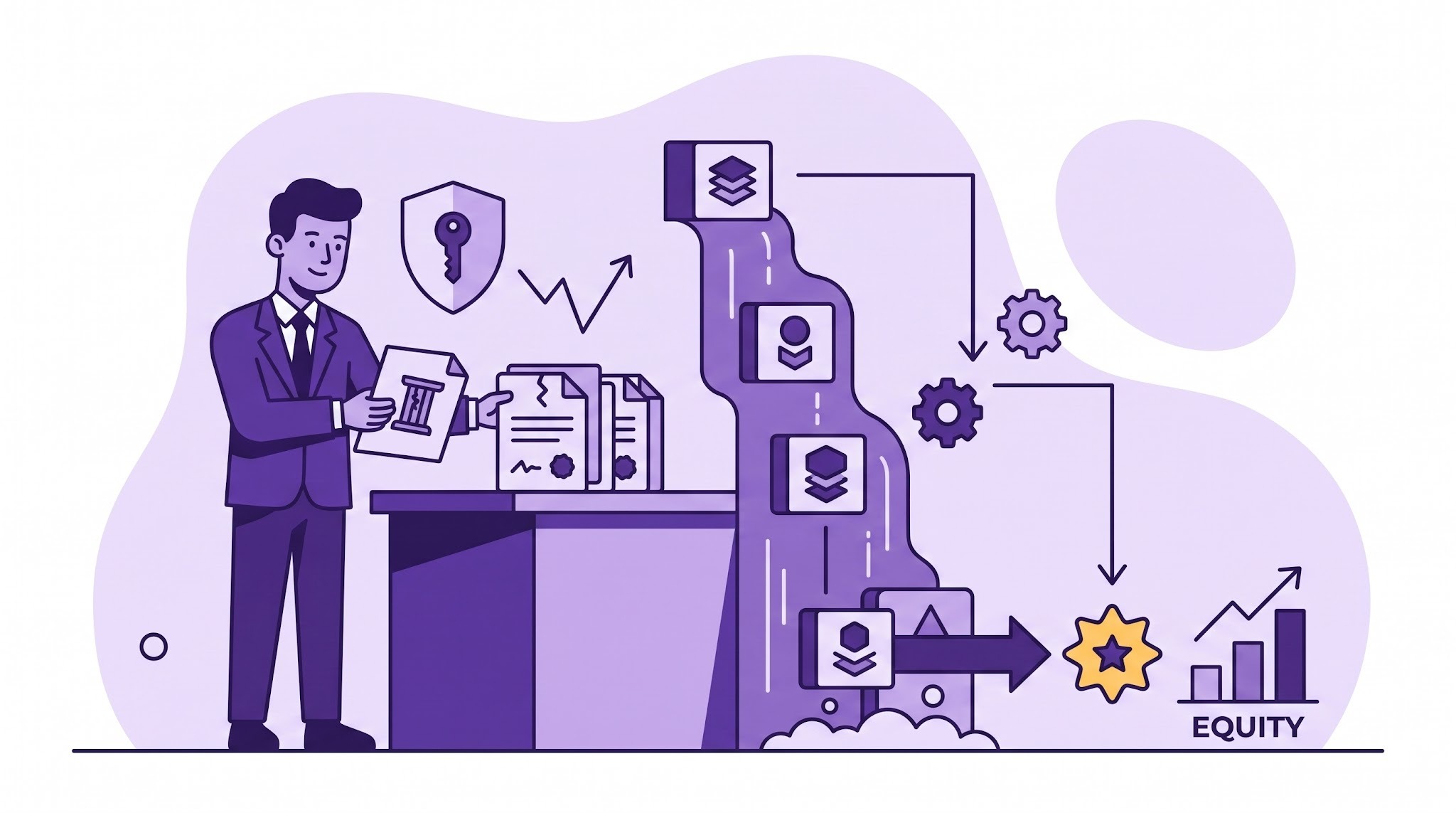
The bankruptcy priority waterfall is the legal order in which creditors and shareholders are repaid during a restructuring or liquidation. It is one of the most important concepts in distressed debt investing because it determines who gets paid, who absorbs losses, and, in some cases, who ends up owning the reorganized company. Investors use this hierarchy to estimate recovery values and identify the fulcrum security: the class of debt most likely to convert into equity.
In a typical US bankruptcy, value flows through the capital structure in the following order:
Each class must be paid in full before the next receives any recovery. If the company's value runs out before reaching a particular level, everyone below that point typically receives little or nothing. During a restructuring, investors also encounter the automatic stay, which temporarily halts most collection efforts after a bankruptcy filing, and a cramdown, where a court approves a restructuring plan despite objections from one or more creditor groups.
1.Distressed debt investors pursue four broad strategies, each differing in investment objective, time horizon, and level of involvement in the restructuring.
2.Trading investors buy distressed bonds or loans they believe the market has undervalued and sell them once prices recover or credit spreads narrow. Rather than participating in the restructuring, they profit from correcting market mispricing through detailed credit analysis.
3.Active non-control investors build positions large enough to influence restructuring negotiations without taking ownership of the company. They may participate in creditor committees, negotiate covenant amendments, or help shape the terms of a restructuring to improve recoveries.
4.Loan-to-own investors deliberately acquire the fulcrum security, expecting it to convert into equity during a restructuring. Instead of earning returns solely from the debt, they aim to emerge as significant or controlling shareholders of the reorganized business.
5.Restructuring and turnaround investors remain involved after the financial restructuring, working alongside management to improve operations, strengthen governance, and rebuild the business before eventually exiting through a sale, refinancing, or public listing.
High-yield and distressed debt are both below-investment-grade, but they represent very different levels of financial stress and require entirely different investment approaches.
Imagine two retail companies. Company A has a BB credit rating and continues to make its debt payments despite slower sales. Its bonds trade at 92 cents on the dollar, making it a typical high-yield investment. Company B, however, has missed interest payments, is preparing for bankruptcy, and its bonds trade at 35 cents on the dollar. Investors buying Company B's debt are estimating how much they will recover through a restructuring.
Although both asset classes sit below investment grade, they require very different investment approaches. High-yield investors focus on generating income while minimizing defaults. Distressed debt investors assume defaults may happen and instead ask a different question: What is this business actually worth, and how much will creditors recover? That shift, from analyzing credit risk to underwriting recovery value, is what separates distressed debt investing from traditional high-yield investing.
Distressed debt investing offers return potential that few other credit strategies can match, but the margin for error is thin and the complexity is high.
Distressed debt investing sits between traditional bond investing and equity, combining the legal protections of debt with the upside potential of ownership, but only for those who can accurately assess recovery value and navigate a complex restructuring process.
The returns can be exceptional, but so can the losses. Success depends less on market timing and more on the quality of analysis: understanding the capital structure, estimating realistic recovery scenarios, and knowing where in the waterfall value is most likely to accrue.
For most investors, access comes through specialist funds rather than direct participation. But understanding how distressed debt works, how debt becomes distressed, how bankruptcies unfold, and how creditors recover value, is relevant in a credit market where defaults are a permanent feature, not an exception.
When debt converts to equity during a restructuring, ownership structures can become complex fast. New shareholders emerge, cap tables shift, and managing stakeholder ownership becomes critical.
Qapita's equity management platform helps companies manage cap tables, track equity conversions, and maintain clarity through every stage of ownership change, from the first creditor conversion to post-reorganisation equity management.
Qapita brings structure to complex ownership changes. Book a demo to see how we can help.
Shareholders are last in the priority waterfall and in most bankruptcies their equity is wiped out entirely, with ownership transferring to creditors through a debt-to-equity conversion.
Chapter 11 allows a company to restructure its debts and continue operating, while Chapter 7 involves a full liquidation where assets are sold and the business ceases to exist.
They buy debt at a steep discount and profit either when prices recover, when creditors receive better-than-expected repayment, or when debt converts into equity in the reorganised company.
The fulcrum security is the debt tranche where the company's value runs out during a restructuring. Holders of this security are most likely to convert their debt into equity and become the new owners of the business.
Restructurings can take anywhere from a few months to several years depending on the complexity of the case, the number of creditor groups involved, and whether the company files for bankruptcy or restructures out of court.
Direct participation is largely restricted to institutional investors due to high minimum trade sizes, limited liquidity, and complex legal documentation. Most retail investors access the space through high-yield mutual funds or ETFs that hold some distressed securities.









.png)