


 Equity management

 Equity management
- Fund management

 Fund management
 - Fund managementFund management
- Fund managementFund management


%20(1).png)

The cofounder role in a startup means founder level ownership combined with clear responsibilities, decision rights, equity, and departure terms, not just a title.
US law does not define "cofounder" as a statutory job, so your cap table, governance documents, and written agreement create the real role.
After reading this article, you will know how to distinguish a cofounder from a CEO or COO, divide responsibilities across a founding team, and document equity and vesting without ambiguity.
A cofounder is someone who helped create and build a company from the start, joining at or near the beginning, making a long-term commitment, and receiving founder-level equity. Unlike an early employee, a cofounder shares origin-level ownership and often carries governance rights such as voting authority or a board seat.
There is no statutory definition of the term. Status comes instead from timing, contribution, risk, and equity. Cofounders devote all their time or capital and stay through the risky early stages.
The difference from an early employee comes down to three things.
1. Cofounders receive founder-level common stock and are part owners from inception, while early employees usually get options from a pooled plan of around 10% to 15% of the company.
2. Cofounders often hold board seats and voting rights on major decisions. And they shape the idea, strategy, and early pivots rather than executing under someone else's direction.
3. Timing is flexible. For example, Airbnb's Nathan Blecharczyk joined a few months after Brian Chesky and Joe Gebbia started experimenting with the concept, yet he is still recognized as a cofounder because he helped build the company at its formative stage and took founder-level equity.
A cofounder owns a core function of the company and shares in strategic decisions, fundraising, hiring, and risk. There is no single template, but responsibilities usually split into business-side leadership, technical leadership, and the unglamorous work of holding the team together under pressure.
The business-side cofounder typically owns a major function with real decision-making authority. According to CRV, that usually includes go-to-market, operations, or finance, plus a governance role and full visibility into the cap table and cash position.
Common duties include:
One cofounder usually leads these areas, but the others still influence them. When you head into a raise, the ability to model how each round affects ownership matters, which is where fundraise modelling earns its place.
A technical cofounder does far more than write code. The role covers system architecture, technology choices, and engineering standards, plus setting the long-term technical roadmap, per CRV and Slidebean.
The scope also includes recruiting and mentoring the first engineers, managing technical debt by deciding what to build robustly now versus later, and making IP and security decisions coordinated with counsel. Just as important, the technical cofounder acts as a thought partner to the business side on feasibility and trade-offs. As Dean Irwin frames it, technical cofounders are architects and owners of the technical asset base, not just coders.
There is a fourth job that never appears in a title: keeping the founding team aligned when things get hard. A CRV-cited talk at Business of Software reports that roughly 65% of high-potential startup failures stem from people problems, including cofounder conflict, misaligned expectations, and culture, rather than product or market errors.
That makes emotional labor and resilience a real cofounder responsibility. How you and your cofounders handle conflict, fundraising rejections, and pivots is a genuine driver of whether the company survives.
Founder and cofounder describe origin status: who created the company. CEO, COO, and CTO describe operating roles: the jobs people do. One person can hold both at once, and there is no fixed hierarchy in US law between a founder and a cofounder. Authority comes from equity and governance, not the label.
The practical upshot is simple. CEO and COO titles are defined in corporate governance documents and can be reassigned as the company grows. A founder can step down as CEO and remain a founder and board member. Founder and cofounder status, by contrast, does not change, because it describes what already happened at the beginning.
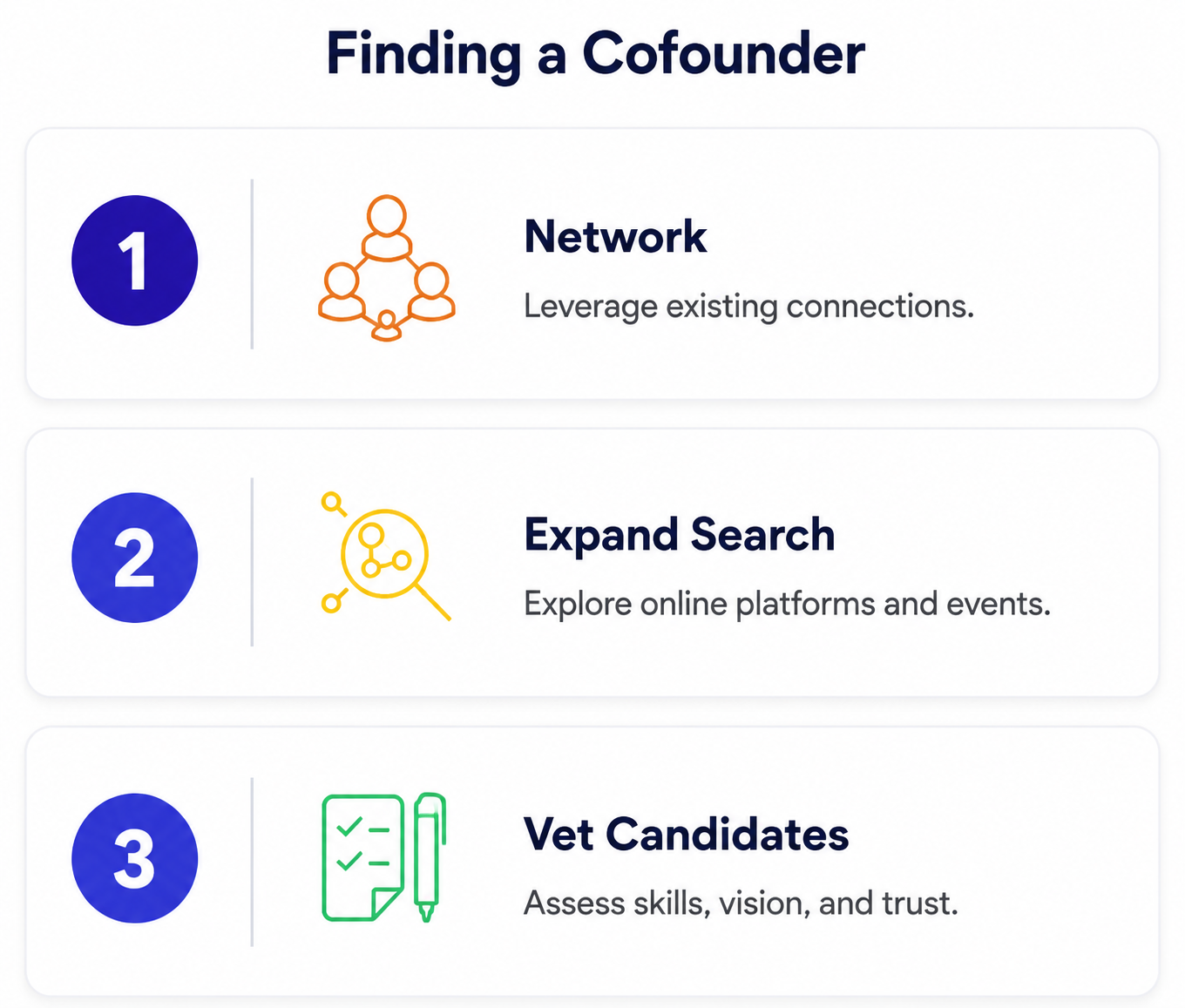
Finding a cofounder is different than hiring a full time employee. Unlike hiring, there is no job description and no salary to advertise. You are asking someone to work for little or no pay, take on founder-level equity and risk, and stay beside you through setbacks that most employees would walk away from.
Start by looking at people you already know and have either enjoyed working with or would want to work with. Former colleagues and classmates are often the strongest candidates because you already have evidence of how they work under pressure, how they handle conflict, and whether they follow through. Many great cofounder relationships have been built on real-life interactions and an actual history of working together.
If your immediate network does not surface the right match, expand deliberately rather than broadly.
Where to look beyond your network
Here are three key ways to search for a cofounder: your personal network, online platforms and communities, and industry meetups and conferences:
Complementary skills are necessary but not sufficient. You also want alignment on your business vision and work ethic, and someone who can handle intense stress and weather the startup journey's highs and lows with you. Beyond skills, look for:
A few good conversations are not enough. We recommend working on a trial project together for a set period of time. Building something like an app for a few weeks or months will give you insight into their working style, compatibility, and problem-solving approach. You want to see how this person behaves when something breaks, when a deadline slips, or when you disagree on direction.
Beyond the trial project, do real due diligence. Check a potential cofounder's references and talk to their former colleagues or partners to gauge their reliability, work ethic, and interpersonal skills.
Some questions worth asking those references:
There is no universal formula, but there are clear principles, real data on what founding teams actually do, and a set of mechanics that protect everyone regardless of which number you land on.
So before you land on a number, each founder should be honest about their contribution across these dimensions:
The most important variable is what each cofounder actually brings to the company, now and over time. Different founders bring different strengths and capabilities to the table. One founder might have the technical skills to build the product, while another might excel at market strategy and customer acquisition. Quantify the value of these contributions, both current and future, in relation to the company's objectives.
A useful frame from Antler covers five dimensions: the original idea or IP, commitment and risk, responsibilities and duties, business or domain expertise, and capital invested.
One caution worth noting: founders tend to make the mistake of splitting equity based on early work. It takes seven to ten years to build a company of great value. Small variations in year one do not justify massively different founder equity splits in year two through ten.
Not all founders work full time. Some may hold another job and work on the startup during off hours and on weekends, while others may be able to commit themselves fully from day one.
Consider the time each founder can give to the venture, today and in the foreseeable future. A part-time cofounder is not the same as a full-time one, and the equity should reflect that honestly — or you risk resentment compounding quietly over time.
Some founders may provide essential starting capital for the company, which could justify a different equity stake. Alongside capital, consider what each person is giving up.
Leaving a senior role at a well-compensated job to go full-time at a pre-revenue startup is a different level of sacrifice than leaving nothing behind, and that asymmetry is reasonable to factor in. That said, small adjustments of five to ten percent for major opportunity cost differences are reasonable, but you should not over-index on this factor.
Leadership roles often come with varying levels of impact. The CEO typically handles fundraising, strategic planning, and building external relationships.
In a technical startup, the CTO's work on core product architecture may warrant a stake close to the CEO's. The question is not just who has the bigger title but whose contribution is hardest to replace.
Equity is read externally, not just felt internally. Investors look at founder equity split as a cue on how the CEO values their cofounders. If you only give a cofounder 10 percent or 1 percent, others will either think they aren't very good or aren't going to be very impactful in your business.
Conversely, an extreme split can be a red flag to investors. A 90/10 split tells investors something is wrong with the team, even if it feels fair internally.
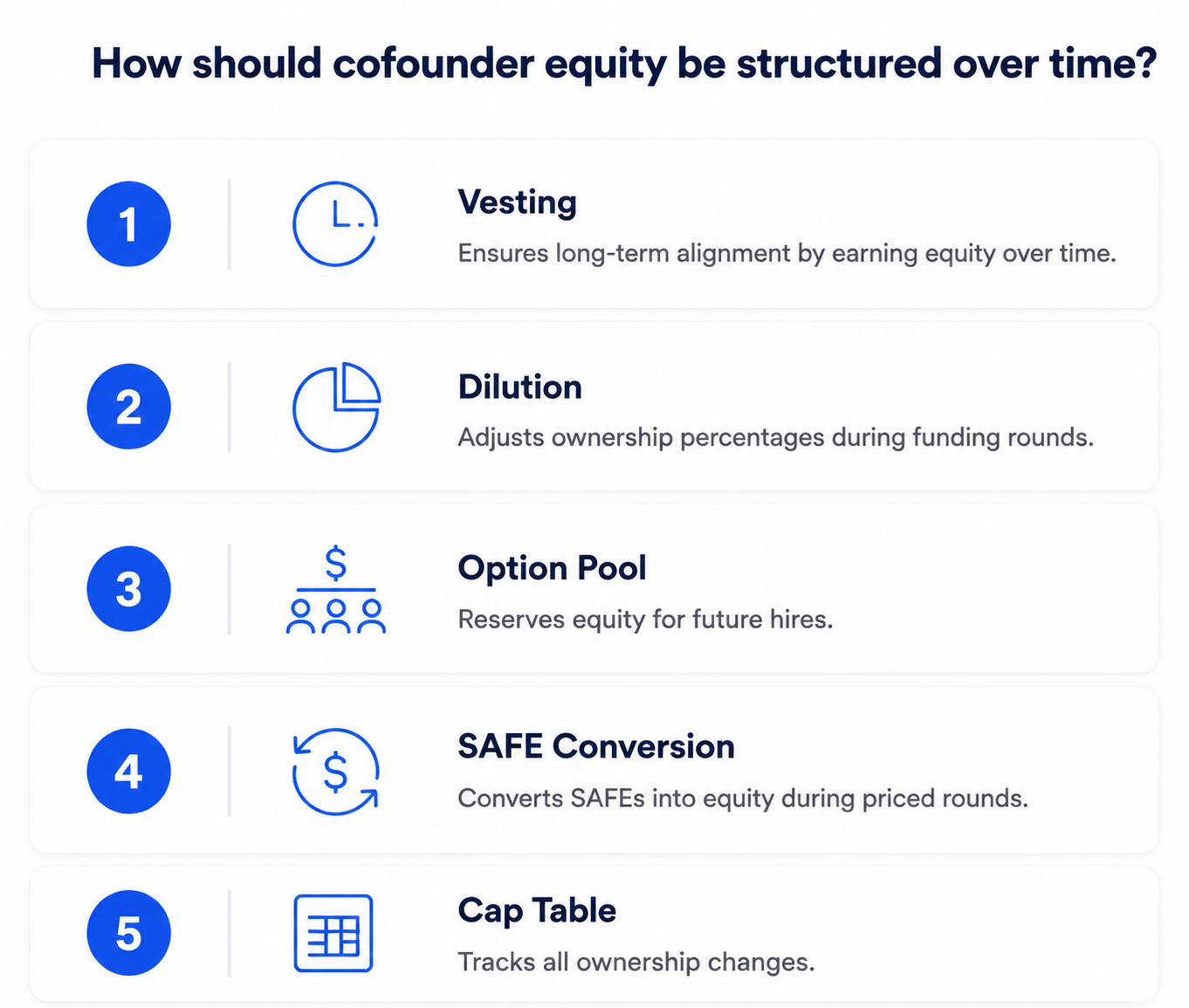
Cofounder equity is structured at the beginning but evolves as the company grows, raises capital, and issues new shares.
At the time of company formation, cofounders agree on an initial equity split. This split reflects contributions, roles, risks, and expectations regarding future involvement. In many cases, this is recorded alongside a vesting schedule to ensure equity is earned over time rather than granted upfront.
Most cofounder equity is subject to vesting. A common structure is a four-year vesting schedule with a one-year cliff.
Vesting helps ensure equity grows in step with continued contribution and long-term commitment.
As startups raise funding, new shares are issued to investors and employees. This increases the total number of shares in the company and reduces each existing holder’s percentage ownership.
Founders and cofounders continue to hold the same number of shares, but their ownership percentage adjusts as the company grows and new equity is created.
Most startups create an option pool to allocate equity for future employees. This pool is carved out of the company’s total equity and impacts the ownership percentage of existing shareholders, including cofounders.
The size of the option pool is typically defined during fundraising and is part of the broader cap table structure.
In early-stage companies, instruments like SAFEs convert into equity during future priced rounds. When a conversion occurs, additional shares enter the cap table, further adjusting ownership percentages among all existing shareholders.
All of these changes are tracked in the cap table. The cap table is the official record of who owns what in a company, including founders, employees, and investors.
It reflects equity splits, vesting progress, dilution effects, and conversion events over time, making it the central system of truth for ownership structure.
Co-founder equity is not defined only at the beginning. It evolves through funding events, hiring decisions, and time-based vesting. Understanding this structure helps explain why early ownership decisions have long-term implications for control and outcomes.
As ownership grows more complex, these strategies to manage a growing cap table help keep records clean.
“Cofounder" carries no legal weight on its own. So the agreement you sign is what actually defines responsibilities, voting rights, equity, vesting, IP ownership, and what happens when someone leaves.
A US cofounder or shareholder agreement typically covers equity and vesting, often four years with a one-year cliff, meaning no shares vest until the first anniversary, then monthly after that. It usually includes reverse vesting, so the company can repurchase unvested shares at a nominal price if a founder departs. It should also cover IP assignment through invention assignment agreements, board composition, shareholder voting rights, and departure terms.
Those departure terms carry the good-leaver and bad-leaver concepts common in US practice, even when the exact phrasing differs. A founder who leaves after substantial vesting typically keeps vested shares and loses unvested ones.
A founder terminated for cause or leaving very early may face repurchase of unvested and sometimes vested shares, implemented through vesting, repurchase rights, and for-cause termination clauses. You can go deeper in our explainers on building a cofounder agreement, setting a vesting schedule, and structuring an equity split.
Co-founders' decisions around equity, roles, and governance become harder to track as the company grows. What starts as informal alignment eventually turns into structured ownership, multiple funding rounds, and ongoing changes to the cap table.
Qapita pairs equity management software with expert-led services, so founders don't just get a tool, they get help avoiding the early equity mistakes that get expensive at fundraising. See how your equity split and vesting stay clean from day one.
At the earliest stage, this includes setting up cofounder equity split, vesting schedules, and option pools in a structured way. As the company grows, the same system tracks dilution from funding rounds, SAFE conversions, and new equity grants, ensuring ownership changes are accurately reflected.
Instead of managing these updates across spreadsheets or disconnected tools, cofounders get a live view of ownership, vesting progress, and cap table changes in one place
Book a Demo to see how your founding team's equity and vesting stay clean from your first SAFE onward.
Yes, if the existing founders agree and the company issues founder-level equity, usually with a vesting schedule and IP assignment. Adding a cofounder often means issuing new shares or options, which dilutes existing holders, and may require updating board composition and shareholder agreements. The title alone does nothing legally; what matters is how equity and governance are formally granted and documented.
Not from the title alone. A cofounder becomes an owner only when shares or options are formally granted and accepted, subject to vesting and repurchase terms. Adopting the label doesn't create ownership. Ownership arises from documented equity, which is exactly why your agreement and cap table matter more than the word "cofounder."
There's no universal answer, but some research suggests a trade-off. MIT Sloan and related SSRN work found solo founders are roughly 50% to 55% less likely to dissolve than three-person teams, largely due to coordination and conflict costs. Two-founder teams often balance diverse skills with manageable conflict. Larger teams can work, but only with clear roles and agreements.
Acceleration clauses determine what happens to unvested shares in an acquisition. Single-trigger acceleration vests all shares immediately upon acquisition, while double-trigger acceleration requires both an acquisition and the cofounder losing their job. Double-trigger is more investor-friendly; single-trigger protects founders if the acquirer brings in their own team. Most early-stage companies default to double-trigger.











.png)