

 Equity management

 Equity management
- Fund management

 Fund management
 - Fund managementFund management
- Fund managementFund management




TL;DR
Most founders choose their equity management software in an afternoon, during the week they incorporate, on the recommendation of whoever sent the first Slack message. Then it sits there for four years, quietly accumulating grants, SAFEs, conversions and vesting schedules, until a Series B auditor asks for an ASC 718 expense report and finance discovers the feature lives two pricing tiers up.
That is the real cost of this decision. Not the subscription. The switch.
This comparison covers the seven equity management platforms actually worth shortlisting in 2026, with pricing taken from each vendor’s own published pages, review data from G2’s Equity Management category as of August 2026, and more usefully a clear map of which compliance requirement forces an upgrade at which stage. Every pricing figure here is dated and sourced. Where a vendor doesn’t publish a number, we say so rather than guessing.
Equity management software is the system of record for who owns what in your company, and what happens to that ownership over time.
That covers more ground than a cap table. A modern equity management platform tracks every security you’ve issued common and preferred stock, options, RSUs, warrants, SAFEs, convertible notes alongside vesting schedules, board approvals, exercise events and the documents behind each one. It calculates dilution when you raise, generates the expense reports your auditor needs, files the forms the IRS expects, and gives employees a dashboard that tells them what they actually own.
The distinction that matters: a spreadsheet stores numbers. Equity management software stores transactions, and derives the numbers from them. That’s why a platform can survive a Series C diligence process and a spreadsheet can’t. When an investor asks how you got to a fully diluted figure, a transaction ledger has an answer. A cell with a formula in it does not.
Equity management software vs. cap table software. The terms get used interchangeably, and for early-stage companies they largely are. The split shows up later: cap table tools track ownership; equity management solutions add employee plan administration, valuations, financial reporting and liquidity on top of it. If your only need is knowing who owns what, cap table software is enough. If you’re issuing grants to employees, you’ll outgrow it.
Three things changed, and they changed the buying decision.
Audits arrive earlier. Companies that would once have run informal books until Series C are now facing GAAP audits at Series A, driven by investor requirements and by acquirers who won’t touch a company with unaudited stock-based compensation. ASC 718 reporting has moved from a late-stage nice-to-have to a Series A line item which is a problem, because most equity management platforms still treat it as a premium feature.
Cap tables got structurally messier. SAFEs stacked on SAFEs, multiple valuation caps, side letters, secondary transactions, and the big one cross-border subsidiaries. A US Delaware parent with an Indian engineering entity and a Singapore holding structure is now an ordinary shape for a Series A company, not an exotic one. Most equity management tools were built for one jurisdiction and bolt the others on.
Employees stopped taking equity on faith. After several years of flat and down rounds, a grant letter with a number on it doesn’t buy loyalty. Employees want to see current fair market value, vesting progress, exercise cost and tax exposure and if they can’t, the equity stops functioning as compensation. Which means the employee-facing side of your equity management platform is now a retention tool, not a courtesy.
None of this makes equity management software optional. It makes the choice consequential.
Best for: Companies from seed through IPO that will face a US GAAP audit, operate across more than one country, or both.
Qapita is a Singapore-headquartered equity management platform, founded in 2019, now serving 3,000+ private companies and 100+ listed companies, with over US $55 billion of equity under management and 500,000+ stakeholders on the platform. It’s used by Flipkart, Ola, Nykaa, boAt, Zetwerk, Carousell, Ninja Van and Infosys, among others: a customer list that skews notably more mid-market and enterprise than most of this category.
What it does differently. The core offering covers cap table management, stock plan administration, 409A valuations, ASC 718 financial reporting, equity compensation advisory and tender offers and critically, 409A and financial reporting isn’t fenced off in a top-tier plan. If you are a Series A company with an audit six months out, this is the difference between a working platform and an upgrade conversation.
The second differentiator is structural. Qapita handles multi-entity, multi-jurisdiction equity with built-in legal and tax frameworks for 150+ countries, which matters if your cap table sits in Delaware and your option holders sit in Bangalore, Singapore or Berlin. Most platforms will store those grants. Fewer will tell you that Germany taxes at vesting while India taxes at exercise, and reconcile both under one policy.
409A valuations are delivered in five business days with full documentation and audit support. On the liquidity side, tender offers and structured secondaries are available without moving to an enterprise tier: unusual in this category, where pre-exit liquidity is typically an enterprise-only motion.
Reviews. 4.6/5 on G2 across 324 reviews the highest review volume in the Equity Management category. Reviewers consistently cite implementation support and responsiveness; several are explicit Carta migrations. The recurring criticism is report customization, which is fair and worth asking about in a demo if you have unusual reporting needs.

Best for: US venture-track startups where investor and law-firm familiarity is the deciding factor.
Carta is the incumbent. Roughly 50,000 companies across 160+ countries, deep integration into the US venture ecosystem the fact that your lawyer and your investors have already used it. That reduces friction at every diligence event, and it’s a real benefit that comparison articles tend to undersell.
The platform has also broadened considerably: Carta Fund ERP for fund administration, and Carta Law following its acquisition of Avantia Law. Whether that breadth helps you depends entirely on whether you need it.
The tier detail that matters most. On Carta’s own plans page, 409A valuations begin at Grow. ASC 718 / US GAAP reporting, ASC 718 audit support, Rule 701 management, IFRS reporting, exit modeling and IPO advisory all begin at Scale, the top tier. If your audit needs stock-based compensation reporting and you’re on Build or Grow, you are having an upgrade conversation with sales, not clicking a toggle.
Reviews. 4.3/5 on G2 across 233 reviews the lowest rating among the major platforms here. On “has the product been a good partner in doing business,” Carta scores 8.3/10 against a category average of 9.2. Reviewer criticism clusters tightly and consistently: cost, onboarding friction, and support responsiveness at renewal.

Best for: Seed-stage US startups that want a published price and a clean interface.
The tier detail: ASC 718 stock-based compensation reporting sits in Enterprise. So does managed equity administration and secondary liquidity. Pulley’s published pricing is a genuine advantage at seed but the number you can see stops before the requirement that arrives at Series A.
Reviews. 4.7/5 across 132 reviews, and the scenario-modeling interface earns specific praise from founders stress-testing dilution before signing a term sheet. Note the customer mix: 87% of Pulley’s G2 reviewers are small businesses. That’s a fair reflection of where the product is strongest, and where it’s least tested.
Best for: Companies headquartered in Europe or the UK, running local scheme types.
Ledgy is Zurich-based and built for the instruments that US-first platforms handle badly: EMI and CSOP in the UK, VSOP in Germany, BSA-AIR in France, plus GDPR obligations on employee data. If you are a European company, this is a meaningfully different product rather than a regional skin on a US one.
Strong on the operational side too: 70+ HRIS integrations keep joiner and leaver data accurate as headcount moves, and an AI assistant handles stakeholder and plan updates conversationally a feature reviewer have started citing specifically.
Reviews. 4.7/5 across 74 reviews, with 55% mid-market, a more senior buyer mixes than most platforms at this size. Reviewers praise support and onboarding; the consistent criticism is occasional reporting bugs and limited customization.
Best for: Late-stage private and public companies, particularly through an IPO transition.
A naming correction worth making, because most comparison articles get it wrong: Shareworks is Morgan Stanley, not J.P. Morgan. It came from Morgan Stanley’s 2019 acquisition of Solium and now sits inside Morgan Stanley at Work alongside Equity Edge Online. J.P. Morgan Workplace Solutions is a separate product, built on the former Global Shares. They are different vendors with different pricing and different strengths.
Shareworks is the enterprise answer. It supports public and private plan designs: LTIPs, ESPPs, performance shares with API-level HRIS data sharing, a sandbox for forecasting and budgeting scenarios, executive services for senior leaders, and the brokerage infrastructure behind tender offers and post-IPO trading. Morgan Stanley at Work reported serving 3,400+ stock plan clients globally as of mid-2024.

Best for: Companies that want to be live in a week without a sales cycle.
Cake is now Venice, California-headquartered with Australian roots, serving 10,000+ companies, and it competes hard on two things: onboarding speed and migration.
Migration is included free on every plan, with a human reviewing the data and a reconciled cap table you can inspect before you pay. Cake says most migrations complete in one to two business days. That’s a sharper offer than the industry norm, where migration is a $1,000–$5,000 professional services line.
Pricing (published): Free for your first 5 stakeholders. Build at $1,000/year covers 25 stakeholders, plus $1 per additional stakeholder. Team at $2,750/year covers 40 stakeholders, plus $5 each above that, and includes two 409A valuations per year the strongest 409A inclusion at this price point in the category. Pro is custom.
The tier detail: ASC 718 reporting, Form 3921, Rule 701, cross-border incentive plans and SPVs are all in Pro. Same pattern as Carta and Pulley.
Reviews. 4.8/5 across 135 reviews, and G2’s fastest-rising product in the category in August 2026. Reviewers like the interface and the education tools; complaints centre on frequent layout changes and add-on costs accumulating.
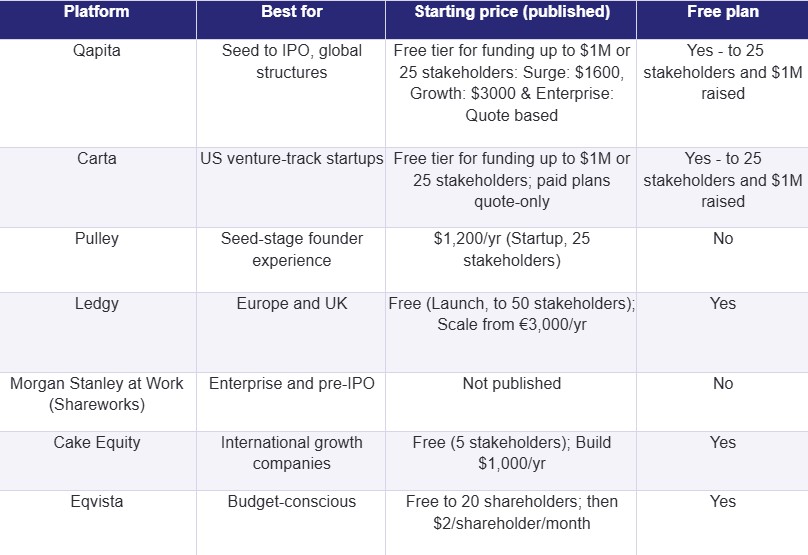
This is the single most useful table in this article, and it comes straight from each vendor’s own published plan pages.
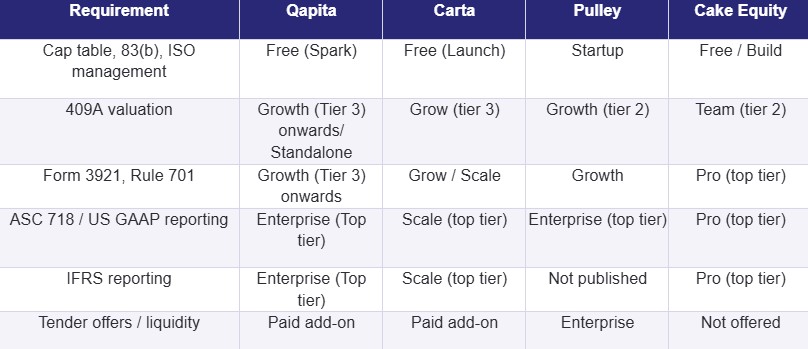
This is not a pricing quirk. It’s a structural pattern in how equity management tools are packaged, and it produces a predictable outcome: a company buys at seed based on the seed-stage price, then hits an audit at Series A or B and discovers the requirement is two tiers up. At that point you have two options, both bad. Upgrade from a position of zero leverage, mid-audit. Or migrate moving four years of transaction history, grant records and vesting schedules to a new platform while your auditor waits.
The question to ask every vendor on your shortlist: “Which plan includes ASC 718 reporting, and what will that plan cost me at 120 stakeholders?” Ask it before the demo. The answer tells you more than the feature list.
A transaction-based cap table rebuilds ownership from underlying events rather than storing a snapshot someone edited. That means share counts reconcile across every view, conversions are traceable, and the fully diluted figure you send an investor holds up to questions. The practical benefit is time: cap table cleanup before a round routinely eats weeks of finance capacity, and it’s entirely avoidable.
Grant issuance, board approval, e-signature, vesting accrual, exercise processing and termination handling become a workflow rather than a monthly manual exercise. HRIS integration is the underrated piece when a leaver record syncs automatically, you don’t discover eight months later that someone’s unvested options were never cancelled.
409A valuations, Form 3921 for ISO exercises, Rule 701 disclosures, 83(b) elections, ASC 718 expense reporting, and the local equivalents wherever your employees sit. These aren’t optional and the penalties for getting them wrong are real. The reason to automate them is not tidiness, it’s that manual compliance fails silently, and you find out during an audit.
Scenario modeling that shows what a term sheet actually costs you: dilution across share classes, SAFE conversion behaviour, option pool top-up impact, waterfall outcomes at different exit values. Founders who model before negotiating negotiate better. Founders who model in a fifteen-tab spreadsheet model wrong.
Employees who can see current fair market value, vesting progress, exercise cost and tax exposure treat equity as compensation. Employees who received a PDF two years ago treat it as a lottery ticket. Given how much of your comp budget runs through equity, that difference is expensive.
Seven questions, in order. Answer them before you take a demo.
If a vendor won’t answer 2, 5 or 6 in writing before the contract, that’s your answer.
Almost every article on this topic treats “international support” as one checkbox. It isn’t, and the distinction is expensive.
There are three different problems hiding in that phrase:
The failure mode is worth naming precisely, because it’s common: you engage a local advisor in each country, each optimises for their own jurisdiction, and you end up with Indian ESOP terms that break your US accounting treatment and European RSUs that don’t reconcile with the parent plan. The platform decision either prevents that or guarantees it.
If your next eighteen months include a second entity, weight this heavily. It’s the requirement most likely to force a migration, and the one least visible on a feature comparison table.
Something worth knowing before you weigh any of the review claims in this article, including ours.
Right now, at least three vendors in this category describe themselves as ranked #1 on G2 and each is technically telling the truth, because G2 issues badges across dozens of slices: Leader, Momentum Leader, Best Usability, Best Relationship, Best Results, Most Implementable, plus regional and segment cuts for Americas, EMEA, Asia Pacific, Small Business, Mid-Market and Enterprise. In a category with 84 tracked products, there are a lot of legitimate ways to be first at something.
So the badge tells you nothing on its own. Four things underneath it do.
Precisely, because precision matters here: Qapita is recognised on G2 as a Leader in Equity Management globally and across Asia and Asia Pacific, is a Momentum Leader, and is rated highest in customer satisfaction in both the Mid-Market and Enterprise segments. It holds the largest review base in the category 324 reviews at 4.6/5 as of August 2026, ahead of Carta’s 233.
Three things sit behind that, and they’re all checkable.
The reviews come from harder customers. 49% mid-market, 26% enterprise. Companies with multiple share classes, subsidiaries, audits and hundreds of grant holders. Satisfaction scores earned on that workload mean something different from satisfaction scores earned on a twelve-row cap table.
Support is the product, not a wrapper around it. Equity is a domain where the platform is necessary and insufficient you also need someone who knows whether your Indian recharge agreement survives US GAAP treatment. Reviewers cite implementation support and responsiveness more than any single feature, and a recurring theme in Qapita’s reviews is companies migrating from Carta specifically over cost and support.
Nothing critical is fenced behind an enterprise tier. ASC 718 reporting, 409A valuations, tender offers, multi-entity support: core offering. Every competitor in the comparison table above gates at least one of those to its top plan. That’s why a Series A company that buys Qapita is not scheduled for an upgrade conversation at its first audit.
And what it isn’t. Qapita is not the platform with the most US venture brand recognition - Carta is, comfortably. If your priority is that your investor’s operating partner has used your cap table tool before, that’s a real consideration and Carta wins it. Qapita’s argument is that eighteen months from now you’ll care more about whether ASC 718 is in your plan than whose logo is on your login page.
Equity management software is the system of record for who owns what in your company. It tracks shares, options, SAFEs and vesting schedules, runs 409A valuations, generates audit and investor reports, and gives employees a live view of their equity.
Most platforms are free under about 25 stakeholders. Paid plans start at $1,000–$1,600 a year and run to $3,000–$3,500 a year once 409A valuations are included. Above that, pricing is quote-based almost everywhere. Qapita publishes its rates: free, then $1,600/year, then $3,000/year with 409A included.
Qapita is the strongest all-round choice, because one platform covers you from your first SAFE to IPO, including 409A valuations, multi-entity structures and liquidity. Start free on Spark, move to a paid plan when you issue employee grants.
Yes. Qapita Spark is free for up to 25 stakeholders and under $1M raised, and includes cap table management, equity plan management, funding round modelling and a data room. Carta, Ledgy, Cake and Eqvista also offer free tiers at various stakeholder limits.
Cap table management means keeping an accurate record of every share, option, warrant, SAFE and convertible note, with ownership shown on both an outstanding and fully diluted basis. Done properly it is transaction-based, so every number traces back to a document.
Not on day one. The threshold is your first employee grant, because that introduces vesting, a defensible strike price and 83(b) timing, all of which fail silently in a spreadsheet and surface expensively in diligence. Free tiers mean there is little reason to wait past that point.
A standalone 409A runs roughly $2,000–$5,000. Bundled into a platform it is cheaper: Qapita includes it in the $3,000/year Growth plan, or adds it to a lower plan for $1,500. Qapita delivers 409A reports in five business days with audit support included.
From your first GAAP audit, which now typically lands at Series A. ASC 718 is a top-tier feature on every major platform, including Qapita Enterprise, so establish what that tier costs before you commit to a vendor.
Qapita. Spark is free up to 25 stakeholders, Surge is $1,600/year for 40, and the per-stakeholder rate is published, so a small business can see its cost at every size before signing. Most competitors stop publishing prices exactly where a growing company starts paying.
One to two weeks for most companies, including data validation. Qapita includes onboarding and migration support from the Surge plan upward, rebuilding your full transaction history rather than importing a snapshot. Move between funding rounds, never during one.
Yes, and it costs nothing to start. Spark is free until you pass 25 stakeholders or $1M raised, and the same platform carries you through 409A valuations, multi-country hiring and liquidity later, so you are not migrating mid-audit.
Qapita is the closest full-lifecycle alternative and the strongest choice if you need multi-entity support or published pricing. Pulley suits seed-stage US startups, Cake fast setup, Ledgy UK and EU schemes, and Eqvista the lowest cost.