


 Equity management

 Equity management
- Fund management

 Fund management
 - Fund managementFund management
- Fund managementFund management




A B2B business, short for business-to-business, is a company that sells products or services to other businesses, government organizations, or institutions. They do not cater to the needs of individual consumers.
These businesses support how other organizations operate, produce goods, or deliver services. Because of this, purchases typically involve larger deal sizes, longer evaluation cycles, and multiple decision-makers inside the buying company.
The easiest way to identify a B2B business is by looking at who pays for it.
B2C businesses sell to individuals who make decisions based on personal need, preference, or price. This difference shapes everything from deal size to sales cycle length to how long it takes for revenue to be realized.
B2B businesses are categorized by how they create and capture value.
Some companies operate beyond a single model depending on their customer base and distribution approach.
B2B SaaS companies are B2B businesses that operate on subscription-based pricing where revenue depends on acquisition, retention, and expansion over time.
Founders raising capital for this model should understand the specific financing options available to B2B SaaS startups before committing to a fundraising path.
B2B e-commerce is the buying and selling of products or services between two businesses through an online platform. It runs on a storefront, marketplace, or supplier portal built for how businesses buy.
Buyers can order in bulk and get pricing based on volume or contract terms. Purchases are usually paid by invoice. Larger orders often go through an approval step before proceeding.
These platforms typically connect to each side's inventory, accounting, or procurement systems, so orders update automatically instead of being entered by hand.
The result is a digital version of traditional B2B buying, with the same multiple stakeholders, larger order volumes, and recurring purchases, but with less time and friction.
Business-to-business marketing, or B2B marketing, is how a company promotes its products or services to other businesses instead of individual consumers. It targets the people inside an organization who research options, evaluate vendors, and approve the spend.
When marketing to B2B companies you must remember that one person discovers the product, another evaluates it technically, finance reviews the economics, procurement negotiates, and an executive approves. Winning means satisfying all of them, usually over weeks or months.
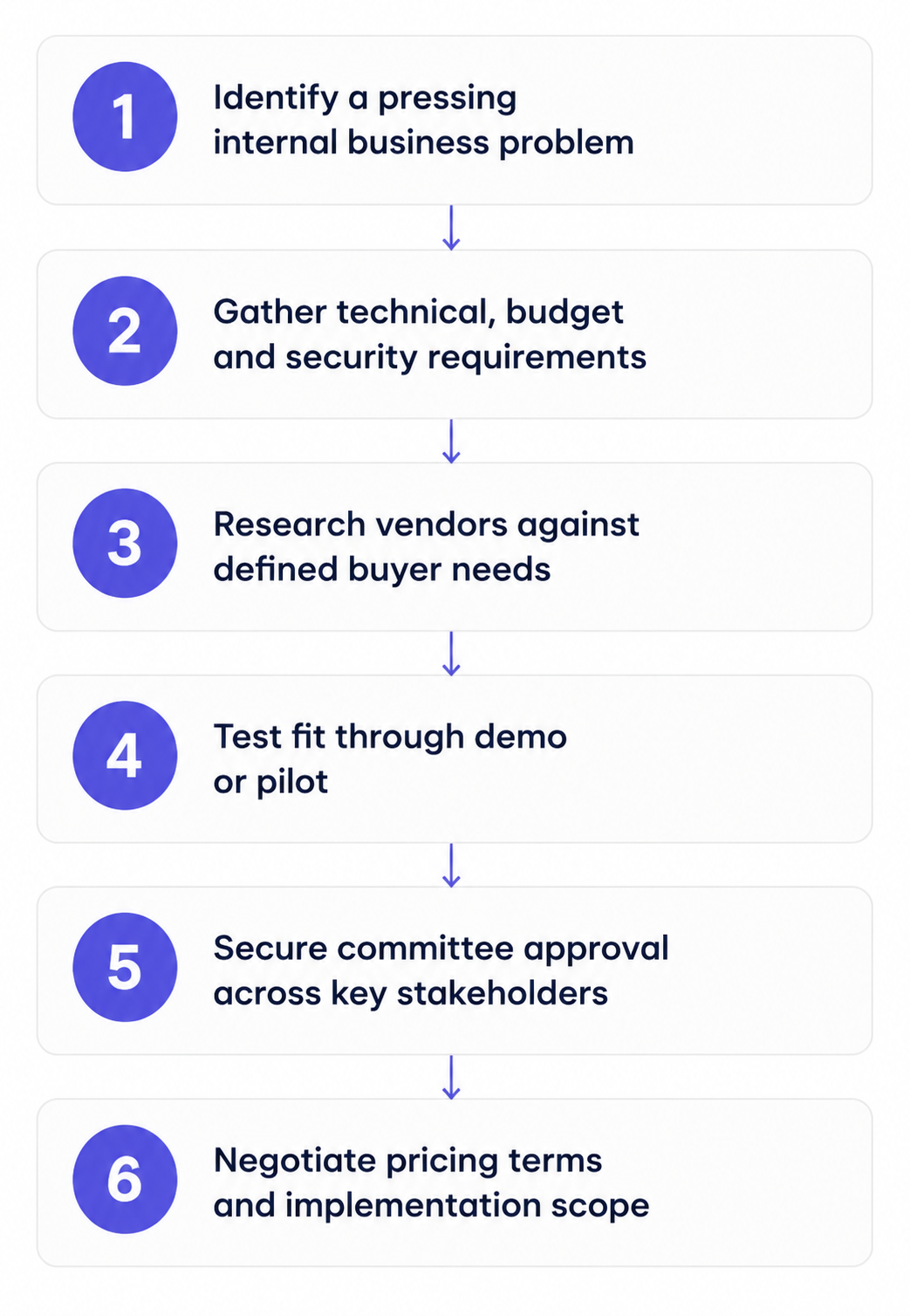
A typical B2B buying journey moves through these stages:
Most B2B marketing programs run on a mix of channels built for that research-heavy process:
Because a B2B purchase clears several stakeholders, marketing rarely closes a deal on its own. It builds the trust and evidence that move a buyer through the stages covered next.
Every B2B business is really in the trust business. No matter how good your product is, a buyer is putting their reputation on the line when they bring you in front of their team, their CFO, or their board, and that's a bigger commitment than any individual consumer ever makes on a purchase. The companies that win long-term aren't just the ones with the best features; they're the ones buyers feel safe vouching for internally.
That dynamic is also starting to shift. As buyers increasingly research and shortlist vendors on their own, often before a salesperson ever enters the picture, the businesses that earn trust before the first conversation, through transparency, proof, and reputation, will have the advantage. Building a B2B company today means building for a buyer who's already half-decided before you know they exist.
B2B companies usually design structured onboarding processes that include implementation support, training, and integration with existing systems to ensure smooth adoption across teams within the customer organization.
Key skills include stakeholder communication, problem-solving across complex requirements, understanding business workflows, and the ability to translate technical or product capabilities into measurable business outcomes.
Because retention and expansion are critical to revenue growth, customer success teams ensure clients achieve outcomes, reduce churn risk, and identify opportunities for deeper product adoption over time.
Scaling typically involves adapting pricing models, aligning with regional compliance requirements, building local partnerships, and adjusting sales strategies to match different procurement and buying behaviors across markets.
As startups scale, they rely on systems for CRM, analytics, and financial tracking. Platforms like Qapita help manage ownership complexity by keeping equity, cap tables, and dilution tracking structured as teams expand and raise capital.