


 Equity management

 Equity management
- Fund management

 Fund management
 - Fund managementFund management
- Fund managementFund management



As a startup founder, you perform multiple roles, constantly chasing your vision and transforming ideas into reality. However, the journey is never smooth, and one crucial hurdle you might face is getting a 409A valuation for your startup. This regulatory requirement from the Internal Revenue Service (IRS) can feel overwhelming, affecting your decisions ranging from taxes to Employee Stock Options (ESOPs).
As per Section 409A of the Internal Revenue Code (IRC), this valuation must be completed by an independent appraiser. Therefore, understanding the 409A valuation cost is essential before you make a final decision. This cost can vary according to a range of factors, like the complexity of the capital structure, the stage of your business, and several others. In this blog, we will cover different aspects of 409A valuation price and share insights on how the right valuation provider can make the process a hassle-free experience for you.
Most startups pay between $1000 to $6000 for a 409A valuation, with early-stage companies typically paying on the lower end. Your 409A valuation cost can vary significantly depending on the service agreement and the provider you choose. You may be required to pay somewhere between $1000 and $6000 for this valuation under normal circumstances. However, several factors directly impact the 409A valuation cost.
One key factor that influences the 409A valuation price is the frequency. While a 409A valuation is performed annually, in case of material events, a fresh valuation may be required.
Material events are considered to be significant changes in circumstances that could potentially affect the overall value of the company. These can include events like a new funding round, mergers and acquisitions, or a material change in company revenue. If several material events take place in quick succession, then a new 409A valuation is required after every such instance.
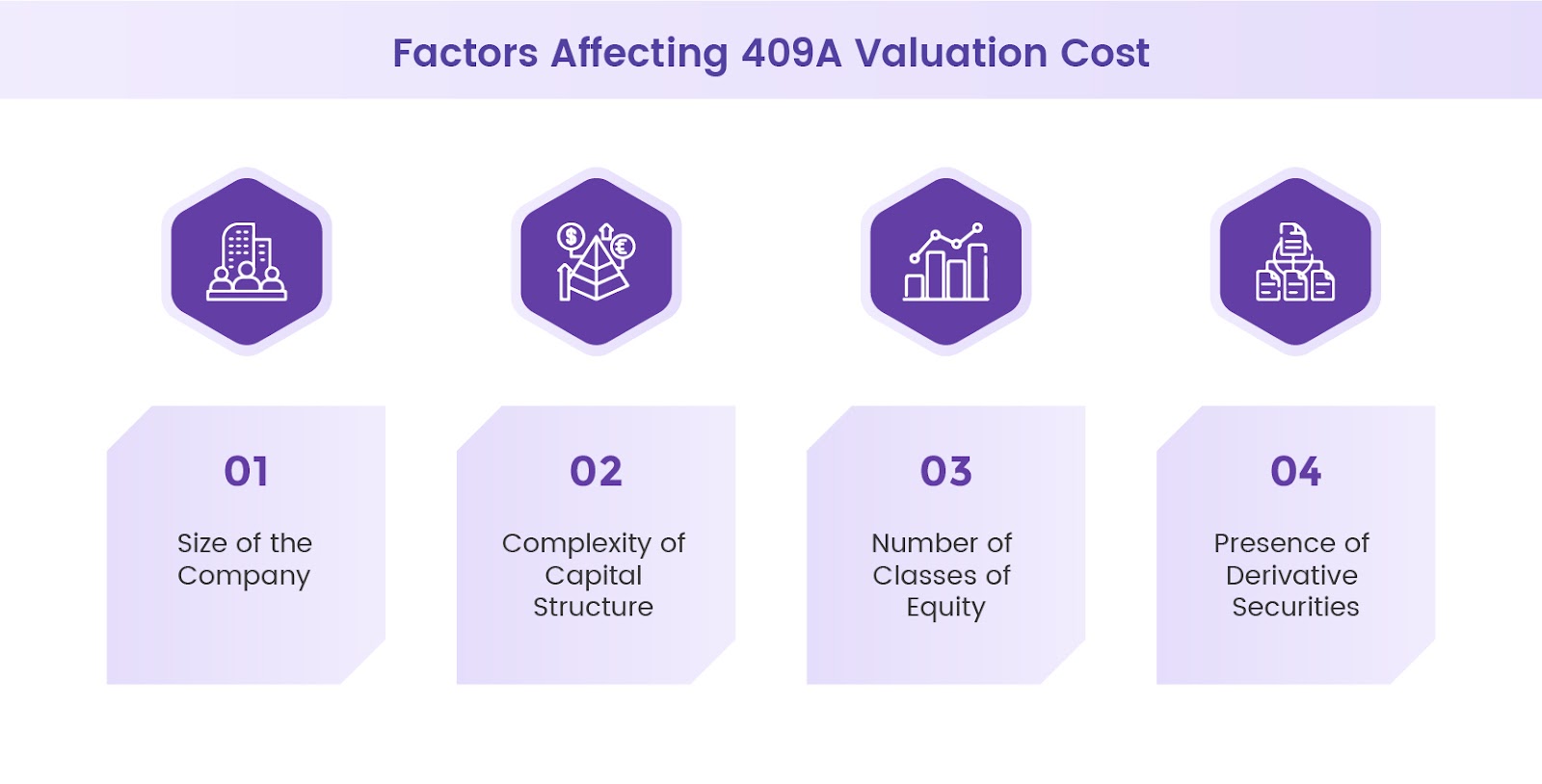
Several factors directly influence how much you would pay for a 409A valuation. Understanding these helps founders avoid surprises and plan better. Here are the factors that directly impact your 409A valuation cost:
1. Size of the Company: The size of your company plays a vital role in deciding the 409A valuation cost. Larger companies with more employees and assets would necessitate a complex valuation process, leading to higher costs.
2. Complexity of Capital Structure: The complexity of your cap table also impacts the cost. If your company has a simple capital structure with common stock and a single class of preferred stock, the valuation process is relatively simple. However, if your company has multiple classes of equity, warrants, or convertible debt, the valuation process becomes complex and costly.
3. Number of Classes of Equity: The number of equity classes in your company can affect the 409A valuation price as well. Each class of equity may have different rights and preferences, which need to be considered in the valuation process.
4. Presence of Derivative Securities: If your company has derivative securities such as warrants, convertible securities, or options, it adds a layer of complexity to the valuation process. These securities need to be valued separately, which can increase the 409A valuation cost.
5. Timing and urgency: Expedited valuations or tight deadlines may increase the overall cost.
When you pay for a professional 409A valuation, you are not just paying for a number- you are paying for accuracy, compliance and peace of mind Providers like Qapita ensure you get a comprehensive set of services:
1. Complete Expert Valuation: A team of financial experts will perform an in-depth analysis of your company's financials, market position, and future prospects. This will support you in deciding a Fair Market Value (FMV) for your company's common stock.
2. Guaranteed Safe Harbor: The IRS provides safe harbor protection for 409A valuations conducted by qualified independent appraisers. This means that when the valuation is performed correctly, the IRS is less likely to challenge it.
3. 409A Valuation Report: You will receive a detailed 409A valuation report explaining the company's valuation method, assumptions, and conclusions. This report can be used for financial reporting, tax planning, and fundraising purposes.
4. A Thorough Audit: The valuation firm will conduct an audit to ensure that the valuation complies with IRS regulations and generally accepted valuation practices. This process will help avoid any actions from the IRS due to non-compliance with rules.
To start the 409A valuation process, you must provide certain documents to the independent appraiser. These typically include
To assist you in preparing for the 409A valuation, our team of specialists has compiled a comprehensive list of necessary documents. You can access this checklist by clicking here.
You might be tempted to undertake this process yourself to save on the 409A valuation cost. However, as per IRS Section 409A, it is neither allowed nor recommended that the valuation be completed in-house. The IRS rules specify that a qualified and independent third-party appraiser must perform a 409A valuation. The appraiser must have the required credentials from the National Association of Certified Valuators and Analysts.
This requirement is in place to ensure that the valuation is unbiased and complies with the accepted standards. Here is why attempting it yourself can be risky:
1. Independence: A qualified appraiser acts as a neutral third party, free from conflicts of interest. They have the expertise to assess your company objectively, unlike internal calculations that might be biased.
2. Expertise: 409A valuations involve complex financial analysis. Qualified appraisers like Qapita use proven methods and adhere to industry standards like the Uniform Standards of Professional Appraisal Practice (USPAP). This ensures that the valuation is accurate and defensible.
If your in-house 409A valuation does not meet IRS standards, your company could face significant tax implications:
1. Tax and Penalty: In this case, ESOPs suddenly become taxable income for both the employee and the company. In addition to the tax, the IRS may impose a steep 20% penalty as well.
2. Interest Charges: You will also be responsible for paying interest on the outstanding tax amount along with the applicable penalties.
To avoid these unwanted outcomes, you must partner with a professional 409A valuation service. This will ensure IRS compliance and offer a reliable basis for informed financial decisions.
Free cap table software can be a good option for managing your company's ownership structure. But it should not be your preferred choice for a 409A valuation. Here's why:
1. Expert Guidance: A 409A valuation involves more than just entering numbers into a program. Cap table software often relies heavily on automation and may not consider the unique circumstances of your company. Qualified appraisers consider various factors like market conditions, specific situations, and recent funding rounds to complete this process. This elaborate approach ensures your valuation is accurate and defensible.
2. Safe Harbor Security: The IRS offers a safe harbor status provision for valuations conducted by qualified appraisers. This protects you from potential tax challenges down the road. Cap table software alone will be unable to achieve this status. If you do not have a safe harbor valuation under section 409A, you could end up spending valuable time and resources defending your valuation in case of an audit.
3. Overvaluation of Common Stock: Cap table software can often lead to the overvaluation of common shares. While they may meet compliance requirements, this software can inflate a private company's common stock value by up to 50%. This overvaluation of company shares can demotivate employees and defeat the purpose of having an option plan in the first place.
Choosing the right 409A valuation provider is critical to ensuring IRS compliance and avoiding costly penalties. Startups should look for an independent valuation firm with a proven track record, deep expertise in startup equity and a clear understanding of evolving regulatory requirements. Transparency around methodology, pricing and timelines is essential to avoid unexpected costs or compliance gaps.
Beyond credentials, the top 409A provider fuses expert human insight with cutting-edge technology. While automation streamlines tasks, truly robust valuations demand seasoned judgment for intricate cap tables, layered funding or complex securities, besides continuous support and crystal-clear documentation to keep you audit-proof at scale.
Here at Qapita, we take a comprehensive approach to your 409A valuation. Our experts perform a manual analysis of your company's financials, going beyond the limitations of automated software. Then, we combine our analysis with the latest tech solutions to tailor the valuation to your specific circumstances, making it more likely to withstand IRS scrutiny in the future. We have served over 1,800 clients across 40 countries.
Selecting the right partner for your 409A valuation is a critical decision. Here are some key factors to consider when evaluating a 409A valuation partner:
1. Experience: Look for valuation experts with a proven track record in conducting 409A valuations. They should have a team of analysts who understand your company stage and can adapt their methodologies accordingly.
2. Audit-readiness: A reliable 409A valuation provider should collaborate closely with your company, establishing a Fair Market Value (FMV) of your stock. As the IRS occasionally checks 409A valuations, you must choose a partner who uses USPAP-compliant methodologies). This ensures your valuation is audit-ready and minimizes the risk of future challenges.
3. Completeness of 409A Valuation Report: Do not settle for an auto-generated 409A valuation report. You should look for a comprehensive report that details the valuation methodology used, along with clear explanations for key assumptions and adjustments. This transparency allows you to understand the rationale behind the valuation and provides valuable documentation for future reference.
4. Past Case Studies: Ask potential partners for case studies that showcase their experience with companies like yours. Understanding how they have handled valuations for enterprises in your industry can give you confidence in their ability.
Remember, choosing the right valuation partner is not just about 409A valuation cost but also about ensuring expertise and strategic alignment with your business goals.
Selecting the right valuation partner is much more than looking for the best 409A valuation cost. It is about ensuring expertise and strategic alignment with your business goals, as the right partner can be a strategic tool for your company's financial decisions about ESOPs and other financial matters.
Factors such as experience, technology, audit readiness, and the completeness of the 409A valuation report play a significant role in this decision. At Qapita, we understand these complexities and offer services that cater to your specific needs. Our team of experts offers a combination of personalized assistance with a platform-based approach to cater to your valuation needs.
If you are ready to take the next step, Book A demo today!
We are here to help you navigate the complexities of 409A valuations and set your startup on the path to success.
Most companies finalize their first 409A valuation right before rolling out an ESOP or initial equity grants. Securing it early minimizes compliance risks and shields the company plus employees from tax penalties.
A 409A valuation usually requires one to three weeks. The precise duration hinges on elements like cap table complexity, business stage, and speed of providing financial and corporate data. Early-stage startups with straightforward setups often get results quicker, whereas later-stage firms with diverse equity classes need more time.
Although startups might compute an internal value estimate, a self-generated 409A valuation lacks IRS safe harbor status. IRS rules mandate an independent, qualifies third-party appraiser for compliance. Relying on an internal valuation can expose both the company and employees to significant tax penalties if audited.
A startup should ideally update it promptly after a funding round concludes, ideally within weeks, as it is a material event that alters common stock’s fair market value (FMV). A swift refresh guarantees new employee stock options use a precise, IRS-compliant FMV. This approach cuts tax penalty exposure for the company and employees.
A change in a company’s 409A valuation directly affects the strike price (also known as the exercise price) of newly issued employee stock options. If the 409A valuation increases, the strike price for future option grants will also increase. Conversely, if the valuation decreases, the strike price may be lower for new grants. Existing option grants, however, are not retroactively affected by changes in valuation.
A valuation set too high or too low risks violating IRS standards, potentially hitting employees with surprise taxes plus interest under Section 409A. Conversely, an overly high 409A valuation raises the strike price, making stock options less appealing and weakening their pull for recruiting and keeping top talent.