


 Equity management

 Equity management
- Fund management

 Fund management
 - Fund managementFund management
- Fund managementFund management




Giving a family member an interest in a limited liability company (LLC) involves decisions about value and the rights accompanying the gift. An LLC ownership transfer within a family still needs documentation showing what the recipient receives and which approvals apply.
For 2026, the federal annual gift-tax exclusion is $19,000 per recipient for qualifying gifts. Applying it to a business interest requires examining the gift’s value and eligibility. A transfer exceeding the exclusion may require reporting and use part of the donor’s available lifetime exemption, even when no immediate tax payment arises.
The guide covers family transfers alongside sales and member buyouts, explaining how valuation, governing agreements, and tax treatment affect the steps before closing.
An LLC ownership transfer moves some or all of an existing member’s interest to another person or entity. The transaction must identify the economic rights being assigned and whether the recipient will also become a member.
Those rights may include:
An assignment and admission as a member can require separate steps. Completing one does not necessarily complete the other.
The LLC owns its business assets. Its members own interests in the LLC. When a member sells an interest, the buyer acquires an ownership position in the existing entity, subject to the transaction terms and admission requirements.
The company can usually continue operating under its existing legal identity. However, contracts, licenses, financing arrangements, and the operating agreement may impose conditions on an ownership change.
An asset sale follows a different structure. The company sells specified assets, while ownership of the selling LLC may remain unchanged.
A membership interest may include rights to profits, distributions, voting, management, and access to records. The operating agreement can assign different rights to different members or classes of interests.
The distinction becomes especially important when an interest moves to an outsider. The recipient may acquire a right to distributions while needing additional approval for admission as a member. Existing transfer restrictions can also limit the assignment itself.
Before negotiating a price, confirm the rights attached to the interest and the rights the buyer expects to receive. A percentage alone gives an incomplete picture when voting power, distribution priorities, or management authority differ.
The reason for the transfer affects its structure and documentation. A sale to an outside buyer, an internal buyout, and an estate-planning transfer each raise different questions about price, approval, and ongoing involvement.
Selling an LLC may involve all members selling their interests, one member selling a stake, or the LLC selling its business assets. Define the transaction before negotiating detailed terms.
The two principal sale structures are:
A buyer considering an ownership sale will examine the entity’s liabilities, contracts, tax history, and outstanding obligations. An asset buyer will focus on the assets and liabilities included in the purchase, along with any required assignments or consents.
Ownership changes also occur when a business brings in a co-founder, admits an investor, rewards a key operator, or buys out a departing partner.
The source of the new member’s interest matters. A purchase from an existing member reduces the seller’s stake. An issuance of new interests by the LLC can dilute existing members, depending on the agreed economics.
For a departing member, address the ownership transfer separately from resignation as a manager, termination of employment, and release from personal guarantees. Those obligations may continue after the interest changes hands.
An owner may transfer an LLC interest to a trust as part of an estate plan. The transaction commonly involves an assignment to the trustee in the trustee’s representative capacity.
The operating agreement may permit certain estate-planning transfers or require consent even for a family trust. Review those provisions before signing an assignment.
The trust’s terms and tax status also matter. A transfer to a revocable trust may have different consequences from a gift to an irrevocable trust. Counsel should confirm ownership, trustee authority, succession arrangements, and any restrictions connected with the LLC’s tax election.
Family events can change ownership through a gift, divorce settlement, inheritance, or estate administration. Each route needs documentation suited to the event.
A gift may require a supportable valuation and gift-tax reporting. A divorce can involve marital-property rules and court orders. An inheritance may require estate documents and proof of the personal representative’s authority.
Receiving an economic interest through one of these routes does not automatically resolve member-admission requirements. Review the operating agreement alongside the relevant estate, family-law, or court documents.
Startup LLCs may reorganize ownership before a financing round, a new incentive arrangement, or conversion to a corporation.
Historical records matter during this work. Confirm member percentages, contributions, prior transfers, and approvals before deciding how existing interests will map into the new structure.
The restructuring may also change tax treatment. An ownership ledger supports the analysis, but the conversion documents and tax review determine how the transaction should proceed.
Review the governing documents and tax position before agreeing to a closing date. These checks identify restrictions early enough to address them in the deal terms.
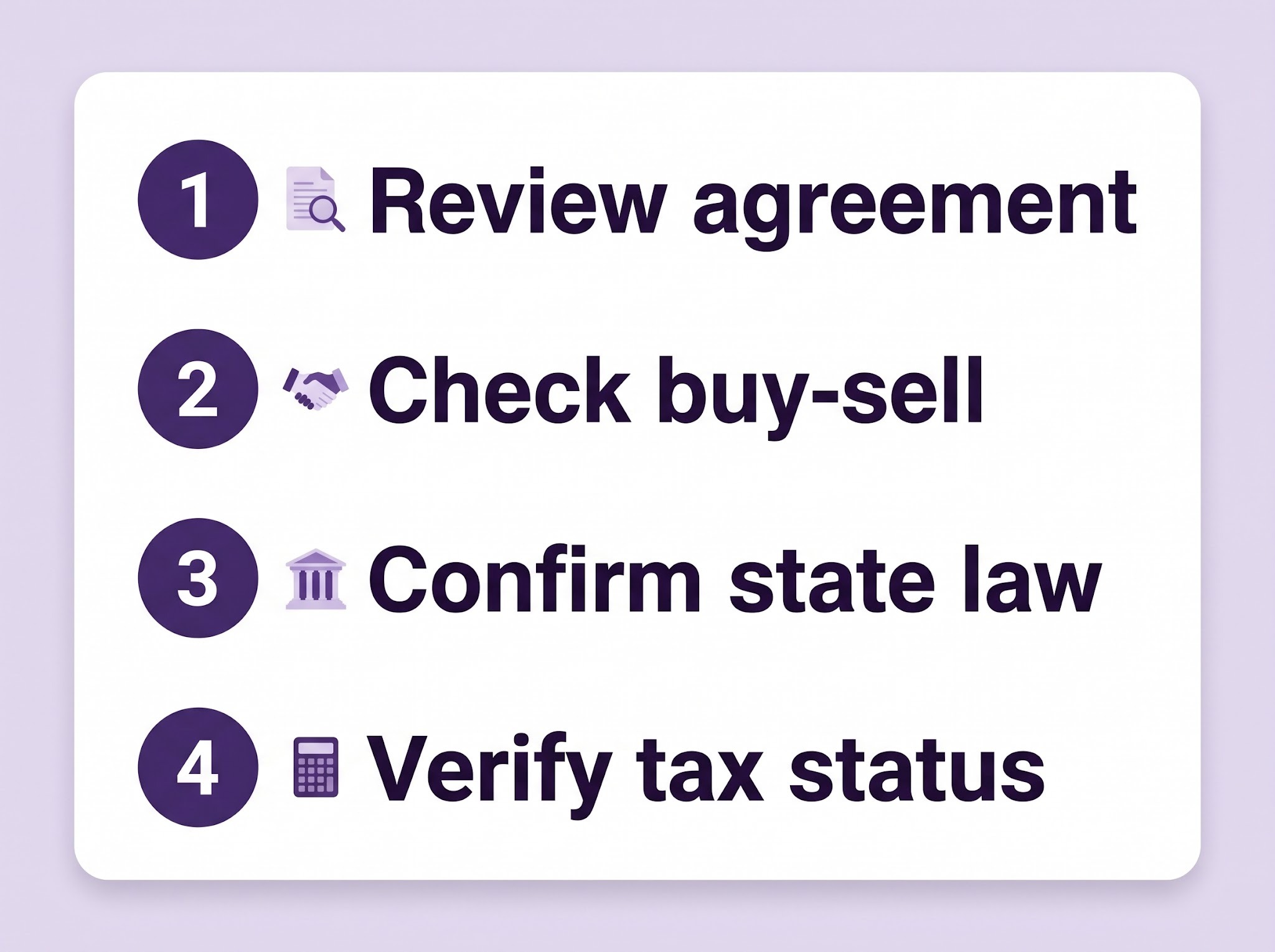
Start with the operating agreement and its amendments. As Davis Business Law’s 2025 transfer guide explains, the agreement and applicable state law govern the transfer process.
Look for:
Read the definitions as well as the operative clauses. A restriction on “transfers” may cover more than an outright sale.
Some LLCs use a separate buy-sell agreement. Others include those terms in the operating agreement. Review both documents if both exist.
Common triggering events include:
A trigger may create a purchase option, impose a mandatory buyout, or establish a valuation procedure. Check the notice requirements and deadlines before negotiating a different arrangement.
The formation state’s law generally governs the LLC’s internal affairs, including member rights and internal governance. Mandatory statutory provisions can apply even when an operating agreement addresses the issue.
Other jurisdictions may still matter. An LLC formed in Delaware and operating in Texas may have Delaware internal-governance requirements alongside Texas registrations, licenses, taxes, and contracts.
Identify the formation state, every state where the business is registered, and any regulated activities affected by the ownership change. A single filing portal may cover only part of the required work.
An LLC’s legal form and federal tax classification are separate questions. Depending on its owners and elections, an LLC may be treated as a disregarded entity, partnership, S corporation, or C corporation.
A transfer can change the number or type of owners and therefore affect the existing tax treatment. Adding a second owner to a disregarded entity or leaving a partnership-taxed LLC with one owner requires particular attention.
Remove the old assumption about automatic partnership “technical termination” after a large ownership transfer. Federal law eliminated that rule for tax years beginning after 2017. The relevant questions now concern the actual transaction, continued partnership status, and required returns.
Several transfer categories overlap. A partial transfer can also be a gift, a sale to an existing member, or an assignment to a trust. Identify both the amount transferred and the transaction’s legal structure.
A full business-ownership transfer involves all outstanding interests moving to a new owner or ownership group. A sole member might sell the entire interest, or all members might sell together.
One member selling 100% of their personal stake is a complete exit for the member. It is a full transfer of the LLC only if the stake represents all company ownership.
Document who will become a member and who will manage the business immediately after closing. This is especially important when the departing owner is the sole member or manager.
A partial transfer moves a portion of an existing member’s interest. A sole owner might sell or gift a 30% company interest and retain 70%.
Specify the units or percentage points being transferred. “Thirty percent of the company” and “30% of the seller’s interest” can produce different outcomes.
Update the ownership schedule and address the resulting voting rights, distributions, tax allocations, and member-admission requirements.
An internal buyout involves one member purchasing another member’s interest. The buyer already holds membership rights, which may simplify admission questions.
Other requirements still apply. The operating agreement may specify valuation procedures, approvals, payment terms, or purchase rights held by other members.
Document the seller’s remaining obligations and any releases. A transfer agreement between members cannot, by itself, release a seller from a lender’s personal guarantee.
An outsider may acquire an existing member’s interest or receive newly issued interests from the LLC. These transactions send the money to different recipients and may affect existing owners differently.
Address:
Record the effective date of admission so the company’s legal and tax records use a consistent timeline.
A trust transfer generally requires identifying the trustee, the trust, and the capacity in which the trustee will hold the interest.
Review permitted-transfer exceptions, consent requirements, lender restrictions, and the trust’s eligibility under any applicable tax election. A family relationship alone does not establish permission to transfer.
Keep the assignment and supporting trust documentation with the company records. The LLC may need evidence of who can act for the trust without retaining the entire estate plan.
In a redemption, the LLC purchases or redeems a member’s interest. The remaining members’ relative ownership percentages may increase as the redeemed interest is canceled.
The company’s ability to fund the payment matters. Review cash flow, distribution restrictions, financing covenants, and any installment arrangement.
A redemption can receive different tax treatment from a direct purchase by another member. Agree on the structure before calculating the seller’s expected proceeds.
An ownership sale transfers an interest in an existing entity. An asset sale transfers the assets identified in the purchase agreement. This distinction affects liabilities, consents, and tax treatment.
Table: Legal and operational differences between ownership and asset sales.
An asset purchase may limit some assumed liabilities, but successor-liability rules and other exceptions require review. Likewise, buying membership interests exposes the buyer economically to the LLC’s existing obligations without automatically making the buyer personally liable for every company debt.
This ten-step sequence covers a typical transfer. Some work happens in parallel, and required consents should be obtained before closing. Use the agreement and applicable law to establish the actual sequence.
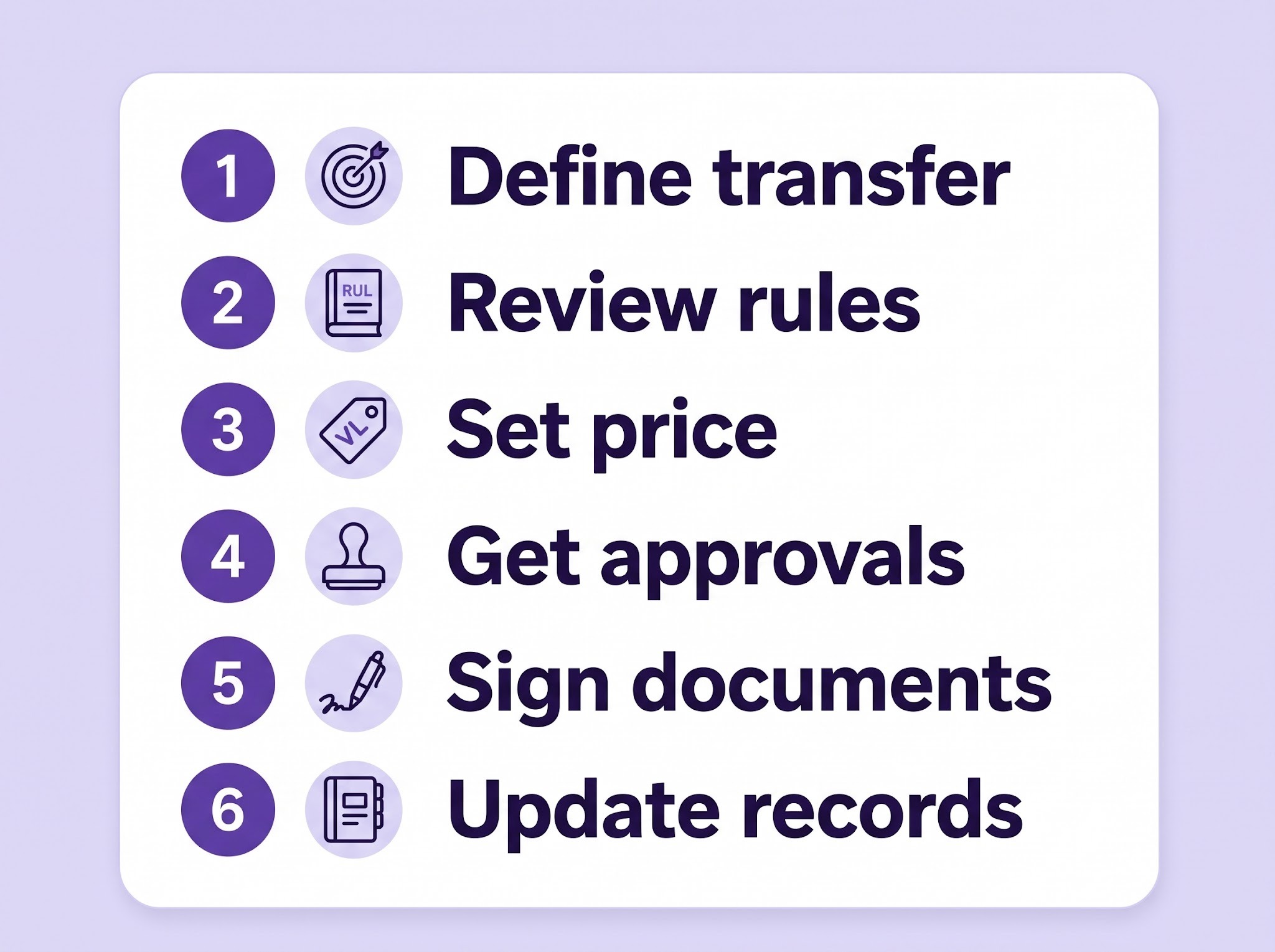
Determine whether the transaction is a full sale, partial sale, gift, trust assignment, redemption, or issuance to a new member.
Then record:
Resolve any differences between the seller’s description and the buyer’s expectations before preparing final documents.
Find the approval threshold and transfer procedure. The agreement might require unanimous member consent, a specified majority, manager consent, or another process.
Check notice periods, permitted recipients, purchase options, and rights of first refusal. Obtain any necessary waivers in writing.
A prohibited transfer may be ineffective or expose the parties to a dispute. A permitted assignment may still convey only economic rights until the recipient completes the admission process.
For an arm’s-length sale, the parties may negotiate the price. An internal buyout may follow a contractual formula or require an appraiser. A gift or estate-planning transfer may require a valuation suitable for tax reporting.
Common approaches include:
Select the approach for the transaction and interest being valued. A minority interest with transfer restrictions may require a different analysis from a controlling interest in the entire business.
Document the approvals needed for both the transfer and any new member’s admission. Written records allow the company, bank, and future buyers to verify the authority for the change.
Depending on the governing documents, the closing package may require:
A manager-managed LLC does not automatically have a board. Use the governance structure established in its documents.
The documents should reflect the agreed transaction, rights, payment, and effective date. Axley’s 2025 guidance on membership-interest sales emphasizes reviewing transfer restrictions and preparing the sale documents with legal and tax counsel.
Common documents include:
Counsel should review releases, indemnities, and any restrictive covenants for enforceability and fit.
At closing, complete the agreed payments, deliver the signed documents, and confirm satisfaction or waiver of the closing conditions.
If the buyer pays over time, document the installment schedule, interest, default remedies, and any security. State clearly when the interest transfers and who holds voting rights during the payment period.
Keep evidence of payment with the closing package. The purchase agreement, assignment, admission documents, and ownership schedule should reflect consistent effective dates.
Record the completed transaction in the systems used by the company and its advisors. Updates may include:
Coordinate capital-account and tax-basis work with the accountant. These balances are distinct from ownership percentages and should follow the applicable accounting and tax rules.
A state filing alone usually does not complete an ownership transfer. Private agreements and approvals establish the transaction, while required filings update public records.
Check whether the ownership or management change affects an annual report, statement of information, registered-agent record, or other filing. Requirements vary by state and entity details.
Review registrations outside the formation state as well. A change involving a licensed or regulated business may trigger additional approvals or notices.
Prepare the notification list early enough to obtain required consents before closing. After closing, send the agreed notices and confirm account changes.
Relevant parties may include:
Distinguish advance consent from post-closing notice. Sending a notification after the transfer cannot cure every failure to obtain prior approval.
Confirm employer identification number (EIN) requirements, tax-account changes, reporting responsibilities, and any withholding. For partnership-taxed LLCs, coordinate Schedule K-1 allocations for the year of transfer.
Beneficial ownership information (BOI) reporting also requires a precise distinction. The Financial Crimes Enforcement Network (FinCEN) announced the exemption for US-created entities in March 2025. A domestic LLC’s ownership change therefore does not, by itself, create a federal BOI filing obligation under this exemption.
Banks may still request ownership information for their own compliance. Separately review state-level requirements and any obligations involving a foreign-formed entity registered in the United States.
Use the following checklist to assemble the closing package. The transaction may require only some of these documents, and several functions may be combined in one agreement.
The core package should establish the seller’s authority, describe the transaction, and show the resulting ownership.
Additional documents depend on payment arrangements, the departing member’s roles, and the company’s contracts.
A buyer or lender may ask how the company moved from its original ownership structure to the current one. Keep the supporting documents for each change.
A current spreadsheet without signed historical assignments can leave unanswered questions. Store prior schedules, approvals, contribution records, and closing documents together.
For an LLC preparing to convert to a corporation, these records also support the mapping of existing interests into the proposed corporate capitalization.
The absence of a written operating agreement does not eliminate transfer rules. Applicable state law supplies defaults, and other enforceable agreements may also affect the transaction.
State defaults may govern assignment, admission, voting, and management rights. The outcome can differ from the arrangement the members assumed they had.
For example, a recipient may acquire economic rights while requiring further consent to become a full member. Review the actual state statute before relying on a general description.
Also check whether the state recognizes oral or implied operating agreements. A missing signed document does not necessarily mean the members have no governing agreement.
Where the members can agree, document the intended arrangement before closing. Address transfer procedures, approval thresholds, valuation, ownership, and management.
Use the amendment or adoption procedure permitted by applicable law and existing agreements. A new document cannot simply override unresolved rights held by another member.
If the members disagree about ownership or consent, resolve the dispute before presenting the transfer as complete.
A sole owner may have fewer internal approvals to obtain, but a sale still needs a clear record of the interest transferred and the incoming owner’s admission.
Prepare the assignment or purchase agreement, update the ownership record, and review tax treatment. Address management authority, bank access, contracts, licenses, and any personal guarantees separately.
The transfer should leave the company with an identifiable owner and authorized management immediately after closing.
Review these issues while negotiating the transaction. They can affect the price, closing conditions, and amount each party ultimately receives.
Ownership changes can affect rights beyond the operating agreement. Review:
In an ownership sale, the LLC generally remains responsible for its existing obligations. The buyer should examine those obligations during diligence and negotiate appropriate protections.
The tax result depends on the entity’s classification and the structure of the transfer. Review:
For partnership-taxed LLCs, Internal Revenue Service Publication 541, revised December 2025, explains how an interest sale can include capital gain or loss and ordinary-income components associated with certain underlying assets. A seller’s reduction in partnership liabilities can also affect the amount realized.
Have the accountant calculate the result from the transaction documents. The cash purchase price alone may not capture the full tax consequences.
Valuation supports negotiations, contractual buyouts, tax reporting, and dispute prevention. Start by identifying what the valuation must establish and whose rights it measures.
The transaction’s purpose affects the appropriate standard and process.
The value of the entire business may differ from the value of a particular membership interest. Control, transfer restrictions, and distribution rights can affect the analysis.
An appraiser or buyer will generally examine the company’s financial performance and the durability of its future earnings.
Relevant inputs include:
A consulting business dependent on one founder’s relationships presents different risks from a software-as-a-service business with recurring revenue and transferable customer contracts.
Explain those differences in the valuation assumptions rather than applying an industry multiple without adjustment.
Company value, member capital accounts, and a member’s tax basis measure different things. They should not be treated as interchangeable.
Debt affects the value available to owners and may also affect an individual member’s tax calculation. Distribution priorities can change how proceeds are divided.
Two members holding the same percentage may therefore receive different net amounts. Reconcile the ownership percentage with the operating agreement’s distribution provisions and the accountant’s transaction calculations.
A partial sale and a new issuance can produce similar-looking ownership schedules through different transactions. Keep the percentage calculation connected to the source of the interest and the destination of the payment.
Assume Alex owns 70% of an LLC and Jordan owns 30%. Alex sells a 20-percentage-point interest in the company to Priya.
Table: A sale of 20 percentage points transfers ownership from Alex to Priya.
The wording matters. Selling 20% of Alex’s existing 70% stake would transfer 14 percentage points. Alex would retain 56%, Jordan 30%, and Priya 14%.
The documents should identify the intended calculation. Then update the ownership schedule, voting provisions, distribution rights, and applicable tax allocations.
A new member may contribute capital to the LLC in exchange for newly issued interests. The company receives the money, and existing members may experience dilution under the agreed terms.
For example, if Priya receives 20% after a new issuance and Alex and Jordan dilute proportionally, their original 70% and 30% positions become 56% and 24%.
It differs from Alex selling Priya a 20-percentage-point interest, where Jordan’s 30% remains unchanged.
The distinction is:
Record the same units, percentages, classes, and effective dates across the transfer documents and membership ledger.
The accountant should separately determine capital-account treatment, tax basis, and reporting allocations. Avoid changing those balances simply to make them resemble ownership percentages.
If a corporate conversion and financing are planned, cap table management software can support the resulting corporate ownership records and financing models. Confirm support for the particular LLC structure and instruments before selecting a system.
The closing documents establish the transaction. Post-closing work puts the new ownership into operation and gives the people responsible for reporting a consistent record.
Keep the completed closing package with the records it changes.
Retain historical versions. Replacing an old schedule without preserving it can make later ownership reconstruction harder.
Several external systems may continue showing the departing owner until someone updates them.
Remove obsolete access when the transition permits it. Continuing access should reflect an agreed transition role.
Employees, customers, vendors, lenders, and landlords may need different information about the transfer.
A routine minority-interest transfer may require limited communication. A full sale involving new management may require a clearer explanation of decision-making authority, payment instructions, and operational contacts.
Use a documented communication plan. Confirm who sends each notice and keep evidence where a contract requires delivery.
Most avoidable problems arise when the documents, rights, and operational changes describe different transactions. Review the following issues before treating the transfer as complete.
Mistake 1: Treating the transfer as just a form. A state filing rarely establishes every aspect of a transfer. The assignment, required approvals, and admission documents must support the ownership change.
Mistake 2: Ignoring transfer restrictions. Review notice requirements, purchase rights, permitted recipients, and consent thresholds. A buyer’s payment does not resolve a prohibited assignment or incomplete admission.
Mistake 3: Forgetting tax classification. A partnership-taxed LLC, disregarded entity, and corporation-taxed LLC can produce different consequences from similar-looking transactions. Confirm the existing classification and any change caused by closing.
Mistake 4: Skipping the operating agreement update. An outdated ownership schedule can contradict the assignment and create uncertainty during future diligence. Update the documents required by the agreement while preserving prior versions.
Mistake 5: Mixing asset-sale and ownership-sale concepts. State exactly what the buyer acquires and which obligations each party retains. The distinction affects consent, liability allocation, and tax treatment.
Mistake 6: Relying on a spreadsheet without supporting records. A spreadsheet can work for a simple structure when someone maintains it carefully. Problems arise when it loses the connection to signed documents, approvals, and transaction history. Review the connection before fundraising or conversion adds complexity.
Before closing, confirm the interest, recipient, approvals, price, and tax treatment. After closing, check whether the new owner can exercise the intended rights and whether the company’s records support those rights.
Assign responsibility for outstanding filings, bank changes, tax allocations, and contractual notices. Each item should have an owner and a due date.
A useful final test is whether the company could explain the transaction to a buyer, bank, or accountant using its retained documents. If the explanation depends on someone remembering an undocumented agreement, the closing package needs more work.
If an LLC transfer is part of a planned conversion to a corporation, Qapita can support the corporate equity work following that transition. Its tools help teams organize capitalization data, model financing scenarios, and maintain ownership history. Confirm the treatment of your existing LLC interests with Qapita and your advisors before implementation.
Relevant capabilities include:
Book a demo to learn more about preparing corporate ownership records for the financing plans which follow your transfer.
These answers address common transfer questions. The operating agreement, applicable law, and transaction facts determine the final requirements.
Yes, subject to the operating agreement and applicable law. The transaction usually transfers a membership interest. The recipient may need separate approval for admission as a member with voting or management rights. Document both the assignment and any required admission.
Review the governing documents, define the interest and rights being transferred, and obtain required approvals. Prepare and sign the transaction documents, complete payment, and update the ownership records. Address state filings, tax reporting, contracts, and account access where applicable.
Yes. You may sell membership interests or arrange for the LLC to sell business assets. An interest sale changes ownership of the entity. An asset sale transfers specified assets and may leave ownership of the selling LLC unchanged. Compare the legal and tax consequences before choosing.
Document the transfer of the sole member’s interest and the incoming owner’s admission. Establish who will manage the company after closing. Review tax treatment, EIN requirements, bank authority, licenses, and contractual consents. A sole owner’s exit should not leave the company’s membership or authority unclear.
Percentages can change through a transfer between members, a sale to an outsider, a redemption, or an issuance of new interests. Specify units or company percentage points, then update the ownership schedule. Have the accountant determine the related capital-account and tax-allocation treatment.
Requirements vary. Some ownership changes require no separate transfer filing, while changes to publicly reported managers, members, or other information may require an update. Check the formation state and other relevant registrations. Private transfer and admission documents remain necessary even when a public filing is required.
Applicable state defaults govern issues the members have not validly addressed. Other enforceable agreements may also matter. Review assignment and admission rules before proceeding. Where possible, document the intended arrangement through a properly adopted operating agreement before the transfer.
Often, yes, subject to transfer restrictions and any necessary approvals. Identify the trustee and representative capacity in the assignment. Review the trust’s tax status, the LLC’s tax election, and any lender restrictions. The transaction may require valuation and estate-planning advice.
Sometimes. The answer depends on the existing tax classification and the transaction’s effect on the entity and its owners. A change in the responsible party and a requirement for a new EIN are separate questions. Have the accountant check both before changing tax accounts.
The core package commonly includes the operating agreement, purchase or gift documentation, an assignment, required written consents, and an updated ownership schedule. A joinder or amendment may establish the new member’s rights. Installment payments, releases, third-party consents, and required filings can add documents.