

 Equity management

 Equity management
- Fund management

 Fund management
 - Fund managementFund management
- Fund managementFund management




Purchase price allocation is the process of breaking down an acquisition price after a deal closes.
When a buyer acquires a company, the full price paid cannot be recorded as a single asset. It has to be assigned to what the buyer actually received, such as cash, receivables, inventory, equipment, customer relationships, technology, contracts, brand value, and liabilities taken over.
The remaining value is recorded as goodwill. Goodwill usually represents the portion of the purchase price that cannot be attributed to any specific asset, such as expected synergies, future growth potential, or the value of the assembled business.
Before you get into the calculation, there are a few key components you should know. These are the buckets a buyer uses to break down the total purchase price after an acquisition.
Purchase price allocation does more than record an acquisition. It can affect the buyer’s future earnings, tax position, audit review, and goodwill impairment risk.
For example, when more value is assigned to customer relationships, technology, or contracts, the buyer may have to record amortization expense in future periods. When more value is left in goodwill, the allocation may attract closer audit review and create future impairment risk.
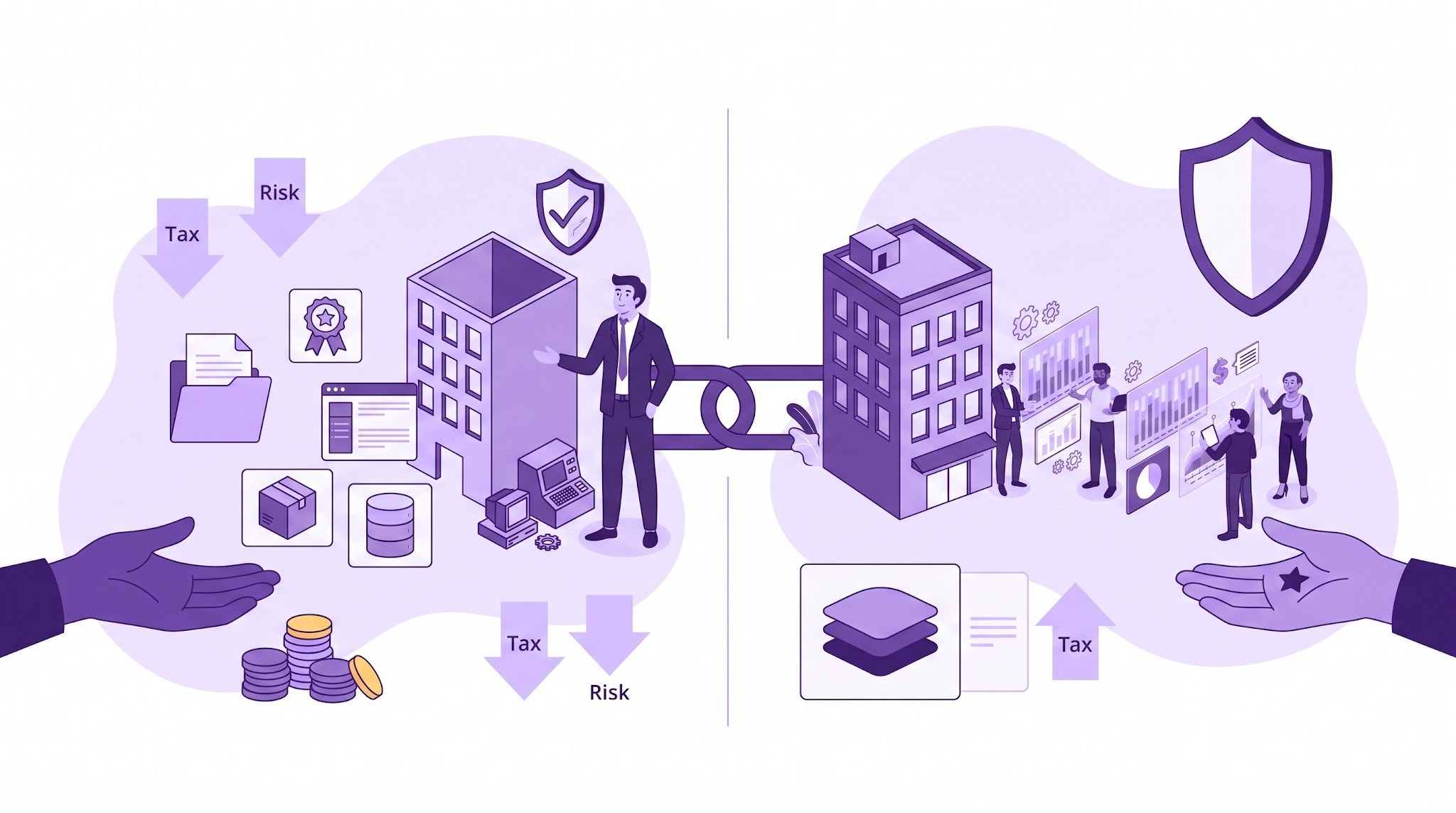
In asset deals, the allocation can also affect taxes. Buyers usually prefer allocations that support faster depreciation or amortization benefits. Sellers may prefer allocations that reduce taxable gains.
That is why PPA should not be handled only after the deal is signed. The assumptions behind the allocation can influence the purchase agreement, financial reporting, and future tax treatment.
Purchase price allocation follows a clear sequence:
Let us understand each step in detail:
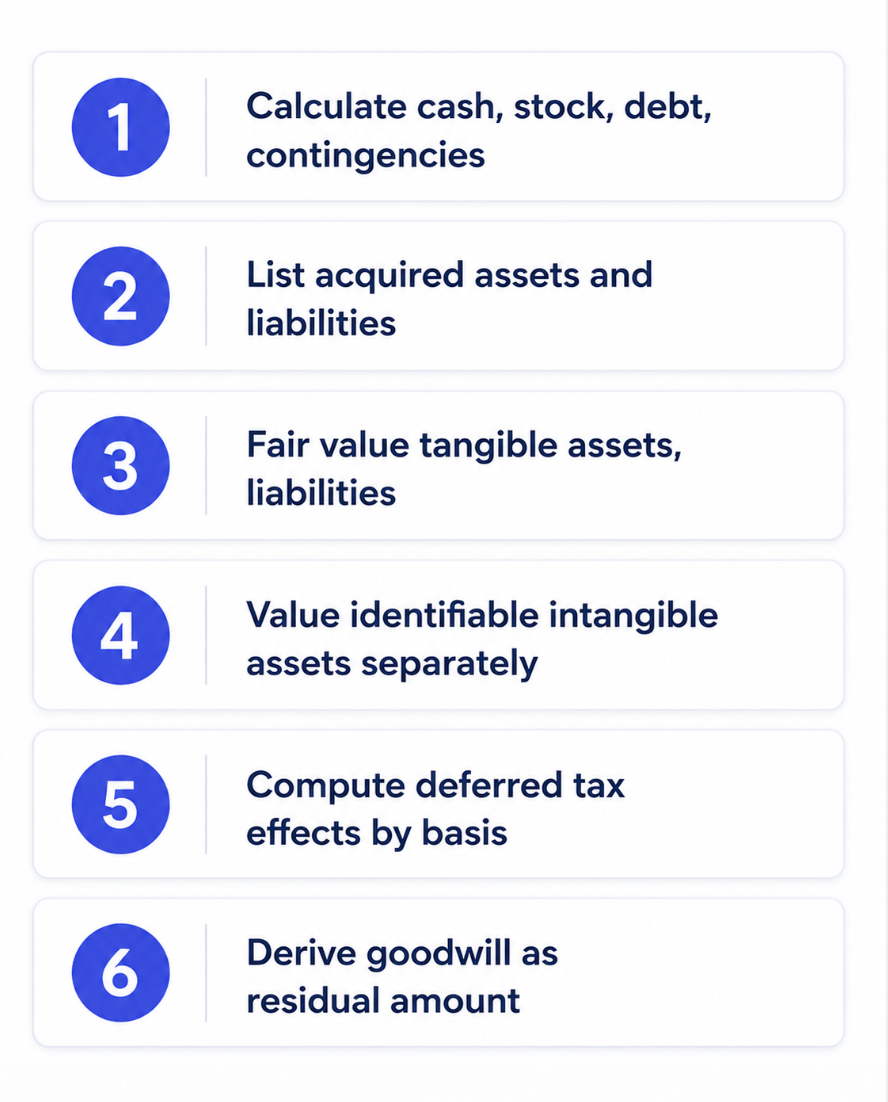
Start by calculating the total value transferred to acquire the business. This includes the cash paid at closing, stock issued, assumed debt, deferred payments, earnouts, and any other consideration agreed to in the transaction.
This step matters because the purchase consideration serves as the starting point for allocation. If the buyer misses contingent payments, assumed debt, or other deal components, the entire allocation can be understated.
Next, list everything the buyer acquired and every obligation it took over. This includes cash, receivables, inventory, fixed assets, customer contracts, technology, leases, debt, payables, deferred revenue, and contingent liabilities.
The goal is to create a complete recognition list before valuation begins. If an asset or liability is missed at this stage, it may incorrectly flow into goodwill later.
Once the asset and liability list is complete, the buyer measures tangible assets and assumed liabilities at fair value on the acquisition date.
This usually includes items such as cash, receivables, inventory, property, equipment, debt, leases, and other obligations. Some balances may be close to book value, while others may need fair value adjustments.
The buyer then identifies and values intangible assets that can be recognized separately from goodwill. Common examples include customer relationships, developed technology, software, trademarks, licenses, contracts, and order backlog.
This is one of the most important parts of purchase price allocation. If valuable intangible assets are not identified properly, too much value may be pushed into goodwill.
Fair value adjustments can create differences between book value and tax basis. When that happens, the buyer may need to record deferred tax assets or deferred tax liabilities.
For example, if an asset is stepped up for accounting purposes but its tax basis does not change, the buyer may record a deferred tax liability. This step helps connect the accounting allocation with future tax consequences.
After all identifiable assets and liabilities are measured, the buyer calculates the residual amount.
If the purchase consideration exceeds the fair value of net identifiable assets, the difference is recorded as goodwill. If the fair value of net identifiable assets exceeds the purchase consideration, the buyer may recognize a bargain purchase gain.
Goodwill should come last in the process. It should not be used as a shortcut for assets or liabilities that were not properly identified earlier.
Purchase consideration is the total value the buyer gives up to acquire the business.
It can include cash paid at closing, buyer shares issued to sellers, assumed debt, deferred payments, earnouts, contingent consideration, and the fair value of any stake the buyer already held before gaining control.
This matters because the deal value used for PPA is not always the cash paid on closing day. If earnouts, assumed debt, or equity consideration are missed, the allocation can be incorrect.
One of the hardest parts of purchase price allocation is deciding what should be recorded separately from goodwill.
An intangible asset can usually be identified separately if it meets either of these conditions:
Common identifiable intangible assets include:
This step matters because these assets may create future amortization expense. If they are missed, too much value may end up in goodwill, which can lead to auditor questions and weaker support for the allocation.
Goodwill is calculated after the buyer has measured the fair value of identifiable assets and liabilities.
For a simple acquisition, the formula is:
Goodwill = Purchase consideration - Fair value of net identifiable assets
Net identifiable assets means the fair value of identifiable assets acquired, minus the liabilities assumed.
For example, if the buyer pays $100 million and the fair value of net identifiable assets is $67 million, the goodwill recorded is $33 million.
For more complex acquisitions, the formula may also include non-controlling interest and any stake the buyer already held before gaining control:
Goodwill = Consideration transferred + Non-controlling interest + Fair value of previously held equity interest - Fair value of net identifiable assets
If the result is positive, the buyer records goodwill.
If the fair value of net identifiable assets exceeds the purchase consideration, the buyer may recognize a bargain purchase gain instead.
Assume a buyer acquires a company for $100 million. The full amount does not automatically become goodwill. The buyer first has to assign fair value to the assets acquired and liabilities assumed.
Here is how the allocation could look:
In this example, the buyer identifies $85 million of assets and assumes $18 million of liabilities. That leaves $67 million in identifiable net assets.
Since the buyer paid $100 million, the remaining amount is recorded as goodwill.
Goodwill = Purchase consideration - Fair value of identifiable net assets
Goodwill = $100 million - $67 million = $33 million
The $33 million goodwill may represent expected synergies, future growth, market access, assembled workforce value, or other benefits that cannot be recorded as separate identifiable assets.
This is why purchase price allocation matters. If the buyer misses an intangible asset, such as developed technology, customer relationships, or brand value, goodwill may be overstated. That can create problems during audit review and future impairment testing.
Deferred tax arises when the accounting value of an asset or liability is different from its tax value. The company does not pay or recover that tax immediately, but it may need to record the future tax effect in its financial statements.
Fair value is the price at which an asset or liability would be measured on the acquisition date. In purchase price allocation, the buyer does not simply use the target’s old book values. It measures the acquired assets and assumed liabilities at fair value.
Sometimes this results in a fair value write-up. For example, the target may have recorded developed technology at a low book value, but the buyer may assign a higher fair value to it during PPA.
If the accounting value increases but the tax basis does not, a book-tax difference is created. That difference can result in a deferred tax liability.
A simplified way to understand this is:
Deferred tax liability = fair value write-up × applicable tax rate
Note that this formula is only a shorthand. The actual calculation depends on the asset, jurisdiction, tax basis, and applicable tax rules.
The same purchase price can lead to different tax outcomes depending on whether the transaction is structured as an asset deal or a stock deal.
In an asset deal, the buyer acquires specific assets and assumes specific liabilities. This can give the buyer a new tax basis in the acquired assets, which may affect future depreciation and amortization.
In a stock deal, the buyer acquires ownership in the target company. The assets and liabilities may still be measured at fair value for financial reporting, but the tax basis may not step up in the same way unless a special election or local tax rule applies.
Accounting allocation and tax allocation may differ. The buyer may record assets at fair value in the financial statements, whereas the tax treatment is based on a different basis.
Each allocation decision changes how the acquisition appears in future reporting. A higher value assigned to customer relationships, technology, or fixed assets can create future amortization or depreciation. A higher amount left in goodwill can increase the risk of impairment.
On the balance sheet, the buyer records the acquired assets and assumed liabilities at fair value. This can also create new intangible assets, such as customer relationships, developed technology, brand value, contracts, or licenses.
On the income statement, some allocated assets create future expenses. For example,
Goodwill is treated differently. It is not amortized under IFRS and US GAAP, but it may need impairment testing. If the acquired business underperforms, the buyer may have to reduce the goodwill value later.
This is why PPA affects more than the opening balance sheet. The allocation can shape reported earnings, audit review, and impairment risk for years after the acquisition.
Purchase price allocation is easier when the finance team has the deal records ready before the valuation work starts.
Use this checklist before starting PPA:
Most PPA mistakes are avoidable if finance, tax, valuation, and deal teams align early.
Not every premium paid in an acquisition should automatically be recognized as goodwill.
Customer relationships, developed technology, software, trademarks, licenses, contracts, and backlog may need to be valued separately.
If these assets are missed, goodwill may be overstated, and the allocation may attract auditor scrutiny.
The target’s balance sheet may not reflect the fair value of acquired assets.
Internally developed software, customer relationships, or brand value may be recorded at low or no book value but still carry meaningful economic value.
PPA requires acquisition-date fair value along with the target’s existing book value.
Finite-life intangible assets are amortized over their useful lives. If the useful life is too short, expenses may be overstated in the early years. If it is too long, earnings may be overstated.
Useful life assumptions should be supported by customer retention, contract terms, technology cycles, churn, and expected economic benefit.
The accounting allocation and tax allocation may not always be the same.
Book values are prepared for financial reporting, while tax allocations follow tax rules and deal structure.
Confusing the two can create reconciliation issues and reporting inconsistencies later.
By the time the audit begins, key assumptions may already be embedded in the purchase agreement, valuation model, or closing schedules.
PPA should be considered along with deal planning.
Valuing customer relationships, technology, brands, earnouts, and deferred tax effects can involve significant judgment.
When the deal includes complex intangibles or contingent consideration, external valuation and tax support can help make the allocation more defensible.
Qapita helps finance teams keep these equity and valuation records organized before a transaction. While the PPA itself should be handled with accounting, valuation, tax, and audit advisors, Qapita gives teams a cleaner record base to work from when acquisition questions begin.
Book a demo to see how Qapita can help your team keep equity and valuation records audit-ready.
PPA is usually led by the buyer's finance team, working with valuation specialists, tax advisors, accountants, and auditors. Complex deals, especially those with unusual intangibles or deal structures, often require external valuation support.
PPA is required when the transaction qualifies as a business combination under applicable accounting standards. Simple asset purchases may follow different accounting treatment.
The timeline depends on deal complexity, asset types, data quality, and audit requirements. Deals with complex intangibles, earnouts, tax issues, or equity-linked consideration usually take longer.