


 Equity management

 Equity management
- Fund management

 Fund management
 - Fund managementFund management
- Fund managementFund management




Special Purpose Vehicles (SPVs) have become a foundational instrument in modern private investment management. While traditional fund structures such as private equity funds, venture capital funds, or hedge funds have served investors well for decades, but they operate within inherent constraints including strict concentration limits, predetermined investment thesis, fixed deployment schedules, statutory limits on investor capacity; limiting flexibility in execution and opportunity capture.
Picture This: Your fund is fully deployed, and your next fund's first close is still a few weeks away. A breakthrough Series A opportunity lands on your desk. The problem? You have no dry powder, and your LPs aren't committed to Fund II yet. You could watch it walk away, or you could use an SPV. One legal entity. Clean. Simple. Effective. This guide shows you how.
In venture capital and private equity, a good deal rarely waits for your fund structure to catch up. In these situations, SPVs offer a great workaround: a focused, time-bound vehicle built to capture one specific opportunity without rewriting your entire fund strategy.
SPVs serve distinct constituencies within the investment ecosystem, each with differentiated objectives that traditional fund structures cannot efficiently address. Understanding the specific use case is prerequisite to appropriate structure and governance design.
At its core, a fund SPV is a separate legal entity (commonly an LLC or LP) set up to hold a specific investment or a group of assets, with capital pooled from investors under clearly defined economics. It sits alongside, not inside, your main fund, isolating risk and economics to that deal.
Three common use cases dominate the VC/PE world:
The lifecycle starts with one crucial decision: where and how to form the SPV. In many VC/PE transactions, onshore SPVs are formed as Delaware LLCs or LPs for US‑centric deals, while Cayman, BVI, Luxembourg, or other jurisdictions are used to accommodate cross‑border investors or optimize tax outcomes.
Choosing a jurisdiction affects tax, regulatory, and banking aspects, so most GPs align jurisdictions with their LP base and underlying asset.
Entities are typically structured as:
Focusing now on the core documentation includes the operating agreement or LPA (governance & economics), a PPM or deal memo (risks and terms), and subscription documents (investor commitments and representations).
Consider the fees and charges, there’s one-time setup or admin fee, a management fee and then a carried interest, ideally 10-25% after the hurdle rate; which feels like a mini fund.
Jurisdictions with favourable regimes can deliver tax advantages but trigger additional reporting regimes such as FATCA, CFC rules, and local substance requirements.
Once the structure is fixed on paper, the SPV lives or dies on execution: can you raise and close commitments quickly enough to hit the company’s timeline? Sponsors typically assemble a target list of LPs (existing fund LPs, family offices, syndicate members, or angels) and share a focused data room with deck, terms, and timeline.
Commitments are usually soft agreed first, then formalized via subscription agreements with defined minimums. Onboarding is where the operational stack matters.
Investors must clear KYC/AML checks, which now often integrate with digital tools to validate identity, source of funds, and sanctions exposure, especially given tightening global standards for private funds.
In parallel, the SPV obtains its tax ID (such as an EIN in the US), opens a dedicated bank account or virtual account, and defines wiring instructions. A well-run SPV can accept commitments, complete KYC/AML, and fully fund in a couple of weeks, while poorly organized processes can stretch timelines and jeopardize the deal.
After funding, the SPV executes its investment, typically as a single capital-call into the target company or asset. Unlike traditional funds that call capital over the years, most SPVs either require funding upfront or use one or two capital calls, simplifying planning for both sponsor and investors. This “single drawdown” model is a key reason SPVs are perceived as operationally lighter than full funds.
SPVs has an ongoing responsibility to:
The payoff phase is where the SPV’s focused design shows. In the cleanest scenario, there is a single liquidity event i.e. an M&A sale or IPO, where the SPV sells its entire position and receives cash or listed securities in return. By consolidating investors into one SPV entity, the target company’s legal team has fewer signatures to manage at closing.
Other scenarios are more nuanced:
Once the exit proceeds hit the SPV’s account, the distribution waterfall kicks in. In many GP-led SPVs, the sequence looks roughly like this: a return on capital to investors, any preferred return, then a catch-up to the sponsor, followed by the agreed profit split (e.g., 80/20) on remaining gains between investors and GP/ Sponsor. The simplicity of a single-asset waterfall is one of the big appeals for LPs i.e. no complex cross‑subsidization between winners and losers.
Tax comes next: the SPV (and its administrator or accountant) must allocate income and gains to investors and provide the right tax forms (such as K‑1s for US pass‑through vehicles). Only after all the distributions are made, final filings are completed, and all the residual cash or claims are resolved then the SPV be dissolved. A disciplined wind‑down includes closing bank accounts, terminating service agreements, and documenting final resolutions, so there are no “zombie entities” a decade later.
SPVs provides a flexible, deal-specific investment interface that contrasts with the diversified, long-term nature of traditional funds, allowing investors to target high-conviction opportunities without broad commitments. Here’s how SPV differs from traditional funds.
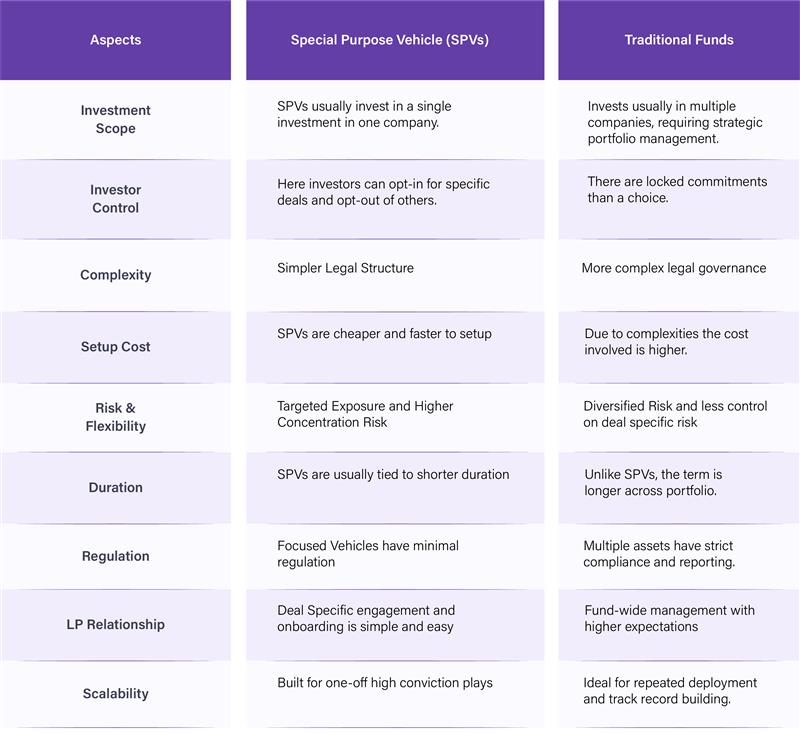
In summary, while SPVs excel in speed, selectivity and cost efficiency for singular high-conviction bets, traditional funds provide superior diversification, scale and professional management across extended portfolios.
SPVs are simpler than traditional funds, but not simple enough to run on a DIY mode. Some common pitfalls include;
Here’s the 8 best‑practice checklist for fund SPVs:
Handled thoughtfully, an SPV is more than a sidecar, it is a repeatable, scalable building block in your GP toolkit, letting you say “yes” to more great deals without waiting for the perfect fund structure to exist.
SPVs offer a flexible tool for efficiently generating targeted returns, balancing innovation with safeguards such as waterfalls and first-loss layers. If used transparently, they are vital for the success of private equity and venture capital finance. As the operational load around cap tables, investor reporting, and distributions grows, many sponsors turn to dedicated equity management platforms and services to keep SPV administration accurate and audit-ready, rather than managing it through spreadsheets and email.
SPVs are often set up by GPs of existing funds, emerging managers, experienced angel investors, syndicate leads, and family offices that have access to proprietary deals but want a clean structure for external capital.
The main use cases are sidecars to increase exposure to a company beyond fund limits, co‑invest SPVs for LPs who want to participate on specific deals, and secondary or continuation SPVs to buy or roll existing positions into a fresh vehicle.
LPs get targeted exposure to specific companies or assets, often alongside a GP they trust, without committing to an entire fund. They can dial up exposure to sectors or stages they like and decline deals that do not fit their own thesis or risk appetite.
Common documents include an operating agreement or LPA (governance and economics), a private placement memorandum or deal memo (risks and terms), and subscription agreements (investor commitments and representations). Some sponsors also use side letters for bespoke terms with specific investors.
There is no single standard, but many SPVs follow a quarterly or semi‑annual reporting cadence, with ad‑hoc updates around material events (new funding rounds, major valuation changes, or exits). Digital portals that consolidate documents, metrics, and notices are increasingly common.








-T.jpeg)