

 Equity management

 Equity management
- Fund management

 Fund management
 - Fund managementFund management
- Fund managementFund management



A B2B business model defines how a company sells to other organizations and earns revenue. It covers the buyer, the offer, the pricing structure, the sales path, and the revenue source. The customer is always a business, one with multiple stakeholders, formal procurement steps, and defined budgets.
B2B sits alongside several other commercial models:
Here is how B2B and B2C compare across the factors that matter most.
A B2B business model defines how a company sells to other organizations and earns revenue. The customer is always a business, one with multiple stakeholders, formal procurement steps, and defined budgets.
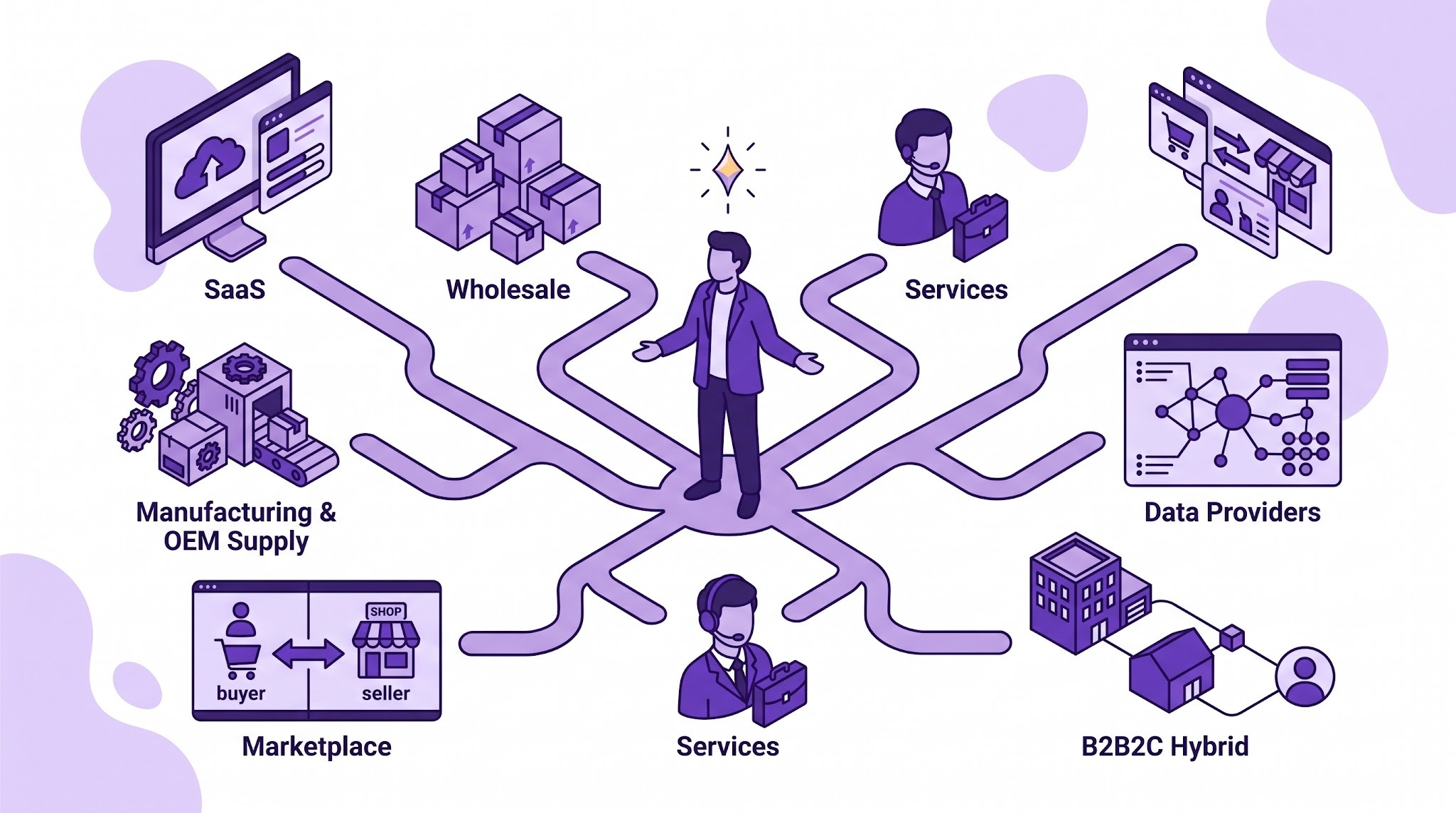
Here is a quick overview of all seven models before we break each one down.
B2B SaaS is software sold on a subscription or usage basis to business customers, delivered over the internet rather than installed on-premise.
How it works: You build software once and sell access to many business customers. Revenue is recurring, usually recognized over the contract term, and growth depends heavily on retention and expansion.
Example: Salesforce sells its CRM and cloud products as subscription licenses, priced by edition, user count, and product tier.
Revenue and pricing model: Common patterns include per-user or per-seat pricing, tiered plans with feature bundles, and usage-based pricing tied to API calls or data volume.
Best for: Software founders at seed through Series C who want predictable, recurring revenue and can invest in product and customer success.
Key challenge: Churn directly hits future cash flow, so you carry a real customer success burden to drive adoption and renewals. Modeling how ARR growth and dilution interact matters here, and clean fundraise modelling helps you show investors the full picture.
Wholesale and distribution means buying products in volume and reselling them to other businesses, earning a margin on the difference.
How it works: You act as the link between manufacturers and business buyers, holding inventory and ensuring availability and short lead times.
Example: W.W. Grainger is a broad-line distributor of maintenance, repair, and operating products serving businesses and institutions across North America.
Revenue and pricing model: Revenue comes from product sales, priced through per-unit prices, volume discounts, and contractual agreements. You earn gross margin on the spread between acquisition cost and selling price.
Best for: Founders moving physical goods at scale who can manage logistics and supplier relationships.
Key challenge: Margins are often thin, and you carry inventory risk, including carrying costs and obsolescence.
OEM supply means producing components or finished goods and selling them to other businesses that build them into their own products.
How it works: You produce at scale and sell to OEMs, assemblers, or brands, often under long-term supply agreements.
Example: Intel served as the primary chip supplier for Apple's Mac line for over a decade before Apple began transitioning to its own silicon designs in late 2020.
Revenue and pricing model: Revenue typically comes from contracts and per-unit pricing, frequently tied to multi-year supply commitments.
Best for: Component and hardware makers with the capital to build and run production.
Key challenge: Capital intensity is high, and customer concentration is a real risk. When a few large buyers drive most of your revenue, losing one can materially hurt the business.
A B2B marketplace is a platform that connects business buyers and sellers and earns money from the transactions it enables.
How it works: You build a two-sided platform, bring supply and demand together, and take a cut or a fee for facilitating trade.
Example: Faire operates an online marketplace connecting independent brands and retailers, letting retailers purchase wholesale goods through a central platform.
Revenue and pricing model: Marketplaces typically earn through transaction commissions, listing fees, and subscription plans with enhanced features or lower fees.
Best for: Founders who can aggregate fragmented supply and demand in a specific industry.
Key challenge: The chicken-and-egg problem. You need sellers to attract buyers and buyers to attract sellers, and getting both sides moving at once is hard.
Professional and managed services means selling expertise and ongoing support to business clients, billed by project, retainer, or time.
How it works: You solve specific client problems with people, whether through consulting, implementation, or ongoing managed support.
Example: Cognizant Technology Solutions offers IT consulting, systems integration, and managed services to enterprise clients across the US and globally.
Revenue and pricing model: Common structures include fixed-fee projects, time-and-materials billing, and recurring retainer or managed services contracts.
Best for: Expertise-led teams that can deliver measurable outcomes for clients.
Key challenge: The model is largely headcount-bound, so revenue scales with billable staff and margins compress as labor costs rise. Buyers here expect you to prove quantified value more literally than in any other model.
A data and analytics provider sells access to proprietary data and the tools to use it, usually to sales, marketing, or finance teams.
How it works: You build and maintain a valuable data asset, then sell access through a platform or API.
Example: ZoomInfo provides a cloud-based platform of business contact and company data, used by sales, marketing, and talent teams.
Revenue and pricing model: Revenue comes mostly from subscription fees, typically on one-to-three-year contracts, plus API access under subscription or usage-based pricing.
Best for: Companies that own a proprietary data asset that is difficult for competitors to build or replicate.
Key challenge: Data freshness and regulatory compliance. Accuracy directly affects customer value, and privacy laws like GDPR and US state privacy regulations create ongoing legal and operational obligations that require dedicated attention.
B2B2C is a hybrid model where a company sells to business partners who then deliver the product or service to end consumers under their own brand. It is common in embedded payments and financial infrastructure.
How it works: Your direct customer is a business, but the end value reaches that business's consumers through your embedded product. You stay behind the scenes while your partner faces the consumer.
Example: Stripe provides payment processing and financial infrastructure to businesses. Many of those businesses are consumer-facing platforms that embed Stripe to handle payments for their own users.
Revenue and pricing model: Revenue is typically transaction-based, charged as a percentage plus a fixed fee per transaction. In partner arrangements, this can also take the form of a revenue share between the provider and the partner business.
Best for: Infrastructure and embedded product providers, particularly those operating in fintech or payments.
Key challenge: Customer ownership is split. The provider holds the partner relationship while the partner controls the brand and the consumer relationship. This limits the provider's direct access to end-user data and reduces upsell opportunities.
B2B models carry structural advantages that show up in revenue quality, not just revenue size.
B2B models carry real friction. Most of it traces back to complexity, concentration, or the cost of delivery.
Choose a B2B business model by matching your buyer, product, delivery method, margins, and sales capacity to the way you earn revenue. A strong fit improves deal flow, cash use, and investor clarity. A weak fit creates friction in pricing, fulfillment, and growth.
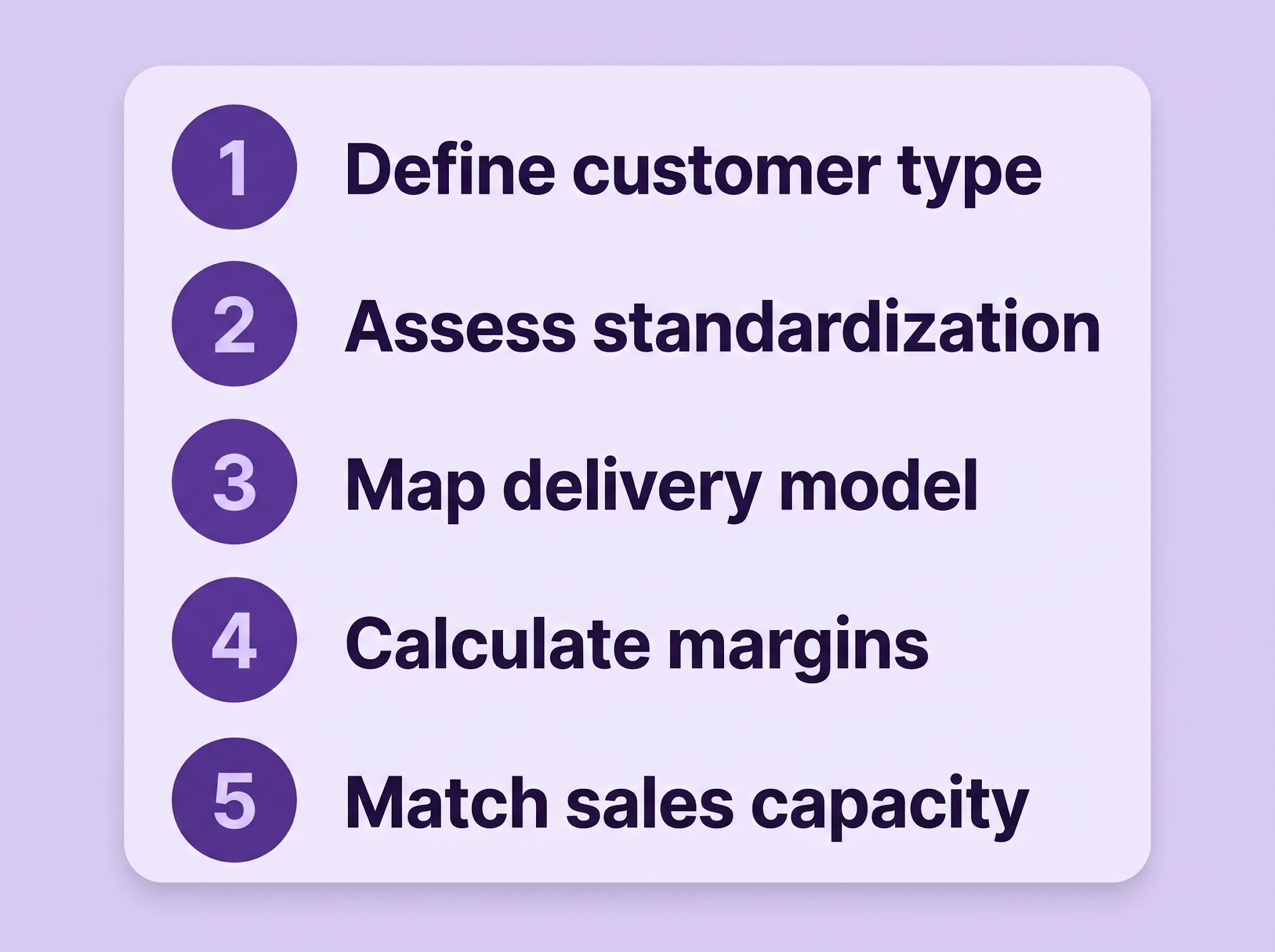
Enterprise buyers come with formal procurement, legal reviews, and multiple decision-makers, sales cycles are longer but contracts are larger and more stable, making SaaS with an account executive motion or professional services the natural fit. SMB buyers move faster but have smaller budgets and higher churn, so a low cost of acquisition is essential, which points toward product-led SaaS, a marketplace, or a self-serve channel. The buyer type determines the sales motion, and the sales motion determines which models are viable.
Purely digital products, software, data feeds, APIs, suit SaaS, data provider, or marketplace models where delivery cost does not grow linearly with customers. Physical goods require manufacturing, warehousing, and distribution, adding real operational cost with every new customer. A mix of both points toward managed services or a B2B2C hybrid.
Purely digital products, software, data feeds, APIs, suit SaaS, data provider, or marketplace models where delivery cost does not grow linearly with customers. Physical goods require manufacturing, warehousing, and distribution, adding real operational cost with every new customer. A mix of both points toward managed services or a B2B2C hybrid.
Gross margin above 70% opens up SaaS, data, and marketplace models where revenue scales without proportional cost increases. Gross margin below 40% is typical in manufacturing and distribution where inventory, logistics, and production compress the spread and volume becomes the primary profit lever. Margins between those bands suit services or hybrid models, though labor costs need close attention as the business grows.
A complex enterprise SaaS or OEM supply model needs a team that can run long cycles, manage procurement, and negotiate contracts, without that, deals stall. A product-led or marketplace model needs a simple, low-friction offer that converts without heavy explanation. The right starting point is the sales motion that exists today, and recurring predictable revenue models with strong retention are also the easiest to fund for founders with near-term fundraising plans.
Most B2B companies that struggle do not fail because they built the wrong product, they fail because they chose a model that did not match how their buyer actually buys. That mismatch shows up slowly: a deal that closes but leaves no margin, a customer that churns because the delivery model was never built for retention, a fundraise that stalls because the revenue is not recurring enough to underwrite growth. The model is what connects the product to the revenue. It determines how cash moves through the business, how quickly it compounds, and how much of it stays. A SaaS business and a services business can sell the same product to the same customer and produce completely different financial outcomes, because the model changes when revenue is recognized, how costs scale, and what the business looks like at year three. Getting that connection right early is one of the few decisions that is genuinely hard to reverse.
Choosing the right B2B model is step one. As the business grows, whether through funding rounds, employee stock options, or new investors coming in, ownership structures get complex fast. Founders who stay on top of their cap table from the start avoid the scramble that comes later.
Qapita's equity management platform helps B2B founders manage ownership clearly from day one. Whether it is cap table management as new investors come in, stock plan management as you build and retain your team, or financial reporting when investors need visibility into the business, Qapita brings structure to the parts of the business that sit behind the model but matter just as much.
Book a demo to see how Qapita helps founders stay on top of equity as the business scales.
B2B stands for business-to-business. It describes any commercial transaction where one company sells a product or service to another company rather than to an individual consumer. A software firm selling to a hospital, a supplier contracting with a manufacturer, and a consultant billing a corporation are all B2B transactions.
B2B leads are potential business customers who have shown interest in a product or service. They are identified through inbound channels like search and content or outbound methods like direct outreach. Qualifying a B2B lead involves assessing company size, budget, decision-making authority, and purchase timeline before committing significant sales effort.
A business-to-business service is any service one company sells to another for use in its operations. IT consulting, payroll processing, logistics management, legal services, and software implementation are all business-to-business services. The buyer is always an organization purchasing on behalf of a business need rather than a personal one.
B2B e-commerce is selling to other businesses through an online channel rather than through a sales representative or manual purchase order process. It lowers the cost of sale by allowing buyers to discover, evaluate, and purchase without a dedicated sales touchpoint. Distributors, wholesalers, and marketplace businesses commonly operate this way.
B2B SaaS is software built for business customers and delivered over the internet on a subscription basis. The vendor hosts and maintains the product while customers pay a recurring fee, typically monthly or annually, based on users, features, or usage volume. Salesforce, HubSpot, and Zoom are widely recognized examples of B2B SaaS companies.
B2B sales involve selling a product or service from one business to another through a structured process. It typically starts with identifying a target account, qualifying the opportunity, running product demonstrations or pilots, negotiating contract terms, and closing the deal. Because multiple stakeholders are involved, including procurement, finance, and end users, B2B sales cycles are longer and require more touchpoints than consumer sales.