


 Equity management

 Equity management
- Fund management

 Fund management
 - Fund managementFund management
- Fund managementFund management
A restricted stock unit is your company's promise to give you shares once you meet vesting conditions, usually by staying employed through a set schedule. Ordinary income is compensation taxed at regular wage rates. You pay nothing to receive an RSU, but you do not own the shares yet and you usually owe ordinary income tax when they vest.
After reading this guide, you will be able to interpret your grant, pinpoint when your shares become yours and taxable, and decide whether to hold or sell after vesting.
A restricted stock unit (RSU) is a form of equity compensation where your employer promises to give you a set number of company shares once you meet certain conditions, usually staying employed through a vesting schedule.
RSUs are granted through a vesting plan, which outlines when the employee will receive the shares. The vesting schedule can be created as per duration, performance goals, or a combination of both. Until the vesting conditions are fulfilled, RSUs do not have any tangible value.
Once vested, the shares are assigned a fair market value (FMV), and they become taxable income for the employee. A portion of the shares is usually withheld to cover the payroll tax. The employee receives the remaining shares, which they can then hold or sell.
Here is the process detailing how RSUs work as a form of employee compensation:
The process begins on the RSU grant date. However, at this stage, the RSUs are just a promise of shares, not actual shares. The employee does not own these units yet and, therefore, has no voting or dividend rights.
RSU vesting is the point at which you meet your grant's conditions. For most employees, that condition is time-based: you stay employed through a defined schedule. Once a portion vests and your company delivers the shares, those shares belong to you even if you later leave the company.
A cliff vest is a schedule where no units vest until one stated date, then a large block vests at once. A grant of 1,000 RSUs with a one-year cliff delivers zero shares for the first year, then all 1,000 at the one-year mark.
A graded vest is a schedule where units vest in smaller tranches over time. A grant of 1,000 RSUs on a four-year graded schedule at 25% per year delivers 250 shares each year. These figures are illustrative; your actual schedule lives in your grant agreement.
A time-based RSU is an award that vests as long as you stay employed through stated dates. Performance-based RSUs, sometimes called PSUs (performance share units), add conditions like hitting revenue targets or stock-price goals. A performance share unit (PSU) is an award that adds business or market targets to the time requirement. In those plans, your shares vest only if both the time requirement and the performance metrics are met.
Once the RSUs vest, they are converted into actual shares of the company. The employee now becomes a shareholder with voting rights and eligibility for dividends.
Private companies typically structure RSUs with either one or two vesting conditions before shares are delivered.
A single-trigger RSU settles as soon as it vests. Meet the time requirement, receive your shares, straight forward, just like a public company grant.
A double-trigger RSU requires two conditions to be met before shares are delivered. The first is time-based service vesting. The second is a liquidity event, usually an IPO or acquisition. Even if your RSUs are fully time-vested, you do not receive shares or owe any taxes until that second trigger occurs.
This structure exists for a practical reason. Without it, you could face a tax bill on shares you cannot yet sell. Double-trigger design protects you from paying taxes on illiquid stock, while also keeping the company compliant with U.S. deferred compensation rules under Section 409A.
To fully understand the implications of RSUs, it is essential to learn more about their associated terms and conditions. Along with the vesting schedule, these elements shape the unique properties of RSUs and distinguish them from other compensations:
1. Performance conditions: You can attach performance conditions to RSUs, meaning that vesting could be contingent on meeting certain performance goals in addition to or instead of a time-based vesting schedule.
2. Clawback provisions: RSUs may come with clawback provisions, which allow you to reclaim vested or unvested shares under certain circumstances, such as misconduct or a restatement of financial results.
3. Dividend equivalents: Your company might provide dividend equivalents on RSUs, allowing employees to receive payments equal to the amount that would have been paid on the shares once they vest.
4. Voting rights: RSU holders do not have voting rights like actual shareholders until the units vest and convert into actual shares.
There are two tax events: when your shares vest, and when you sell them. There is no tax when RSUs are granted.
1. At vesting: The value of your shares on the day they vest is taxed as ordinary income, the same as your salary. The amount is simply:
share price on vesting date × number of shares vested
Your employer reports this on your W-2 and withholds tax automatically. Watch out though: the default withholding rate is 22%, which may be lower than your actual tax bracket. If it is, you'll owe the difference when you file.
2. When you sell: Any gain above the vesting price is taxed as a capital gain. How long you hold the shares determines the rate:
Holding longer than a year gets you the lower rate, but the stock could also fall in that time, so it's a tradeoff.
3. The cost basis trap: Your cost basis is the share price at vesting, the amount you already paid income tax on. Some brokers record this as $0 because you never wrote a check to buy the shares. If you don't correct it before filing, the full sale proceeds get taxed as a gain, meaning you pay tax twice on the same income. Always verify your cost basis before you file.
Say 500 RSUs vest when your company's stock trades at $40. Your ordinary income at vesting is 500 shares multiplied by $40, which equals $20,000 in wage income added to your W-2. That $20,000 is subject to federal income tax withholding, Social Security (up to the wage base), and Medicare.
Your employer withholds $4,400 in federal income tax at the 22% flat supplemental rate, plus FICA. In the 32% bracket, your true federal tax on that $20,000 is closer to $6,400, leaving roughly a $2,000 gap you will owe at filing. Your cost basis in the shares is $40 each. Selling later at $55 produces a capital gain of $15 per share, or $7,500 total, taxed as short-term or long-term based on how long you held past vesting.
RSUs have no exercise price and are taxed at vesting. Stock options require you to buy shares at a set price, and you're taxed based on when you exercise. RSUs almost always have some value as long as the stock is above zero. Options can expire worthless if the price falls below your exercise price.
For a full breakdown, see our detailed comparison of RSUs vs. stock options.
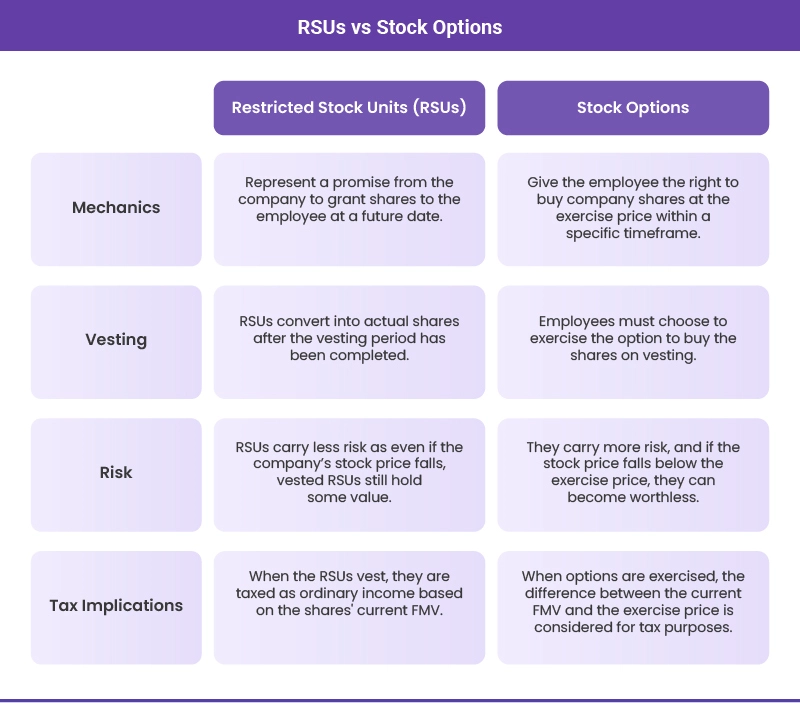
Restricted stock units come with a host of benefits that make them an attractive form of equity compensation for both companies and employees. Here are some of the key advantages on offer:
1. Simplicity: RSUs, representing a future promise of shares from the company to the employee, are straightforward. This is in contrast to stock options, which require an understanding of concepts like exercise price and time value.
2. No upfront cost: Unlike stock options which often necessitate an upfront purchase at an exercise price, RSUs demand no initial cost from employees. They simply receive the shares upon vesting.
3. Reduced risk: RSUs provide a degree of security not offered by stock options. They ensure ownership in the company, even if the stock price falls. Conversely, stock options risk becoming worthless if the stock price drops below the exercise price.
4. Performance alignment: RSUs create a direct connection between employee compensation and company performance. As the company's stock price rises, so does the value of the RSUs, encouraging employees to contribute to the company's success.
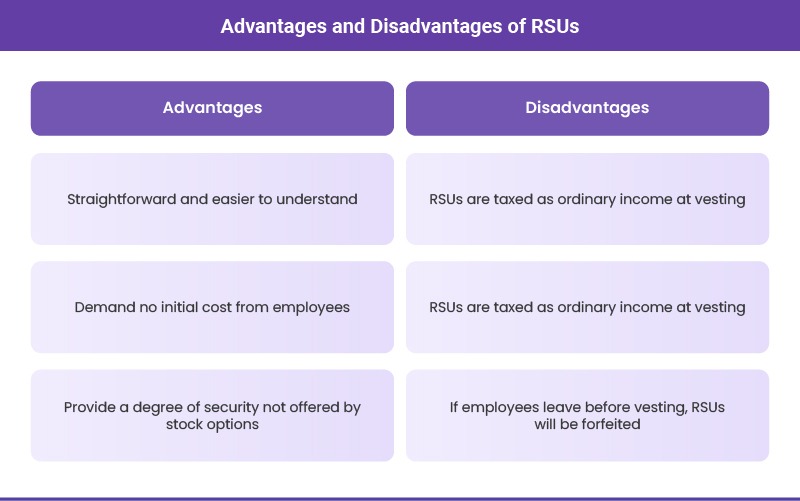
1. Delayed ownership: RSUs promise future shares, meaning employees don't own the shares or have voting rights or dividends until vesting. This can be a downside for employees who value these ownership perks.
2. Tax at vesting: RSUs are taxed as ordinary income at vesting, based on the shares' current market value. This could lead to a substantial tax liability, especially if the stock price has significantly risen since the grant date.
3. Tied to stock performance: The value of RSUs is directly associated with the company's stock performance. If the stock price falls, so does the value of the RSUs, potentially affecting the overall compensation received by employees.
4. Forfeiture risk: Employees risk forfeiting all unvested RSUs if they leave the company before vesting. This forfeiture risk, resulting in a loss of potential compensation and future appreciation, can be a significant disadvantage for employees considering a job change.
Once your shares vest and settle into your brokerage account, you own them and can sell at any time, but a few factors are worth thinking through before you do.
Your company's trading policy. Most public companies impose blackout windows around earnings and other sensitive periods. Check your policy before placing a sale.
Public company RSUs
Once your shares vest and are delivered, you can sell them through your brokerage as long as you're outside a blackout window and clear of any other trading restrictions your company has in place.
Private company RSUs
If your company is private, you generally cannot sell until a liquidity event, an IPO, acquisition, or company-approved tender offer. In some cases your company may allow you to find a third-party buyer directly, but this requires explicit approval and is not always available.
A grant agreement is the legal document that states your RSU terms. Use the steps below to identify the dates, triggers, settlement rules, and forfeiture clauses that control when shares arrive and what can cause you to lose them.
1. Find the grant date and total units in your agreement so you confirm the award size.
2. Mark each vesting date, cliff, and graded tranche so you know when shares can vest.
3. Check the trigger structure and settlement method so you see whether vesting and delivery match.
4. Review pre-IPO terms and private-company clauses so you understand any delay before shares are issued.
5. Read forfeiture and change-in-control provisions so you know what can alter or cancel future shares.
In recent years, companies have increasingly favored RSUs over stock options. Several factors drive this shift:
1. Less dilution: Since RSUs don't have an exercise price, the entire FMV of the share is passed on to the employee as a benefit. So, the company can meet a target dollar value of employee compensation with a lesser number of RSUs as compared to stock options.
2. No exercise cost: With stock options, employees must purchase the option at the exercise price to realize any gain. This can be a significant out-of-pocket expense. In contrast, RSUs do not require any investment on the part of the employee. They are granted for free and converted into shares at no cost to the employee.
3. Alignment with exit strategy: RSUs can be better aligned with a company's exit strategy, such as an IPO. This is because RSUs are typically granted after a private company goes public. They can be a more attractive form of equity compensation for employees in a company that is planning to go public or has recently done so.
Several companies have made the switch from stock options to RSUs. Here are two prominent examples:
1. Microsoft: In the past, Microsoft offered stock options to its employees. However, they switched to RSUs as they found them to be simpler and less risky. RSUs are easier for employees to understand as they represent a promise of future shares and do not require any upfront payment. This shift has made equity compensation more accessible and attractive to Microsoft's employees.
2. Nike: Similar to Microsoft, Nike also transitioned from stock options to RSUs. The company offers its employees a choice between stock options, RSUs, or a mix of both. However, RSUs have become a popular choice due to their simplicity and reduced risk. This change has helped Nike to attract and retain talent effectively.
RSUs are often perceived purely as a financial reward, but they represent something more fundamental, a structural alignment between the people building a company and the outcomes they are working toward. When designed thoughtfully, an RSU program does not just compensate employees for their time; it gives them a genuine stake in the decisions they make every day.
For founders, this means structuring RSU grants with fair vesting schedules, clear communication around liquidity, and transparency around tax implications. For employees, it means understanding that the value of an RSU is not fixed at the grant date, it is shaped by every contribution made between the grant and the day the shares are sold. That alignment, when communicated well, is worth more than the grant itself.
Before your next vesting date hits, take a proper look at your RSU agreement. Get clear on your vesting schedule, what triggers a change, and what happens to unvested units if you leave. It also helps to plan for the tax bill early, since the amount withheld at vesting usually doesn't cover what you'll owe later.
If you're a founder issuing RSUs, they need to reflect correctly on your cap table so ownership stays accurate for everyone involved. Qapita's equity management platform helps founders and employees track grants, vesting, and ownership in one place, making equity decisions simpler and more transparent. Request a demo to see how Qapita can support your equity management.
An RSU is a company promise to deliver a specific number of shares once you satisfy the vesting conditions. Nothing lands in your brokerage account at grant, and no purchase is required. Shares are delivered at vesting, which is also when your tax obligation begins.
Yes, one RSU typically converts into one share at vesting. A grant of 1,000 RSUs generally becomes 1,000 shares, assuming no adjustments. Stock splits, mergers, or specific plan terms can change the ratio, so confirm the settlement terms in your grant agreement.
Not until your shares vest. Unvested RSUs carry no ownership rights, no voting rights, and no dividends. Some plans offer dividend equivalents while you wait, but not all. Once shares are delivered at vesting, you become a shareholder with the standard rights that come with the stock.
No. RSUs are taxed as ordinary income at vesting and do not create the preference income that triggers the alternative minimum tax. This is a common point of confusion with incentive stock options, which can trigger AMT. RSUs do not.
No. The 83(b) election applies to restricted stock awards where actual shares are issued at grant. With RSUs, you receive a promise of future shares rather than shares themselves, so there is nothing to elect on. Tax begins at vesting regardless.
Yes, vested RSU shares are regular stock and can be donated to a qualified charity if your plan broker supports transfers. Donating appreciated shares directly may reduce your capital gains tax exposure, though the outcome depends on your holding period, documentation, and applicable tax law.
Sometimes. Lenders may count RSU income if vesting is consistent and well documented. Underwriters typically request grant agreements, vest records, brokerage statements, and tax forms, and may apply a discount to account for share price variability. Requirements vary by lender.