


 Equity management

 Equity management
- Fund management

 Fund management
 - Fund managementFund management
- Fund managementFund management




Post-money valuation is the total value of a company immediately after it takes in new outside investment. It equals the pre-money valuation plus the capital raised in that round.
Formula
Post-money valuation = Pre-money valuation + New investment amount
Here's what each variable means:
Once you have the post-money figure, you can work out what the investor owns:
Investor ownership % = Investment amount / Post-money valuation
Use the first formula to set the company's value. Use the second to see who owns what once the round is done.

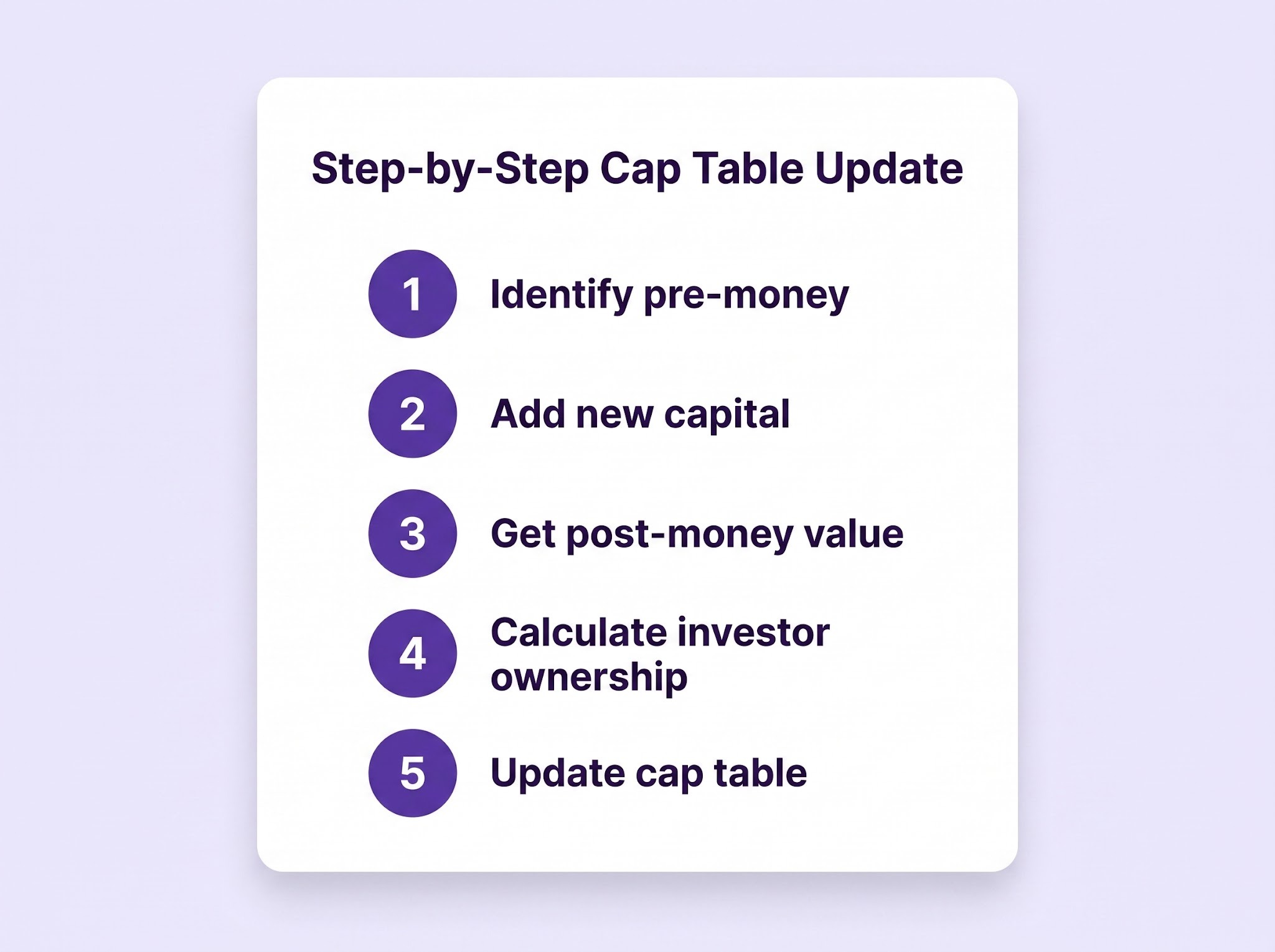
Here's the step-by-step process:
Step 1: Identify the pre-money valuation: The negotiated value of the company before the round.
Step 2: Add the new capital invested: Total up everything coming in this round.
Step 3: Get the post-money valuation: Add the pre-money valuation and the investment to get the post-money figure.
Step 4: Calculate investor ownership: Divide the investment amount by the post-money valuation.
Step 5: Update the cap table: Record the new shares and the revised ownership split.
Step 6: Work backward if you're targeting a specific ownership %: Divide the investment amount by the desired ownership percentage to get the required post-money valuation, then subtract the investment to find the pre-money valuation. For example, a $2 million investment for 20% ownership implies a $10M post-money valuation ($2M ÷ 20%) and an $8M pre-money valuation ($10M − $2M).
Suppose your company raises $2 million at a $10 million pre-money valuation. The post-money valuation is:
$10M + $2M = $12M
The investor’s ownership is then calculated using the post-money valuation:
$2M ÷ $12M = 16.67%
After the round:
Existing shareholders still hold the same number of shares, but their ownership percentage decreases because the company issues new shares to the investor. This reduction in ownership percentage is dilution.
The percentage ownership decreases, but the value of the existing stake may still increase as the company’s overall valuation grows.
Pre-money and post-money valuation represent the company’s value before and after new investment. Pre-money valuation is the agreed value before the round, while post-money valuation adds the new capital to that figure.
The distinction directly affects investor ownership and founder dilution. For example:
The same valuation can therefore produce different ownership outcomes. Always confirm whether a quoted valuation is pre-money or post-money before evaluating a round's terms.
Here's what typically changes when a round closes, and who needs to act on it:
1. Founders: New share issuance dilutes existing ownership, though a lower percentage doesn't always mean lower value if the company's overall valuation has grown. Founders should also track how the round affects option pool planning and ownership left for future rounds.
2. Investors: Calculate their stake using the post-money valuation and record it in the cap table, based on entry ownership and expected future dilution.
3. Finance and equity teams: Update the cap table, fully diluted ownership, and board materials. Accurate post-round data matters for audits and future due diligence.
4. HR and equity teams: Track changes to the option pool and employee ownership percentages, and keep grant information accurate as the fully diluted share count increases.
5. Legal advisors and fractional CFOs: Model dilution, prepare financing documents, and verify that post-round ownership matches the agreed terms.
SAFEs and convertible notes add another layer to post-money calculations because the number of shares issued at conversion depends on their individual terms.
A post-money SAFE generally makes the ownership sold through the SAFE more transparent by expressing the valuation cap on a post-money basis. However, the final ownership calculation still depends on the SAFE’s specific capitalization definition and conversion terms.
When multiple SAFEs are outstanding, each conversion needs to be reflected in the fully diluted cap table. Stacked SAFEs can therefore create more founder dilution than looking at any single SAFE in isolation suggests.
Convertible notes typically convert during a priced round using a valuation cap, discount, or both. The applicable provision determines the conversion price and, in turn, how many shares the noteholder receives.
Accrued interest may also increase the amount that converts, depending on the note terms.
Both SAFEs and convertible notes can materially change the post-round share count. Modeling each instrument before the financing closes gives founders and finance teams a clearer view of the resulting ownership and dilution.
Post-money valuation errors often come from missing key elements in the calculation, not the formula itself. Common mistakes include:
Spreadsheets work for simple cap tables but become harder to manage as the company adds SAFEs, convertible notes, option pools, warrants, and multiple share classes.
Manual tracking increases the risk of missed conversions, formula errors, and inconsistent ownership records. These issues often surface during fundraising or due diligence, when accurate data matters most.
Qapita’s cap table management provides a single source of truth for ownership, with consistent updates and an audit trail across funding rounds.
Several factors can also affect what that headline valuation actually means for individual shareholders:
Post-money valuation represents equity value, the value attributable to shareholders once new investment is included. It reflects what the company's ownership is worth on paper, based on the price investors just paid for their stake. Enterprise value, on the other hand, measures the value of the overall business and accounts for debt and cash. Because a company's debt load or cash position can inflate or reduce equity value, you shouldn't use the two figures interchangeably.
Before you run any post-money calculation, gather the inputs that actually move the number. A calculator is only as good as what you feed it.
Before you run any post-money calculation, gather the inputs that actually move the number:
Post-money valuation matters well past the round it's calculated for. It sets the baseline that the next round's pre-money valuation is often measured against, so today's number directly influences tomorrow's negotiations, dilution, and investor expectations. A round priced too aggressively can make it harder to raise at a higher valuation later, while a disciplined post-money figure gives the company room to grow into its next raise. For founders, it's not just a math exercise, it's a signal of how much runway, ownership, and negotiating leverage remain for future rounds. Getting it right, and keeping the cap table accurate afterward, protects everyone's stake as the company scales.
Funding rounds get complex fast with option pools, SAFEs, convertible notes, and multiple share classes. Qapita's cap table management helps you model valuations and keep ownership records accurate as rounds close. Book a Demo.
No. In a standard priced round, post-money valuation equals pre-money valuation plus new investment, so it is always higher. A down round is different: the new round’s pre-money valuation may be lower than the previous round’s post-money valuation.
No. Post-money valuation represents the company’s equity value after investment, not its cash balance. Only the new investment amount is added as cash.
There is no fixed benchmark. It depends on factors such as traction, market size, growth, investor demand, and expected dilution. A valuation should also be sustainable enough to support future fundraising.
Subtract the new investment from the post-money valuation:
Pre-money valuation = Post-money valuation − New investment
For example, $12M post-money minus a $2M investment equals a $10M pre-money valuation.
An inaccurate cap table can lead to incorrect ownership, employee equity errors, investor disputes, and due diligence issues. Keeping every round, SAFE, option pool, and share class updated helps keep ownership records accurate.