Waterfall Software

Advanced Waterfall Software for Fast, Audit-Ready Exit Modeling

Model liquidation preference waterfalls, breakpoint analysis, and payout by share class, straight from your live cap table, not a rebuilt spreadsheet. Run multiple exit scenarios in minutes and share board-ready outputs with your legal and M&A team.

Why Ditch the Spreadsheet for Automated Waterfall Modeling?

Sync Directly with Your Waterfall Cap Table

A waterfall is only as accurate as the cap table behind it. Qapita builds every waterfall model from your live cap table data, actual share classes, actual liquidation preferences, actual conversion ratios, and actual option holdings. Change the cap table and the waterfall updates with it. No re-entry. No stale numbers from last quarter's spreadsheet.

Waterfall Software Built Around Your Rules, not a Template

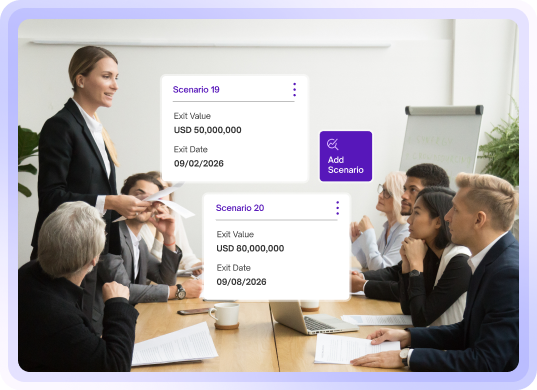
Run the waterfall at $100M. Then $200M. Then $350M. See exactly where preferred shareholders convert to common, where breakpoints shift the distribution, and what founders and employees actually receive at each price point. Every scenario saves automatically. Every comparison is instant.

Board-Ready Output, Not Just a Number

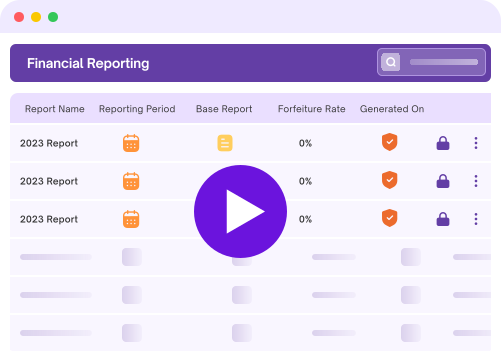
The waterfall you run internally should be the one your board reviews, your legal team verifies, and your M&A advisors rely on. Qapita generates exportable payout summaries, waterfall charts, and share-class breakdowns in the formats your lawyers and acquirers expect, one model, one version, no reconciling what you modeled against what gets signed.

Features Built for Complex Exit Scenarios

Waterfall Modeling

Liquidation Preference Waterfall Modeling

Model exactly how liquidation preferences distribute exit value 1x, 2x, participating, non-participating, and multi-tranche stacks, against your real preference terms.
Payout Detail

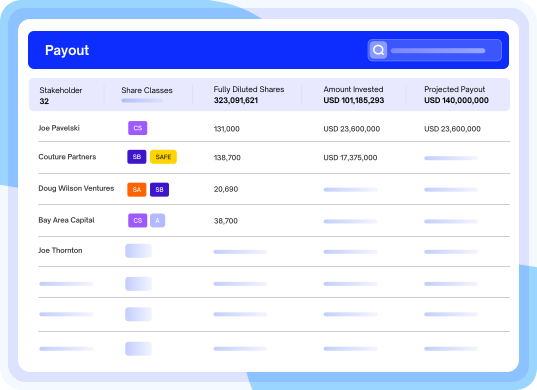
Payout by Share Class and Individual Stakeholder

See what every stakeholder receives, not just the aggregate split. Founders, each investor, each option holder, line by line.
Live Recalculation

Instantly Reactive Scenario Modeling

Change the exit value, the transaction fees, the close date, payouts recalculate in real time. "What happens if we exit at $50M instead of $100M?" has an answer in seconds.
Scenario Planning

Multi-Scenario Exit Modeling

Run twenty scenarios before the board meeting, not scramble to build the twenty-first after someone asks a question you didn't model.

Model Your Next Exit, Before You Need To

See how Qapita builds a full liquidation preference waterfall, breakpoints, share-class payouts, and convertible conversions, directly from a live cap table.
Testimonials

Words from our valued customers

Employee Stock Option Plan Management via Qapita
Qapita’s customer support has been incredibly helpful, always responsive and solution-oriented, even during late hours. our customer success manager flags potential risks we should be aware of. The platform itself is intuitive and easy to navigate, with clear online instructions that make it easy to use even for first-time users.
Jinjin Z.
Associate Manager, Performance and Rewards
Mid-Market(51-1000 emp.)
Great onboarding experience overall.
Great onboarding experience overall. We moved over from Carta, which was very over priced, and did not provide any kind of support. Qapita made the whole experience seamless and pain-free, and helped us to move everything over without any issues. What is also great, is that we get all this for a fraction of what we were paying Carta.
Colin M
HR/Ops Manager
Mid-Market(51-1000 emp.)
I recently transitioned my company from Carta to Qapita, and the experience was outstanding. Qapita truly held my hand through every step. The team was highly responsive, proactive, and incredibly patient. They truly held my hand through the entire process (discovery, onboarding, data migration, validation, and go-live) making something that initially felt overwhelming, smooth and stress-free.
Amanda Skinner
Founder, I2O Retail
Qapita has helped us in drastically improving our employee engagement on our Employee equity front. Equity payslips and valuation slider are really useful.
Prashant Kumar
Co-founder, Zingbus
Qapita is one of the easiest equity management tools with one of the best support teams in the market. Highly Recommended.
Aquibur Rahman
CEO and Founder, Mailmodo
Fast Onboarding, Patient Assistance
The onboarding was very smooth and the team assisted us at every step. The platform is easy to use & has saved us alot of time and effort. The  team is always very patient with all our doubts.
Muskan T
Mid-Market (51-1000 emp.)
Expert guidance and hands-on support made our transition seamless
I recently transitioned my company from Carta to Qapita, and the experience was outstanding. Qapita truly held my hand through every step. The team was highly responsive, proactive, and incredibly patient. They truly held my hand through the entire process (discovery, onboarding, data migration, validation, and go-live) making something that initially felt overwhelming, smooth and stress-free.

Amanda Skinner
HR/Ops Manager
Mid-Market (51-1000 emp)
Qapita is one of the easiest equity management tools with one of the best support teams in the market. Highly Recommended.
Aquibur Rahman
CEO and Co-founder, Mailmodo
Qapita has saved my team an enormous amount of time and effort. They have helped us effectively manage our ESOPs all‑digitally as well as organize our Captable. The user interface is great, onboarding was smooth.


Ankur Sharma
Chief Financial Officer, Boat
Qapita has helped us in drastically improving our employee engagement on our Employee equity front. Equity payslips and valuation slider are really useful.
Prashant Kumar
Co‑founder, Zingbus
In Qapita, we have found a partner that supports us with all aspects related to ESOPs from plan review to employee education. Qapita's platform and their interactive employee sessions on communicating ESOPs effectively have been very helpful.
Ginu Nair
VP HR, Zetwerk
Qapita Simplifies Captable Management
Qapita makes managing our cap table easy and accurate, saving us time and reducing errors. There isn't much customer support or many videos available online about its usage and features. We needed some assistance in the beginning, which led to additional efforts. By automating our cap table, Qapita has improved transparency and compliance, allowing us to focus on growth and strategy.
Namrata K
HR Manager
Mid-Market (51-1000 emp)
Qapita’s cap table modelling tool is super easy-to-use and intuitive, even for such complex scenarios; and its customer success team which consists of financial analysts are very helpful in walking us through the model and considerations. Although they are not a Financial Advisor per se, the guidance and sensibility checks are instrumental in our fund-raising efforts. Qapita is a cost-effective platform for early-stage startups like us to manage cap table and investors relations digitally; and run various scenarios quickly and accurately to aid us in negotiations and decision-making. Highly recommended.
Richmond Yaw
Co-founder and COO, Versa
Great onboarding experience overall.
We moved over from Carta, which was very over priced, and did not provide any kind of support. Qapita made the whole experience seamless and pain-free, and helped us to move everything over without any issues. What is also great, is that we get all this for a fraction of what we were paying Carta.
Colin M
HR/Ops Manager
Mid-Market(51-1000 emp.)
Qapita is an excellent platform. We have used them since Series C to the current Series D. There are lots of other vendors with a lot of bells and whistles that we don’t currently need, Qapita has just the right services that we need and much more cost-effective. Their team is also very helpful and responsive.
Daniel Song
General Counsel, Biofourmis
Perfect implementation of the onboarding process
They are one of the best communicating companies I've ever worked with. All the work was transparent, schedules were met, updates were frequent, questions were responded to in a timely way, communications were clear and understandable. And Qapita is very client-friendly and willing to accommodate most requests.
William Topaz
CAO/CCO, ATM.com, Inc.
As a small business, they were happy to meet with us, explain things to us, answer our questions, and show us how to get the best out of the service. I got the feeling that they were truly trying to help us.
Dan Gericke
Co-founder, ShiftControl
Takes away founders' burden to reward ESOP and retain top talent
Hassle-free and paperless tracking of our equity options, easy issuance and communication to the team. That we as founders are making the decisions, Qapita is doing the rest.
Grace Sai
Cofounder & CEO
How it works

From Live Cap Table to Verified Waterfall in Minutes

No exports, no rebuilding in Excel. Model the exit straight from your live cap table. Four steps, one place, no spreadsheet roundtrips.
1

Start from your actual cap table

No import, no spreadsheet rebuild. The waterfall pulls straight from the data already in your cap table.
2

Set the exit parameters

Enter price, fees, and close date. Every payout recalculates against your real preference terms.
3

Build and compare scenarios

Stack as many versions as the conversation needs. Change one input and see how the split moves across every scenario.
4

Export and share

Get a board-ready output in the format your team already uses. No reformatting, no rework before the meeting.

Ready to see it in action?

Eliminate manual calculations and spreadsheet errors. Build accurate waterfall scenarios directly from your cap table.
FAQs

Frequently asked questions

What is waterfall modeling?

Waterfall modeling is the process of calculating how proceeds from an exit: a sale, acquisition, or IPO, flow through a company's capital structure. It determines the order and amount each shareholder class receives based on liquidation preferences, participation rights, and conversion terms.

How does Qapita's waterfall analysis connect to my cap table?

Qapita's waterfall runs directly on your live cap table data, the same share of classes, preferences, and conversion terms already on file. There's no export and no manual re-entry when the cap table changes.

What is waterfall modeling software?

Waterfall modeling software automates the exit-payout calculations companies otherwise build by hand in a spreadsheet. It applies liquidation preferences and conversion rules to a company's real share classes and recalculates instantly assumptions change.

Can I model multiple exit scenarios and compare them side by side?

Yes. Qapita saves every scenario automatically, so you can compare exit values, fees, and close dates side by side without rebuilding the model each time.

What is a liquidation preference breakpoint, and how does Qapita model it?

A breakpoint is the exit price where a preferred shareholder's best option shifts, usually from taking their liquidation preference to converting to common stock. Qapita identifies these breakpoints automatically from each share class's actual terms.

How does the software handle convertible notes and options during an exit?

Convertible notes, SAFEs, and warrants convert automatically at the modeled share price and factor into the waterfall alongside every other share class, based on their real conversion terms.

Can I use Qapita's waterfall analysis during an M&A process?

Yes. Waterfall outputs are built to be board- and legal-ready, so your M&A advisors and legal team can work from the same model you did.

Can I export the waterfall models to Excel or PDF for my board?

Yes. Waterfall results export as payout summaries, charts, and share-class breakdowns your board and legal team can use directly.

What are the 5 stages of a waterfall model?

Most waterfall models follow five steps: set up the cap table and share terms, apply liquidation preferences by seniority, decide preferred-to-common conversions, calculate breakpoints, and distribute what's left pro rata.

How much does Qapita's waterfall modeling cost?

Waterfall modeling is part of Qapita's cap table platform rather than a separate purchase. Book a demo to see current plans and what's included at your stage.

Employee stock option pools (ESOP): the hidden driver of your cap table​

Your ESOP is part of your cap table equation

Most founders think of their cap table as just founders and investors. But your employee option pool is a critical line item that directly affects ownership percentages, dilution calculations, and fundraising readiness. Without proper ESOP management, your cap table tells an incomplete story.

The fully diluted cap table vs. issued cap table trap

Most founders only look at issued shares, missing the real ownership picture. Your cap table must display fully diluted ownership, accounting for all outstanding options, SAFEs, and warrants. This is what investors actually care about and what determines real control and economics.​

Unmanaged option pools create cap table chaos

If you don't track vesting, grants, and exercises in your cap table, your numbers become unreliable. A founder might think they own 60%, but with unvested options and future hires factored in, their fully diluted ownership could be 35%. Your cap table needs to show both issued and reserved shares to be accurate.

Vesting schedules must sync with your cap table records

When an employee vests or exercises, your cap table changes. If these transactions aren't logged immediately, your ownership breakdown drifts. Every vesting event should be updated on your cap table in real time.​

ESOP sizing impacts your cap table's flexibility

Reserve too small an option pool and you'll either over hire (diluting everyone) or underpay talent (vesting equity they can't afford to exercise). Reserve too large and investors question your discipline. Your cap table should model different pool sizes so you allocate the right amount upfront.

Cap table accuracy hinges on ESOP transparency

Investors, auditors, and regulators all want to see option pool details: how many shares are reserved, how many are granted, how many remain available. A messy ESOP makes your entire cap table suspect. Clean option tracking builds trust in your numbers.​​

ESOP exercises create secondary cap table mechanics

When employees exercise options, they're buying shares at a strike price. This creates a new shareholder and potentially triggers valuation requirements, tax withholding obligations, and cap table restructuring. Your system needs to handle exercise mechanics without breaking your ownership math.

Modeling hire scenarios with your cap table

Before you make that critical hire, run the numbers through your cap table. How much equity does the new role need to be competitive? What's the ownership impact on existing shareholders? What's the fully diluted cap table after 10 more hires? Scenario modeling prevents expensive mistakes, especially when you're navigating different compensation expectations across India and Southeast Asian markets.

Regulatory complexity compounds your cap table burden

In markets like India, ESOPs are governed by multiple compliance layers, special board resolutions, disclosures to regulatory bodies, foreign employee reporting requirements, and intricate tax treatments. Startups can issue up to 50% of paid-up capital as ESOP to employees over 7 years, but each grant must be meticulously logged. In Southeast Asia, requirements vary dramatically: Singapore's framework allows cleaner private company structures, Vietnam's system just liberalized registration requirements in 2024, and Thailand focuses on capital market rules for listed entities. Your cap table must accommodate these jurisdictional differences if you have multi-country operations, or it will break down during audits or fundraises.​

Tax deferral and foreign exchange implications demand cap table rigor

For Indian startups, eligible employees can defer tax on ESOP gains by up to 48 months, but this requires precise documentation of grant dates, exercise dates, and fair market valuations in your cap table. If an employee works across borders, tax treatment changes by jurisdiction. Singapore applies "deemed exercise" taxation when employees leave, Vietnam's recent reforms simplified foreign currency flows, and India requires RBI reporting for cross-border grants. Without real-time cap table updates tracking these nuances, you'll face surprise tax liabilities or compliance penalties.

See who gets what in every exit scenario

Analyze waterfall outcomes across acquisition, IPO, and liquidation events with clear visibility into stakeholder payouts.