


 Equity management

 Equity management
- Fund management

 Fund management
 - Fund managementFund management
- Fund managementFund management



corporation that you acquire directly from the company, and that meets the requirements of IRC Section 1202. If both the company and the shareholder qualify, you can exclude some or all of the federal capital gains tax on your profit when you sell. Done right, that can mean $0 in federal tax on millions of dollars of gain.
Founders receive it as founder stock. Employees get it when they exercise their options. Early investors pick it up in a funding round. Congress created the benefit to encourage long-term investment in active U.S. businesses, and for those who qualify, the savings are significant.
The benefit does not apply automatically, and it does not manage itself. Your acquisition date, the company's structure, and how long you hold the stock all determine what you actually keep. This guide explains how.
IRC Section 1202 is the federal statute behind the QSBS tax exemption. The exclusion percentage available to shareholders has changed over time based on when the stock was acquired.
The exclusion percentage Congress has offered has increased over time:
The most significant recent change came with the one big beautiful bill act (OBBBA), enacted July 4, 2025. For stock issued after that date, OBBBA raised the per-issuer cap from $10 million to $15 million, lifted the gross-asset ceiling from $50 million to $75 million, and replaced the single five-year threshold with a tiered holding-period schedule. Stock issued on or before July 4, 2025 is unaffected, those shares stay under the prior rules.
QSBS qualification comes down to four things. And all four have to be true at the same time. Miss one and the exclusion can disappear.
The issuing company must be a U.S. C-corporation, not an LLC, S-corp, or REIT, and must stay one for most of the time you hold the stock. The company's total assets also have to come in under a size ceiling at the time your shares are issued: $50 million for stock issued on or before July 4, 2025, and $75 million for stock issued after that date.
The company has to be running a real, active business, not sitting on passive cash or investments. This has to hold true for most of the time you own the stock, not just at issuance. Certain industries are excluded entirely: professional services, financial services, farming, and hospitality do not qualify regardless of size.
The stock has to come directly from the company, not purchased from another shareholder. It must be received in exchange for cash, property, or services. Shares bought on the secondary market never qualify, no matter how long you hold them.
One thing to watch: company stock buybacks within four years of your issuance date, or significant buybacks from any shareholder within one year before or after, can quietly disqualify your shares . This is worth reviewing with a tax advisor before any liquidity event.
How long you hold determines how much gain you can exclude:
Run through these six questions before relying on the exclusion:
The single most important QSBS question in 2026 is when the stock was acquired. Here is how the two regimes compare:
Section 1202(e)(3) excludes several trades and businesses from QSBS eligibility. When your company's principal asset is the reputation or skill of its employees or owners, it is likely on the excluded list.
Excluded categories include:
Many technology, industrial, and product companies qualify, while service-heavy professional firms typically do not.
Under the new tiered rules, the timing decision is real. Selling post-2025 stock at three years locks in a 50% exclusion, while waiting to four or five years moves you to 75% or 100%. Across the tiers, your effective federal rate on the gain can move from roughly 15.9% at three years to 0% at five, so the difference on a large gain is substantial.
The trade-off is straightforward to frame, even if the decision is not. Holding longer raises your exclusion percentage but exposes you to more market and company risk. Whether the extra exclusion is worth the wait depends on your gain size, the applicable cap, and your view on the company. That is a conversation for your tax advisor with numbers on the table.
When gain qualifies under QSBS, it is excluded from your federal gross income entirely, no federal income tax and no net investment income tax (NIIT) on that portion. Any gain above the cap remains taxable at normal rates.
The exclusion is capped per company at the greater of:
The 10x rule matters most for investors who put significant capital in. A $5 million investment gives a $50 million exclusion cap, far above either flat dollar limit. For founders with near-zero basis, the flat cap almost always applies.
Three things need to line up:
For stock acquired after September 27, 2010, the excluded gain is also not subject to the Alternative Minimum Tax (AMT), meaning no income tax, no NIIT, and no AMT on the excluded portion.
Four inputs you need:
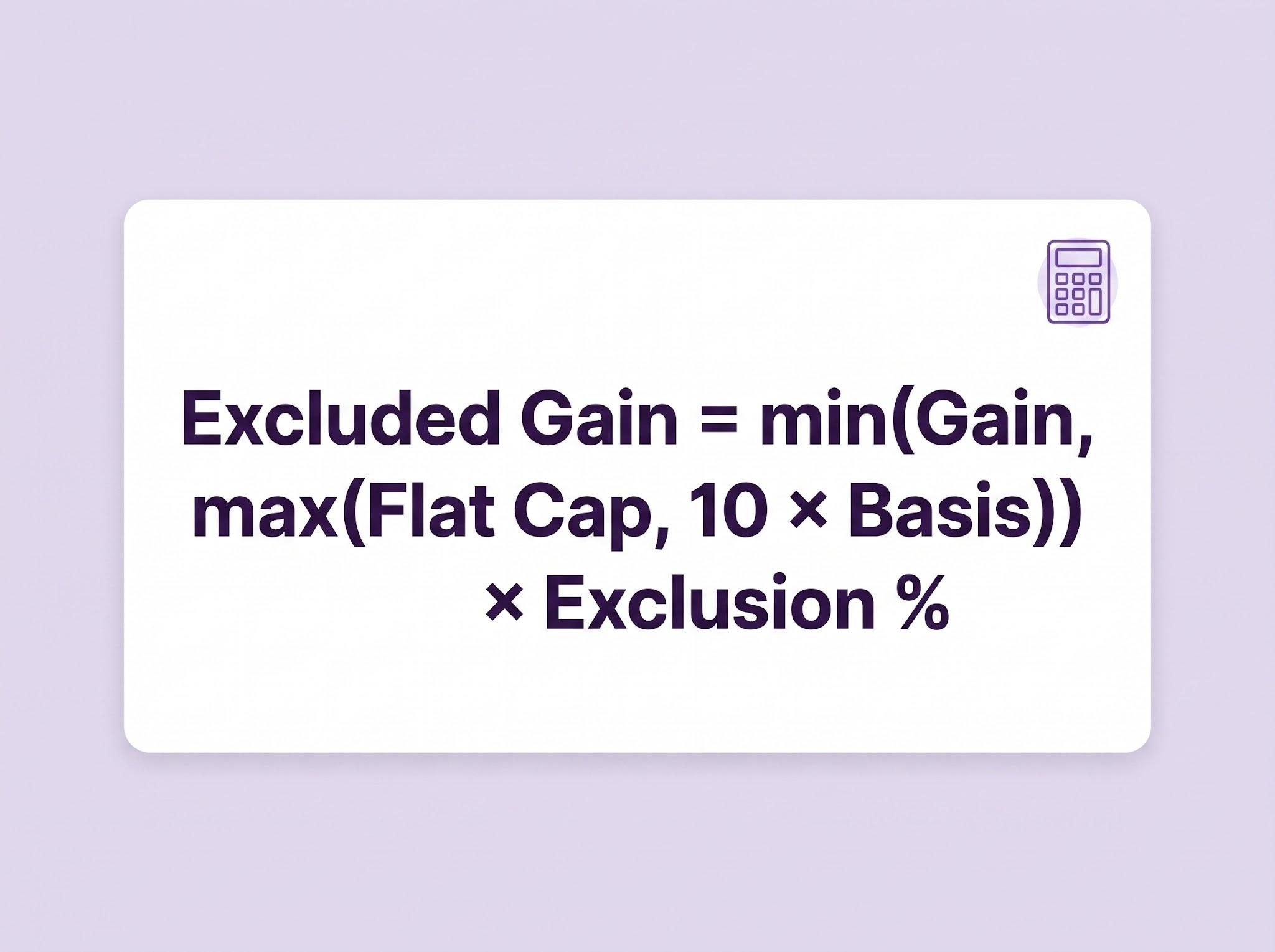
QSBS is a federal benefit. State treatment varies significantly and does not follow automatically.
As of 2026, states that do not conform include California, Alabama, Mississippi, Pennsylvania, and Washington D.C. New Jersey was non-conforming but began conforming from January 1, 2026. Hawaii and Massachusetts partially conform.
For California founders specifically, a $10 million federally excluded gain still carries a state tax bill of over $1.3 million at the 13.3% rate. Residency and timing are worth planning well before a liquidity event.
If you sell QSBS before hitting your exclusion threshold, a Section 1045 rollover lets you defer the capital gains tax by reinvesting the proceeds into new QSBS within 60 days. Your holding period carries over, so you do not start from zero.
Before you sign an acquisition or close an IPO, assemble a QSBS evidence package. Have your counsel and tax advisor confirm each item well ahead of the closing.
QSBS is one of the most valuable tax benefits available to founders, early employees, and investors, but it does not manage itself. The exclusion is earned at issuance, maintained over years, and proved at exit. Each of those three moments requires something from you: the right company structure, continuous eligibility, and documentation that holds up under scrutiny.
The rules are not complicated once you know them. Your acquisition date, your holding period, your issuance records, these are not exit tasks. They are day-one tasks that compound quietly in your favour, or against you, depending on whether anyone was paying attention.
Get the structure right, keep the records current, and confirm everything with a tax advisor before you sell. That is the full playbook.
Gross-asset compliance requires accurate, defensible valuations at each issuance date. Qapita's independent 409A valuations are IRS-compliant and audit-ready, with no shortcuts.
QSBS stands for qualified small business stock. It refers to stock in a U.S. C-corporation that meets the requirements of IRC Section 1202, allowing eligible shareholders to exclude some or all of their federal capital gains tax when they sell.
1202 stock is another name for QSBS. It refers to stock that qualifies for the capital gains exclusion under Section 1202 of the Internal Revenue Code. The terms QSBS, 1202 stock, and qualified small business stock are used interchangeably.
QSBS is one of the most powerful tax planning tools available to founders and early investors. Structuring as a C-corporation from the start, issuing stock at original issuance, and tracking holding periods from day one are all decisions that compound over time. For business owners planning an eventual exit, QSBS can be the difference between paying 20%+ in federal capital gains tax and paying nothing at all.
IRC Section 1202 is the federal statute that creates the QSBS tax exemption. QSBS is simply the stock that meets Section 1202's requirements. Without Section 1202, there is no exclusion, the two are inseparable.
Yes. Employees who exercise options into shares of a qualifying C-corp can hold QSBS, and the holding period starts at exercise. The shares must meet the same company, issuance, and holding-period tests as any other QSBS.
You must generally hold QSBS for more than five years to claim the full exclusion. This still applies to stock acquired on or before July 4, 2025. Later stock uses a tiered schedule that gives partial benefits at three years.
In some cases eligibility can be preserved through a tax-free share exchange, for example if the acquiring company's stock qualifies as QSBS and the transaction is structured as a tax-free reorganisation. Outcomes vary significantly depending on deal structure. A tax advisor needs to review the specific transaction before closing.