

 Equity management

 Equity management
- Fund management

 Fund management
 - Fund managementFund management
- Fund managementFund management
A co-founder equity split is the division of ownership in a company among its founders, usually expressed as a percentage of total shares. It sets who owns how much of the business from day one and forms the basis for future funding rounds, employee stock plans, and exits.
Because this split determines control, decision-making power, and financial upside, it should reflect each founder's contribution, not just their title or how long they've known each other. A well-documented split, backed by a founders' agreement and vesting schedule, protects everyone if circumstances change later.
No single formula works for every founding team, but a structured process gets you to a fair number faster. Here's a step-by-step approach founders commonly use.
1. List every contribution. Write down what each founder brings: the original idea, capital invested, technical work, industry connections, and time commitment.
2. Assign relative weight to each factor. Some teams score contributions on a simple 1–5 scale across categories like idea, execution, capital, and risk.
3. Calculate a starting split. Turn the weighted scores into a percentage split. This is a starting point, not a final answer.
4. Discuss it openly. Every founder should get to share how they see their own contribution and challenge the numbers if something feels off.
5. Agree on vesting. Once the split is set, attach a vesting schedule so equity is earned over time, not handed out in full immediately.
6. Put it in writing. Document the split and vesting terms in a founders' agreement, reviewed by a lawyer.
7. Revisit if roles change. If a founder's role shifts significantly in the first year or two, some teams agree to revisit the split rather than treat it as fixed forever.
Founders generally choose between a few broad models when dividing ownership. Knowing the trade-offs of each one gives your team a clearer starting point for discussion.
Co-founder equity split models vary, each with unique strengths and trade-offs. Understanding these approaches will help you pick the right one for your team and business goals.
With an equal split, every co-founder holds the same percentage, for example, 25% each across four founders. It's simple to agree on and works when time, skill, and risk are genuinely comparable across the team. The trade-off shows up later: an even split among an even number of founders can lead to deadlock on key decisions, since no side holds a majority. It also doesn't adjust if one founder's effort drops off after the first year. This model suits teams where contribution is expected to stay balanced throughout.
A role-based split ties ownership to each founder's function and impact on the business. For example, a technical founder building the core product might hold a larger share than a founder handling marketing, though the actual numbers depend entirely on what each role is worth to that specific company. This method rewards specialized skill and ties each founder's stake to their responsibility, but it depends on the team agreeing upfront on how to value each role, since vague or rushed valuation is where disputes usually start. It fits teams with clearly distinct, high-impact roles.
A dynamic split adjusts ownership over time based on ongoing contribution rather than fixing it at the start. This suits early-stage teams where roles and time commitment are still likely to change, and it avoids a scenario where a founder who scales back involvement keeps the same stake as one who stays fully committed. The trade-off is that it needs a structured, transparent way to measure contribution that every founder agrees to upfront, since a system nobody trusts will cause more disputes than it prevents.
The slicing pie model, developed by Mike Moyer, is a specific framework for running a dynamic split. Rather than assigning fixed percentages at the outset, it tracks each founder's contributions, time, cash, ideas, and equipment in real time and recalculates ownership as those inputs change. Because equity follows what's actually been put in, no founder ends up over- or under-allocated relative to their contribution. It works well when founders join or contribute unevenly across different periods, though it needs consistent, detailed tracking to function, which is more overhead than most other models require.
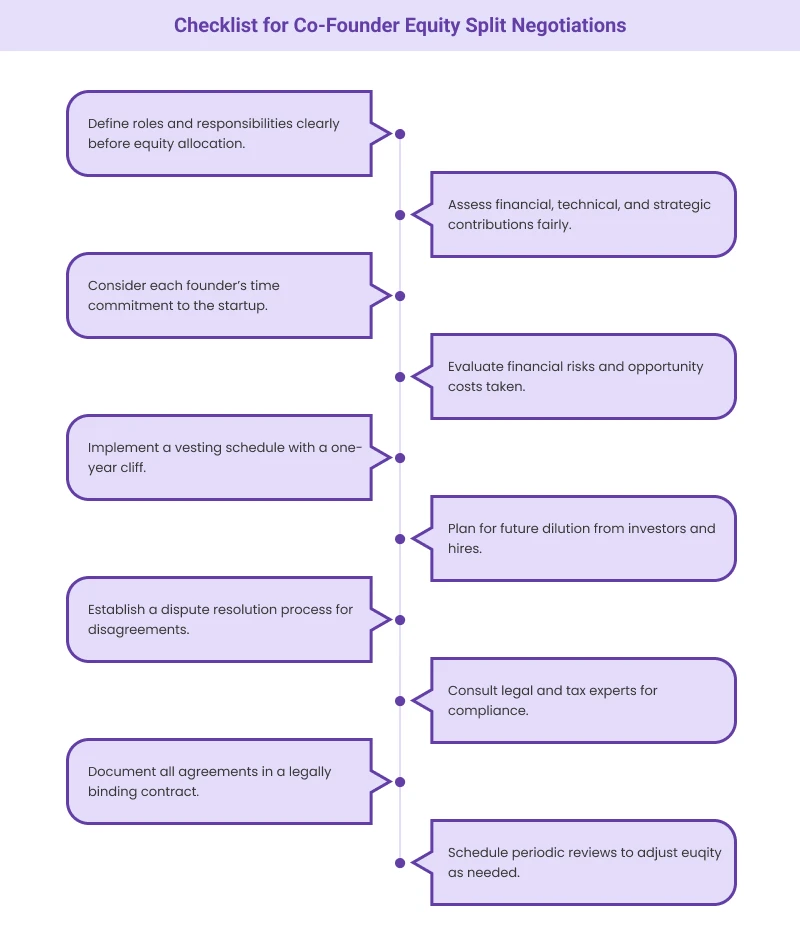
The factors below are the ones founders most commonly weigh.
Uneven contributions are common when one founder joins later or works part-time in the early months. The goal is to reflect that difference fairly, without creating a split that feels punishing to anyone involved.
A few practical approaches:
Equity splits carry legal weight, so informal agreements are risky. A written founders' agreement, reviewed by legal counsel in your jurisdiction, is the standard way to protect every founder's position.
Key elements to include:
Tax treatment of founder equity varies by country, so this section covers general principles that apply broadly, which differ by jurisdiction and change over time.
Many equity disputes trace back to a small set of avoidable mistakes made in the first few weeks of a company's life.
Every funding round changes the ownership percentages of existing shareholders, including founders. Understanding dilution ahead of time gives your team realistic expectations for how ownership will shift.
When a company raises capital, it issues new shares to investors. Existing shareholders keep the same number of shares, but their percentage ownership goes down because the total number of shares outstanding goes up. A founder who owns 40% before a round might own 30% after, even though the number of shares they hold hasn't changed.
A few points founders should keep in mind:
What happens to equity depends entirely on what the founders' agreement says.
A fair equity split comes from a documented process, not a quick agreement made in the excitement of starting a company. The founders who avoid future disputes are the ones who put numbers on paper early, tie ownership to vesting, and revisit the split when someone's role changes.
None of this has to happen in one sitting. Start with an honest conversation about what each founder brings, put the agreed split and vesting terms in writing, and get a lawyer to review it before anyone signs. From there, the split isn't something you set once and forget. It needs tracking through every funding round, every new hire added to the option pool, and every change in who's doing what.
A fair equity split protects the relationship between founders as much as it protects the company. Once that split is agreed, keeping it accurate through vesting schedules, future rounds, and any founder departures is an ongoing job, not a one-time task.
Qapita's cap table management platform tracks founder equity, vesting, and dilution in one place, so your ownership records stay accurate as your company grows and raises capital. Book a demo to see how it works for early-stage founding teams.
Not by default. Equal splits work when contributions are genuinely similar, but many advisors recommend a contribution-based split to reflect differences in time, capital, and risk.
A four-year vesting period with a one-year cliff is common in many markets, though it's a convention rather than a legal requirement and varies by country and company.
Yes, if all founders agree and the change is documented properly. Some teams build in a scheduled review point in the first year for this reason.
It's typically forfeited and returned to the company, assuming a vesting schedule was in place.
Often yes, though the timing and rate depend on the country. Founders should check with a local tax advisor before finalizing their split.
A capital call facility is a credit line that lets a fund draw money quickly, usually to close a deal or cover short-term needs, without immediately calling capital from its limited partners. The fund repays the facility once the actual capital call from investors comes through.