


 Equity management

 Equity management
- Fund management

 Fund management
 - Fund managementFund management
- Fund managementFund management




As a startup founder, managing equity and ownership can be a complex task. You are likely to face challenges like tracking ownership stakes, managing investor relations, and ensuring transparency in equity distribution. Without a structured approach, these tasks can quickly become overwhelming, leading to confusion, disputes, and potential loss of investor confidence.
In such situations, a cap table emerges as a powerful solution to these problems. It is an extensive document that outlines your company's ownership structure, detailing who owns what, including shares, options, and other securities. A cap table serves as a single source of truth for all equity-related information, simplifying equity management and providing clarity for founders, investors, and employees alike.
This blog explores the essentials of cap tables for startups, including their components, benefits, common mistakes, best practices, and more. Let's get started.
A cap table, or capitalization table, is a document that outlines your company's equity structure in detail, listing all the types of securities your startup has issued. It offers a structured overview of who owns what in your company and how much each stake represents.
As venture investing grew more structured, founders needed a consistent way to track who owned what across multiple financing rounds, instruments, and stakeholder groups. Traditional ledgers and ad hoc spreadsheets could not reliably capture changing ownership, dilution, or rights.
Cap tables emerged as the standard record of equity because they offer a single view of founders, investors, and employee ownership over time. Today, a well-maintained cap table is not just a historical log but a core decision making tool for fundraising, hiring, and planning liquidity events, underscoring the importance of cap table for any growing company.
Let's understand why every startup, regardless of its stage, should prioritize cap table management:
1. Equity distribution and ownership clarity: A cap table can help you track each shareholder's ownership percentage. This helps you make informed decisions about future equity allocations without risking misunderstandings. For instance, if you plan to grant additional stock options to key employees, a cap table helps you evaluate how these moves will affect overall ownership distribution.
2. Attracting investors: Investors want to see a well-organized cap table before committing their funds. It demonstrates that you have a clear understanding of your company's ownership structure and can effectively manage equity. A detailed cap table can instill confidence in potential investors, making your startup attractive for investment.
3. Managing employee stock options: A cap table enables you to manage and track these options accurately, ensuring that employees are rewarded fairly without disrupting your equity structure. With stock options listed clearly in your cap table, you have a streamlined view of how much equity is allocated to employees. This allows you to assess the pool's adequacy and adjust it if necessary.
4. Avoiding dilution and legal risks: Without an up-to-date cap table, you risk dilution during fundraising rounds. Investors may inadvertently receive more shares than intended, leading to disputes and potential legal issues. An accurate cap table reduces legal risks by ensuring compliance with shareholder agreements. This helps minimize the chances of errors in ownership records.
5. Benefits of cap table management software: Using cap table management software, such as Qapita, can simplify and automate the process of maintaining your cap table. Qapita offers a user-friendly platform that helps you manage all equity matters from inception to IPO. It provides a single source of truth for your cap table, ensuring accuracy and compliance with legal requirements. With features like customizable reports, scenario planning, and secure data management, Qapita makes it easier to keep your cap table up-to-date and accessible to stakeholders.
You should start using a cap table as soon as you incorporate and issue equity to co-founders or early employees, not just when you raise your first round. A simple spreadsheet works at idea or pre seed stage, but you should move to cap table software as soon as you sign SAFEs, notes, or your first funding round.
Treat every equity conversation as a trigger to update the cap table instead of waiting for year end. If you already rely on emails or pitch decks to answer ownership questions, it is a strong signal to formalize your cap table in a dedicated system.
Qapita is built as an end to end cap table management solution for startups and growth stage companies. It helps teams set up a clean cap table from day one, capture every equity event with proper approvals and documentation, and turn ownership data into clear scenarios for new rounds, option pool changes, and exits.
Consistently rated as a leading equity management platform on G2, this combination of structured setup, real time accuracy, and decision ready modeling makes Qapita a strong choice not just for startups, but for scaling and late stage companies that need governance, transparency, and scenario analysis in one platform.
To see how this works in practice, book a demo with the Qapita team and explore the product against your current cap table.
The following helps you understand the differences between the two:
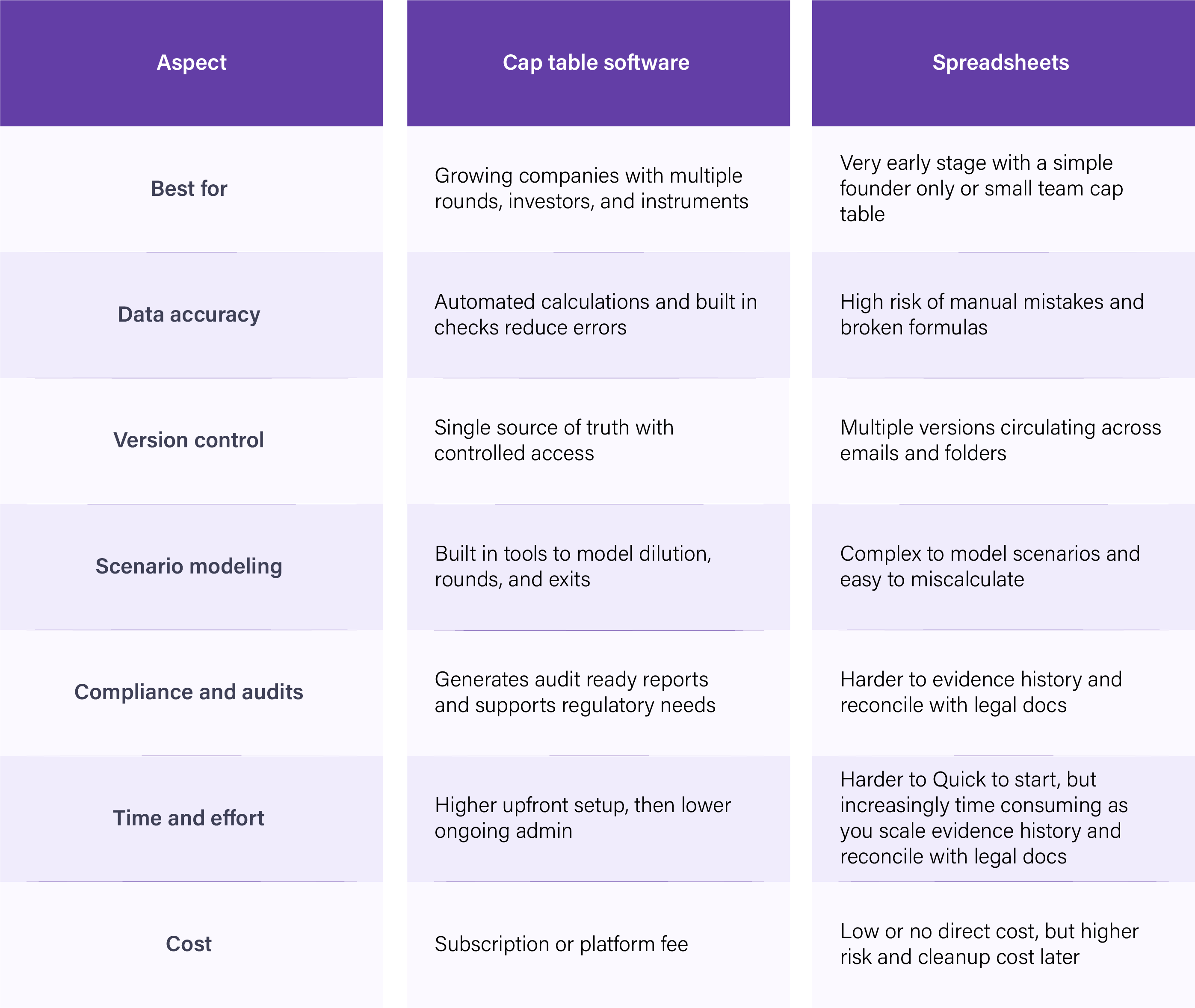
For a founder, a practical rule of thumb is to move from spreadsheets to a dedicated cap table platform once your ownership structure is no longer simple and static. That usually happens after your first funding round, when you introduce an option pool, convertible instruments, or multiple investor updates. At that point, software gives you a single, reliable record of ownership, reduces the risk of errors in key transactions, and makes fundraising and diligence significantly smoother.
Cap table structure outlines the ownership distribution among founders, investors, and employees. It evolves with the company, detailing share classes, funding rounds, and equity grants. The following section will help you understand the key components of a cap table.
At its core, a cap table answers the fundamental question: "Who owns what part of the company?" This foundation provides a clear picture of how ownership is distributed across all stakeholders.
Your ownership section should detail:
This section serves as your starting point for understanding the current state of company ownership.
Different types of equity in your cap table are organized into share classes, each with their own distinct rights and privileges, such as common and preferred shares, each with distinct rights like voting power and liquidation preferences.
Your cap table should maintain a chronological record of every transaction that impacts company ownership. Think of this as your company's equity "ledger" that tracks the evolution of ownership over time.
Important transactions to document include:
This historical record proves invaluable during due diligence processes, providing potential investors with transparency into your company's equity evolution.
Valuations track the monetary value of shares over time, covering pre-money, post-money, and 409a valuations. A comprehensive cap table tracks the changing value of your company's equity over time:
These valuations directly impact everything from employee option pricing to investor negotiations, making them essential components of your cap table management process.
When new shares are issued, existing shareholders ownership percentages decrease, a process known as dilution. When a company raises funds or grants equity, the overall “pie” expands, but each current owner’s slice becomes smaller.
This process is normal in growth stages like fundraising and hiring. A detailed dilution analysis helps shareholders understand the impact of these transactions on their equity stake. It also enables scenario planning.
Exit scenarios are a vital part of cap table management, helping predict how proceeds from a sale, IPO, or liquidity event will be divided. This process typically uses waterfall analysis, which calculates distributions based on each share class’s rights and priorities.
Waterfall modeling clarifies the order and amount each stakeholder receives, offering founders, employees, and investors a transparent view of potential returns during exit events.
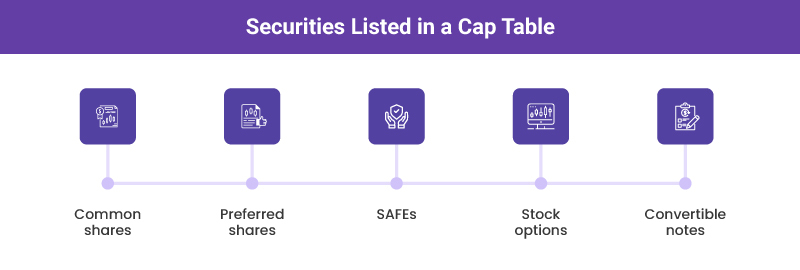
Here is a breakdown of various types of securities listed in a cap table:
Must Read: Preferred Stock Vs. Common Stock: Understanding the Difference
Creating a cap table is about turning every equity agreement into a single, reliable source of truth. The process is simple in concept, but it pays to set it up with care so you do not have to unwind mistakes later.
These essential steps will help you create a well-structured cap table that will support your company's growth.
Before building your cap table, determine who will be responsible for maintaining it. This decision impacts accountability, accuracy, and access management.
In early-stage startups, this responsibility typically falls to the founder, often the CEO, who manages investor relationships and fundraising efforts. As your company matures and equity structures become more complex, this responsibility may shift to your finance team.
Collect every document that touches ownership, so you start with a complete picture. This includes incorporation documents, shareholder registers, financing agreements, board resolutions, grant letters, and any notes or SAFEs that may convert into equity later. From these, list total authorized shares, issued and outstanding securities, security types, and basic holder details.
Very young companies can begin in a structured spreadsheet, but growth stage companies are better served by dedicated equity management software that reduces manual errors and supports audit ready reporting. Whichever route you choose, use a consistent layout so anyone can read it at a glance. Typical columns include stakeholder name, security type, share class, number of units, price per unit, and fully diluted ownership percentage.
Start by entering the founders and early team with their common shares and agreed ownership split. Add any vesting schedules or cliffs, and note restrictions that may affect transferability. This becomes the baseline against which all future dilution and new issuances are measured.
Next, capture each financing event in detail. For every round, record the amount invested, share class, price per share, number of shares issued, and key rights such as liquidation preferences or voting terms. If you have convertible notes or SAFEs, add them with their principal amount and agreed conversion mechanics so you can model their impact on ownership when they convert.
Set aside a defined option pool as a portion of your company’s shares reserved for current and future employees. Include this pool as a separate line in your cap table so investors and founders can clearly see its size and the potential dilution impact. Track equity grants made from the pool, the remaining reserve, and any applicable vesting schedules. Planning your option pool strategically ensures you have enough shares to attract and retain talent while maintaining transparency and control over ownership dilution as your team grows.
A cap table is not a one time exercise. Update it whenever you issue or cancel equity, close a round, adjust the option pool, or convert a note. Regular reconciliation with legal documents and board approvals keeps the numbers defensible in diligence, supports faster fundraising, and builds trust with every stakeholder who relies on it.
A well-structured cap table template provides a clear and organized way to track your company's equity distribution. With our detailed template, you can streamline your equity tracking, making it easier to manage and update your cap table regularly. It allows you to add or remove columns, adjust ownership percentages, and include specific details relevant to your company's needs.
Download a sample Cap Table Template from Qapita: Company Ownership Cap Table Template
Let's use an example to understand the structure of a cap table. Consider that you have just incorporated your startup with 1,000,000 shares. Here is how your initial cap table might look:
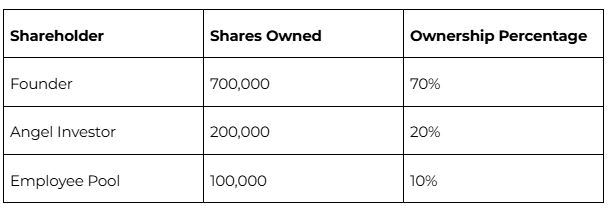
Now, imagine if you go through a Series A funding round where you raise $2 million at a post-money valuation of $10 million. Now, your cap table must be updated according to the following changes:
1. Post-Money Valuation: $10 million
2. Amount Raised: $2 million
3. New Shares Issued: 250,000
To calculate the new shares issued, follow these steps:
1. New shares = Amount raised / Share price
2. Share price = Post-money valuation / Total shares after the round
3. Total shares after the round = Initial shares + New shares
Dilution occurs when new shares are issued, reducing the ownership percentage of existing shareholders. Hence, the updated cap table after Series A will look as follows:
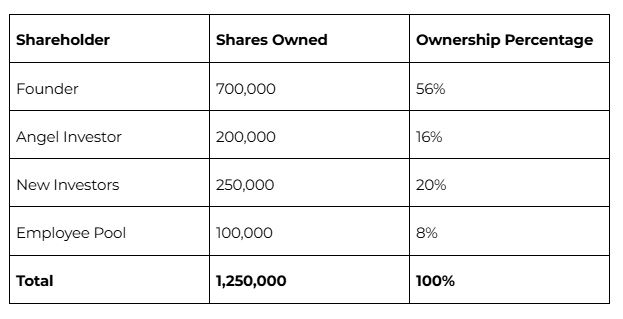
Due to the new investment, your ownership percentage (as a founder) has been diluted from 70% to 56%.
As your startup grows, your cap table will evolve, becoming more complex with each financing round. Initial cap tables might be straightforward, with a few founders and early employees holding shares. However, as you bring in investors, issue more options, and go through multiple funding rounds, the cap table will expand and require more structured cap table management for startups to ensure accuracy and transparency.
Maintaining an up-to-date cap table helps with compliance and also develops trust among all stakeholders, including investors, employees, and co-founders. It helps you navigate strategic decisions, negotiate terms with potential investors, and better plan for future growth.
When you first start your company, your cap table is straightforward. It typically includes just the founders and any initial investors. At this stage, it is all about common shares, representing ownership in your startup.
As the company scales, many teams turn to specialised cap table management companies or platforms to keep this ownership record accurate and audit ready. However, as your startup grows and raises multiple rounds of financing, your cap table becomes more complex. Here's how:
1. SAFEs and convertible notes: These instruments don't immediately convert into equity but do so during a future financing round. When they convert, they can lead to dilution for existing shareholders.
2. Employee stock options: As you hire more employees, you will likely offer stock options as part of their compensation. When employees exercise their options, new shares are issued. This impacts the cap table by increasing the total number of shares outstanding.
3. Stock transfers: Stock transfers occur when shares are sold or transferred between parties. This can happen when founders or early investors sell part of their stake or when employees leave the company, and their options are bought back.
A cap table is a dynamic document that evolves with your company. Pre-financing cap tables reflect your startup's equity distribution before a new funding round. They highlight the initial ownership structure among founders, early investors, and employees.
Pro-forma cap tables, on the other hand, project the future equity structure after a financing round. They incorporate new shares or options issued in the round, giving you a clear picture of post-investment ownership percentages.
Fundraising rounds and option grants inevitably lead to ownership dilution. Effective cap table management requires proactively modeling these scenarios before they occur, rather than being surprised by their impact.
Dilution modeling allows you to:
For a deeper understanding of share dilution, its impacts, and mitigation strategies, read our comprehensive guide on Share Dilution that covers everything from the basics to advanced concepts like the role of SAFEs and valuation caps in equity dilution.
A cap table does not stay static as a startup matures. Each funding stage introduces new stakeholders, instruments, and rights, so the way the cap table is structured and maintained needs to keep pace with the company’s growth.
In the company formation and seed phase, the cap table is built around common shares issued to founders and, in some cases, a small group of early advisors. The focus is on getting the share capital structure right from the start, documenting founder allocations, nominal values, and any vesting that keeps key people aligned over the long term. As the first external capital comes in, the table begins to record seed investors, basic valuation terms, and the creation of an initial option pool for early hires, while keeping the overall structure intentionally simple so it remains easy to update and explain.
By Series A, the cap table starts to carry more weight in negotiations. Preferred shares are introduced, usually as a distinct class with specific economic and governance rights, and the table needs to show clearly how these differ from ordinary shares. It becomes the reference point for pre money and post money valuations, conversion of earlier notes or SAFEs, and the impact of new capital on founder and seed investor stakes. As additional rounds follow, the cap table tracks each series of preferred shares, revised option pools, and changing ownership percentages, so everyone around the table can see how dilution and protections are playing out.
In the late stage, the cap table reads like a history of every major financing and transaction. It may include multiple preferred series, exercised and unexercised employee equity, and records of secondary sales where earlier shareholders have partially exited. At this point, the cap table underpins valuation work, exit modeling, and regulatory readiness, feeding into accounting for equity compensation and the disclosures required ahead of an IPO or acquisition.
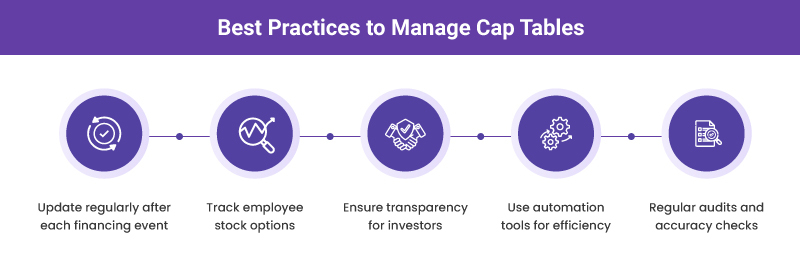
Here are some best practices for maintaining an accurate cap table:
1. Update regularly after each financing event: Update your cap table every time you issue new shares, grant stock options, or go through a financing round. Regular updates ensure that all equity transactions are accurately recorded, preventing inconsistencies and mistakes down the line.
2. Track employee stock options: Accurately tracking employee stock options helps you manage vesting schedules, monitor option exercises, and maintain a clear record of equity allocation to employees. This helps motivate your team and also ensures fair distribution of equity.
3. Ensure transparency for investors: A well-maintained cap table promotes transparency, which is critical for investor relations. Investors want to see an accurate record of equity distribution and potential dilution risks. This transparency helps you build trust with the investors, making it easier to secure funding and negotiate favorable terms.
4. Use automation tools for efficiency: Leveraging automation tools like Qapita can simplify cap table management. Qapita provides a user-friendly platform that automates the tracking of equity transactions, updates ownership records, and generates detailed reports. By using such tools, you can reduce errors, save time, and ensure that your cap table is always up-to-date.
5. Regular audits and accuracy checks: Conduct regular audits to ensure your cap table is accurate and reflects the latest equity distribution. Regular accuracy checks help identify and correct any discrepancies, ensuring that your records are reliable. This practice is crucial for maintaining investor confidence and ensuring legal compliance.
Even well-run companies can let their cap table drift. The biggest issues tend to show up at fundraising, when investors start asking hard questions about ownership, dilution, and documentation.
Waiting until the first priced round to build a cap table makes it harder to reconstruct who owns what. Start tracking equity from incorporation, including co-founder splits, early promises, and any convertible instruments, and keep everything in one source of truth.
Cap tables break when updates are delayed. Make it a habit to record new grants, transfers, cancellations, and conversions as soon as they are approved so there is never a gap between what is signed and what is on the cap table.
Multiple spreadsheet versions increase the risk of typos, broken formulas, and teams working off different numbers. Move to a single, controlled system, and agree on who can edit versus view so there is always one definitive version.
Informal emails, or missing board approvals, eventually turn into ownership disputes. Insist that every equity decision is captured in a signed document, then reconcile that document against the cap table before closing a round or grant.
If founders and employees do not understand how different share classes, preferences, or convertibles affect payouts, expectations can misalign quickly. Use your cap table to model scenarios in advance, and walk key stakeholders through what happens to their stake in each case.
Option pools that are too small constrain hiring, while oversized pools create avoidable dilution. Size the pool based on your near term hiring plan, review it before each round, and make the pool and its impact visible as a separate line on the cap table.
Silence around ownership creates anxiety and erodes trust. Share an appropriate level of cap table information with founders, investors, and employees, explain changes in plain language, and give people a clear place to go when they have equity questions.
Recommended Read: 5 Must-Follow Cap Table Management Tips for Startups
Cap tables play a pivotal role in investor relations and due diligence. Investors use cap tables to understand the equity distribution, founder incentives, and potential dilution risks. A well-maintained cap table provides transparency, showcasing how shares are allocated and ensuring that investors know their stake in the company.
This clarity builds trust, making investors more confident in their decisions and facilitating smoother financing rounds. Transparency in cap table management helps avoid potential disputes, ensuring all parties are aligned with the company's equity structure and future plans.
Investors expect a cap table that is current, fully diluted, and easy to interpret. Clear summaries that highlight total ownership by founder, employee pool, and each investor, along with a brief history of financing rounds, help position the company as organized and due diligence ready.
Pro forma cap tables extend beyond the current snapshot to show how ownership would look after a proposed round. They allow founders and investors to test different raise sizes, valuations, and option pool top ups, making it easier to negotiate terms with a shared view of post money dilution.
Investors review cap tables to assess whether founders still hold enough equity to stay committed through future stages. Clearly showing founder stakes by round and how they evolve over time signals that the leadership team remains meaningfully invested in the company’s long-term success.
Anti-dilution protections, especially in down rounds, help investors preserve the economic value of their stake when new shares are issued at lower prices. When these provisions are modeled transparently on the cap table, they can increase investor confidence while making the impact on founders and other shareholders explicit.
During due diligence, investors use the cap table to verify that all securities are authorized, documented, and consistent with legal agreements. A transparent cap table, supported by clean records and clear audit trails, reduces perceived risk, accelerates closing timelines, and serves as a visible signal of strong governance.
A cap table details a company's ownership structure, showing who owns what in terms of shares, options, and other securities. Whereas, a balance sheet offers a snapshot of the company's financial health, listing assets, liabilities, and equity on a given date. In essence, a cap table focuses on equity distribution, while a balance sheet covers overall financial status.
You should start maintaining a cap table as soon as you incorporate your startup. This ensures accurate tracking of equity from the very beginning, simplifying future fundraising, equity distribution, and compliance with legal requirements. Early maintenance of a cap table helps avoid potential disputes and provides clarity for founders, investors, and employees.