

 Equity management

 ESOP Management
- Fund management

 Liquidity Solutions
 - Fund managementESOP Consulting
- Fund managementFund Management


.webp)

Startups and growing companies often face a common challenge. They need experienced talent, advisors, or co-founders, but may not always have the cash to offer competitive salaries.
This is where sweat equity comes in.
Sweat equity shares are a type of equity compensation that allows companies to reward individuals for their skills, expertise, intellectual property, or business contributions instead of direct monetary payment. These shares are commonly used by startups to attract early employees, directors, technical experts, and strategic advisors who help build the company during its growth stage.
In this article you will find out what exactly sweat equity shares are, how they can be issued, their significance, and the step-by-step procedure to issue them.
Sweat equity shares are issued by a company to its employees or directors at a discount or for a consideration other than cash. It gives the company directors or employees ownership and equity upside in the company. The idea is to compensate individuals for their efforts and contributions with ownership stakes in the company
Sweat equity shares are:
Some of the key features of sweat equity shares are:
Sweat equity shares are issued for contributions such as technical know-how, intellectual property rights, business expertise, or strategic value addition instead of direct monetary payment.
Companies may issue sweat equity shares at a discount to the fair market value of the shares.
Sweat equity shares can generally be issued to employees or directors who contribute value to the company under the Companies Act, 2013.
The issuance of sweat equity shares requires approval through a special resolution passed by shareholders.
The FMV of sweat equity shares and the value of the contribution provided must be determined by a registered valuer.
Sweat equity shares are typically subject to a lock-in period, during which the shares cannot be transferred or sold.
Since new shares are issued, sweat equity can dilute the ownership percentage of existing shareholders.
Early-stage startups often operate with limited capital. There are specific, practical reasons why this instrument is particularly valuable, especially in the early and growth stages of a business.
Early-stage and bootstrapped startups are frequently cash-constrained. Paying competitive salaries to experienced engineers, patent holders, or domain specialists is often not feasible. Sweat equity lets the company reward meaningful contributions without draining working capital. The value goes to the employee; the cash stays in the business.
A senior engineer, an experienced product leader, or a domain expert with proprietary knowledge can be the difference between a startup that scales and one that stalls. Offering sweat equity gives such individuals a direct financial stake in the outcome of their work, making the offer competitive even when the fixed salary is not.
Some contributions cannot be priced by the hour. A co-founder who develops a proprietary algorithm, a technical director who builds intellectual property for the company, or an advisor who secures a critical partnership, these are exactly the kinds of contributions sweat equity is designed to recognize. The Companies Act, 2013, specifically includes know-how, IP rights, and value additions as valid grounds for issuance.
When employees and directors own a piece of the company, their incentives align more closely with its growth. They are not just working for a salary anymore. They have skin in the game, which tends to drive stronger ownership, better decisions, and greater commitment over time.
The mandatory three-year lock-in period on sweat equity shares creates a built-in retention mechanism. Recipients have a financial reason to stay with the company and watch it grow in value before they can exit.
Following is the step-by-step procedure for issuing sweat equity shares:
In India, sweat equity shares are issued according to the Companies Act, 2013 and Companies (Share Capital and Debentures) Rules, 2014. For listed companies, the Securities Exchange Board has laid down the rules regarding the issuance of these shares.
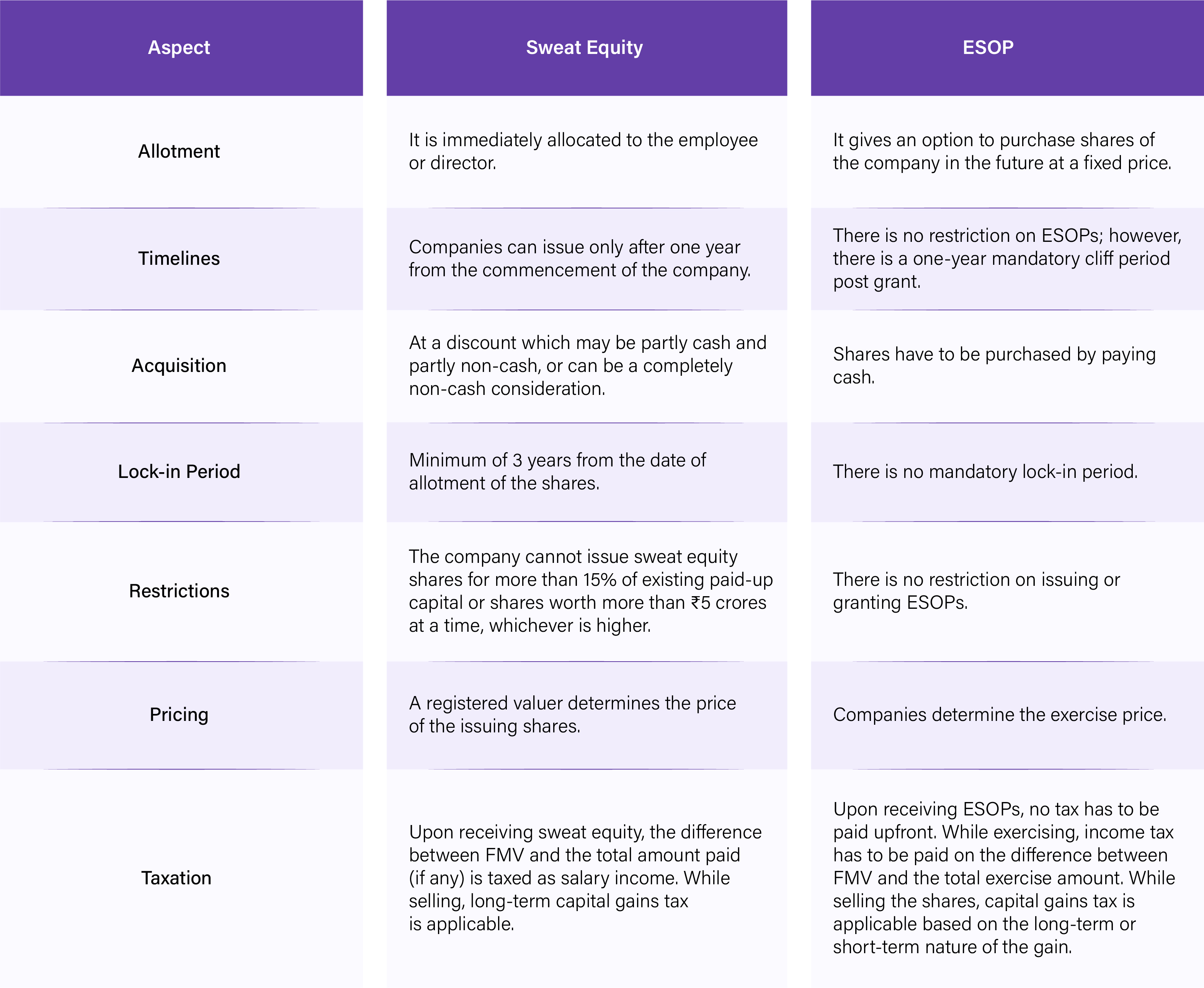
Unlike ESOPs, the sweat equity shares are allocated immediately. Sweat equity shares are generally given to the employees or directors for their:
1. Extraordinary contribution and hard work in the completion of a project.
2. Technical know-how or expertise in an area of the business.
3. Value addition made to the company or contribution towards gaining intellectual property rights.
The key benefits of sweat equity for companies are:
1. Saves cash: Offering sweat equity as a reward saves cash for the issuing company. It is beneficial for cash-strapped businesses; offering equity as compensation reduces the cash expenses.
2. Provide Upside & Retain employees: Sweat equity creates a generous reward for the employees and makes them feel valued. It imbibes a sense of ownership and responsibility in them, helping to retain talent for the company.
Some considerations for founders and employees with sweat equity:
1. Lock-in period: A lock-in period of 3 years may not be agreeable to all the employees/directors.
2. No vesting period: Founders may prefer to have a vesting period, while providing equity upside else there is a risk of employees leaving the company with shares in hand.
3. Upfront tax implications in the hands of an employee: Employees may need to pay tax upon receiving the sweat equity shares.
The followings are eligible to get sweat equity shares:
1. Permanent employee of the company who is working with the company for at least 1 year in India or abroad.
2. Permanent employee of the subsidiary company or a holding company working either in India or abroad for at least 1 year.
3. Directors of the company (independent directors are not eligible).
The conditions for issuing sweat equity shares are:
Listed companies must issue sweat equity shares in accordance with Companies (Share Capital and Debentures) Rules, 2014 by SEBI, while unlisted companies must issue sweat equity shares according to section 54 of the Companies Act, 2013.
Following are the conditions that company must fulfill to qualify for issuing sweat equity shares:
The company shall disclose the following details in the annual board report for the year in which sweat equity shares were issued:
Startups mostly give ESOPs instead of sweat equity to employees to reward and retain them since there is a vesting period in ESOPs schemes. In contrast, sweat equity shares are allocated with immediate effect.
Sweat equity shares play an important role in helping startups and growing companies reward contributors who create long-term value for the business. Whether it is technical expertise, strategic guidance, intellectual property, or operational support, sweat equity allows companies to recognize contributions without immediate cash payouts.
For employees, founders, and advisors, sweat equity shares offer an opportunity to participate in the company’s growth journey and future value creation. However, companies must also ensure proper valuation, compliance, taxation, and cap table management while issuing sweat equity shares in India.
As businesses scale, having the right equity management processes in place becomes essential for maintaining transparency and investor readiness.
Managing sweat equity shares, ESOPs, founder ownership, and shareholder records manually can quickly become complex as your company grows.
Qapita helps companies manage every stage of their equity journey, from designing and issuing the right equity instruments to maintaining a real-time, audit-ready cap table. With in-house expert valuers, an ESOP consulting team, and a purpose-built equity management platform, everything you need is in one place, no spreadsheets, no gaps, no compliance surprises.
Book a demo to learn more.
Yes. Sweat equity shares are taxable in India. At 2 stages, at the time of allotment, the difference between the fair market value and the amount paid is taxed as a perquisite under salary income. And, capital gains tax may also apply when the shares are sold later.
Yes. Under Indian regulations, sweat equity shares generally come with a lock-in period. During this time, the shares cannot be transferred or sold.
Yes. Since sweat equity shares increase the total number of shares issued by a company, they can dilute the ownership percentage of existing shareholders.
Yes, sweat equity shares can be sold, but they are usually subject to a lock-in period under Indian regulations. During the lock-in period, employees or directors cannot transfer or sell the shares. Once the lock-in period ends, the shares may be sold subject to the company’s shareholder agreements, transfer restrictions, and applicable laws.