


 Equity management

 ESOP Management
- Fund management

 Liquidity Solutions
 - Fund managementESOP Consulting
- Fund managementFund Management



Equity compensation can be exciting, but it can also feel confusing at first. The idea of owning a stake in the company you work for is appealing. It signals trust, growth, and the possibility of sharing in the company’s success.
But when you are presented with terms like ESOP and ESPP, it is natural to pause and ask a few practical questions. Should you participate? Is it truly valuable, or does it depend on certain conditions? What risks are involved? And how will it affect your taxes?
Employee stock purchase plan (ESPP) and employee stock options plan (ESOP) are two common methods used by startups and large enterprises to reward and retain employees. These aren’t small decisions. While both ESOPs and ESPPs give employees an opportunity to own company shares, they function in very different ways. Understanding how each works and what it means for your financial goals is essential before you decide to opt in.
In this guide, we break down the meaning, how each of them works, their tax implications and the differences between the two.
ESPP is an employee benefit program under which employees get the company's share at a discounted price. It's the choice of employees whether they want to participate in the ESPP program of the company or not.
ESPP programs are mostly seen in public companies. The participating employees contribute a part of their salary, usually between 1% to 15%, every month for a specified period. The accumulated amount is used to purchase shares for the employee at a discounted price at certain intervals.
The discount percent depends on the plan terms and is mentioned in the ESPP policy of the company. The purchase price is taken as the share price on the purchase date with the discount. When the employee selects the percentage of salary to be deducted for the ESPP program, the offering period begins. The period can last anywhere from 6 to 27 months.
The accumulated funds are used to purchase the shares of the company at a discounted price. This is the Purchasing Date. If there is a lookback provision in the ESPP policy, the discount is taken on the lower of the share price as on the offering and the purchasing date.
Some companies allow a flexible policy to opt out of the program in the middle of the offering period.
Here’s how a typical ESPP usually operates:
• You become eligible and sign up: Once you are eligible, you enroll during the enrollment window and set up your account if needed. Then you choose how much of your paycheck you would like deducted for the upcoming purchase period to invest in company shares.
• Your money builds up quietly in the background: Over the next few months, often three to six, your chosen amount is automatically set aside from your salary. The company handles the deductions.
• The shares are purchased for you: At the end of the purchase period, the accumulated contributions are used to buy company stock on your behalf. If the plan offers a discount, the stock is purchased below market price, thus giving you an instant edge.
• You reassess for the next round: When the next enrollment window opens, you get the chance to review your contributions. You can increase them, decrease them, or keep them the same depending on your financial goals and comfort level.
Let's go through an example to understand how ESPP works.
Let's say a listed company offers an ESPP program to its employees. According to the plan, the discount is 10% and the offering and purchase periods are both 6 months. There is a lookback provision in the policy too. An employee Abhishek, whose salary is Rs 90,000 enrolls in the company's ESPP program for 6 months. He chooses to go for a 15% deduction from this salary towards the ESPP program. Amount deducted per month = Rs 13,500 Amount accumulated in 6 months = Rs 81,000
Case 1: When the share price increases.
Say, the share price on the offering date is Rs 90 and Rs 120 at the end of 6 months. The Shares will be purchased for Abhishek at the end of 6th month.
The share purchase price is determined as follows:
The total shares purchased = Rs 81,000/Rs 81 = 1000
Case 2: When the share price decreases.
Now, suppose, the share price on the offering date is Rs 90 and Rs 60 at the end of 6 months. The Shares will be purchased for Abhishek at the end of the 6th month.
The purchase price is determined as follows:
So, the total shares purchased = Rs 81,000/Rs 54 = 1500
In the US, the ESPP program is of two types: qualified and non-qualified. The qualified ESPP programs have better tax benefits than non-qualified ESPP programs but are subject to restrictions on maximum discounts allowed.
Now, let's see the pros and cons of the employee stock purchase plan.
Now, let's discuss the employee stock options plan and what are its pros and cons.
ESOP stands for employee stock options plan and gives employees the right to purchase the company's shares at a certain price known as the strike price as per the ESOP scheme. The employees may choose to purchase the stocks once the options vest.
Many companies set up ESOPs a s a thoughtful way to transfer ownership, reward long-term commitment, and protect the culture they have built over the years. ESOPs can be a powerful retention tool, beyond succession planning. When employees become shareholders, their connection to the company naturally deepens because they are not just working for the business, they are building value alongside it.
ESOPs are common in startups and a good way for founders to give competitive compensation to their employees. Before creating the ESOP scheme, you may want to familiarize yourself with terms related to ESOP.
• Grant: The grant marks the beginning of an ESOP, when employees are awarded stock options. The number granted typically depends on their role, seniority, and importance to the company.
• Vesting: The vesting period requires employees to stay for a set time before they can exercise their options. The value of those options rises or falls based on the company’s performance.
• Exercise: After vesting, employees can exercise their options within a set window by paying the exercise price and taxes. If they don’t, the options lapse, and any gain stays only on paper until exercised.
• Sale or settlement of shares: Once exercised, options turn into shares. In many unlisted companies, employees receive the net gain, after deducting the exercise price and taxes, without needing large upfront payments.
ESOPs come with complex rules and regulations and require companies to maintain accurate records. Qapita, an equity management tool, makes it easy to grant and administer ESOPs.
Taxation plays a major role in understanding real gains.
Employees are generally taxed twice:
• Nature of tax: It is treated as a perquisite, which means it becomes part of your salary income.
• Taxable amount: The difference between Fair Market Value (FMV) on the exercise date and the price you paid (exercise price).
• Tax rate: It is taxed according to your applicable income tax slab.
• Short-term capital gain (STCG): If you sell the shares within 12 months of exercising them, the gain is taxed at 20%.
• Long-term capital gain (LTCG): If you hold the shares for more than 12 months, the gain is taxed at 12.5%, but only on the portion exceeding Rs. 1.25 lakhs in a financial year.
Similar to ESOPs, ESPPs are taxed twice also.
(a) At purchase: The discount between the market value and your purchase price is taxed as salary income.
(b) At sale: Any profit above the purchase date’s market value is taxed as a capital gain.
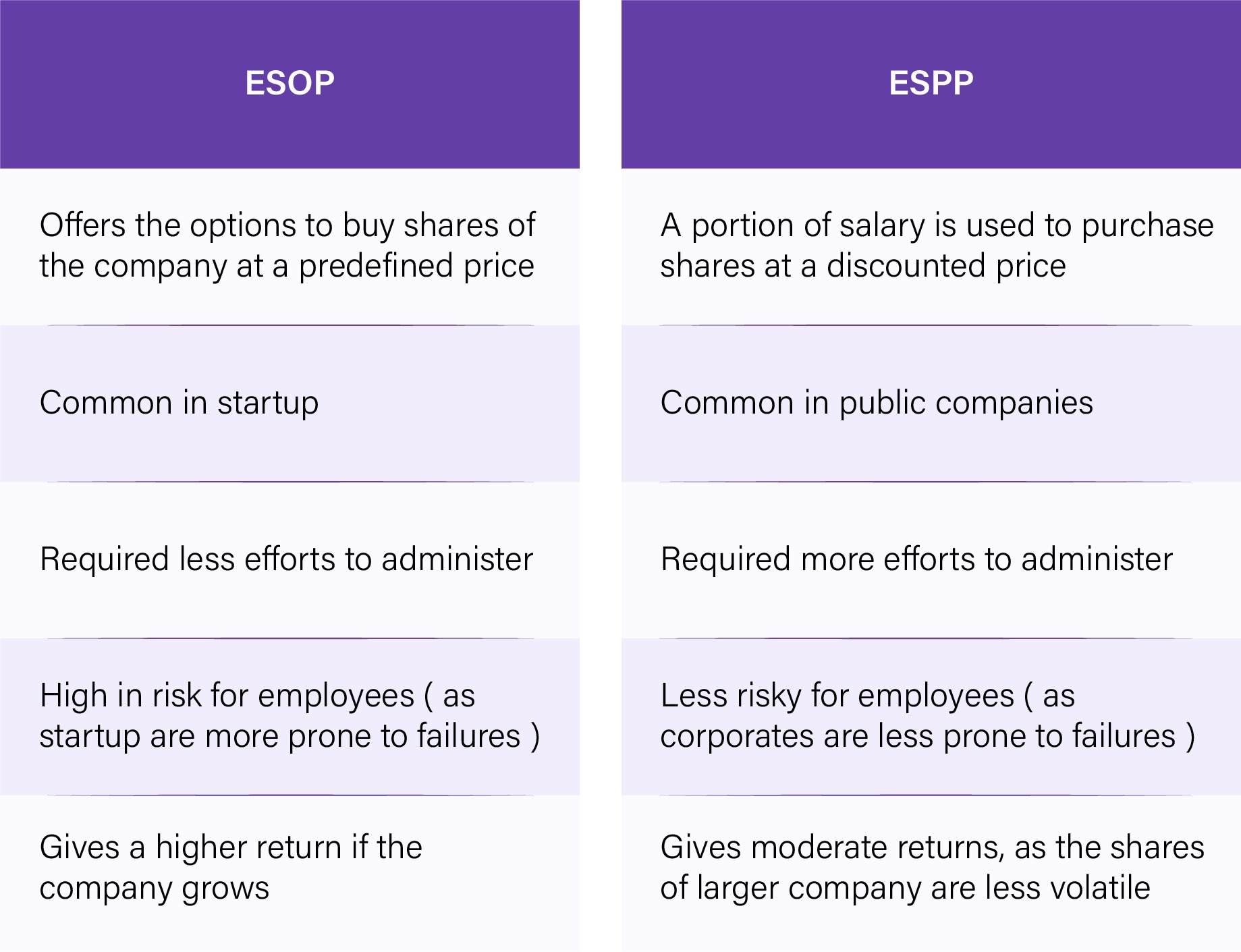
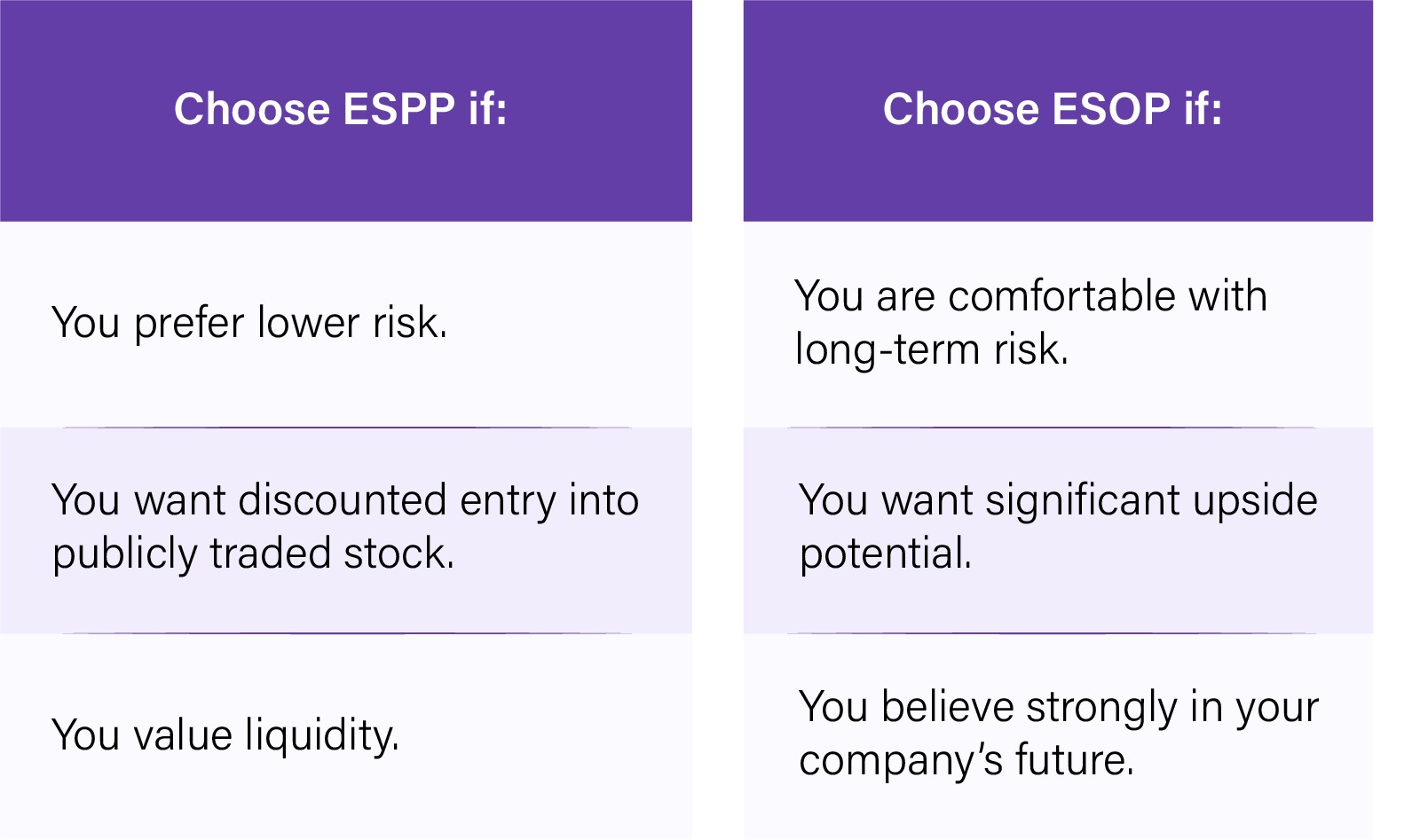
Let's look at the differences between these two. The most evident difference is that ESOPs are quite common in startups while ESPP exists in public companies.
Managing ESOPs doesn't have to be complicated. Qapita is an equity management platform that fully digitises your ESOP journey from designing a scheme and granting stock options to tracking conversions and lapses. With zero paperwork, minimal errors, and seamless communication tools, your employees always stay informed about the true value of their equity.
Ready to take the complexity out of equity management? Book a demo and see Qapita in action.