

 Equity management

 ESOP Management
- Fund management

 Liquidity Solutions
 - Fund managementESOP Consulting
- Fund managementFund Management



In today’s corporate world, Environmental, Social, and Governance (“ESG”) performance isn’t just a compliance checkbox; it’s a strategic necessity. Investors, regulators, and employees are demanding that companies commit to sustainability and inclusive growth. Organizations must now adopt frameworks that align financial outcomes with ethical and sustainable practices.
One underexplored opportunity lies in Employee Stock Option Plans (“ESOPs”). Traditionally used to attract and reward talent, ESOPs can play a transformative role in advancing ESG goals if strategically implemented across the lifecycle.
In India equity-based compensation particularly ESOPs is governed under the provisions of the Companies Act, 2013 read Rule 12 of the Companies (Share Capital and Debentures) Rules, 2014 and the provisions of the Securities and Exchange Board of India (Share Based Employee Benefits and Sweat Equity) Regulations, 2021 (“ESOPs Regulations”).
On the other hand, ESG is a framework for evaluating a company’s sustainability and ethical practices across three key areas: environmental impact, social responsibility, and corporate governance.
ESG reporting in India is guided by the SEBI-mandated Business Responsibility and Sustainability Reporting (BRSR) Guidelines, which are currently applicable to the top 1,000 listed companies by market capitalization.
Let’s explore how ESG can be integrated at various stages of the ESOP lifecycle.
The key to enabling ESG performance lies in evaluating the impact across the fundamental stages of the ESOP lifecycle. The integration of ESG metrics is most effective at the Grant and Vesting stages.
The grant stage involves identifying eligibility and defining the structure.
Practical example:
A manufacturing entity could introduce an "ESG Innovation Grant." For instance, an engineer who successfully implements a circular economy project that reduces raw material waste by 15% (verified via environmental audits) becomes eligible for a specialized tier of employee stock options.
The challenge:
Subjectivity and Bias. Broad ESG goals can lead to inconsistent grant allocations, creating governance (G) risks or perceptions of unfairness.
Mitigation strategy:
Standardized ESG Scorecards. Link eligibility to specific, auditable KPIs already being tracked for SEBI-mandated BRSR reporting. This ensures that governance is transparent and the selection process is objective.
Vesting refers to the timeline and conditions over which employees earn the right to their stock options.
Practical example:
A company can implement a "Hybrid Performance Tranche" structure:
(a) 70% Core Allocation: Vests based on a combination of time (tenure) and financial/individual performance targets (e.g., EBITDA growth or departmental KPIs).
(b) 30% ESG Allocation: Vests only if the company achieves specific sustainability or social milestones, such as a 10% reduction in carbon footprint or achieving a 40% gender diversity ratio in mid-management.
The challenge:
Fixed Regulatory Timelines. Under ESOPs Regulations, vesting periods cannot be extended if it is detrimental to the employee or exceeds shareholder-approved limits.
Mitigation strategy:
Binary Performance Tranches. Instead of extending the timeline, use clear "Yes/No" milestones within the approved vesting window. If the ESG milestone is missed, only that specific 30% performance tranche is forfeited, while the core 70% remains intact. This keeps the plan within legal and shareholder-approved limits.
Traditional ESOPs vs. ESG-Integrated ESOPs:
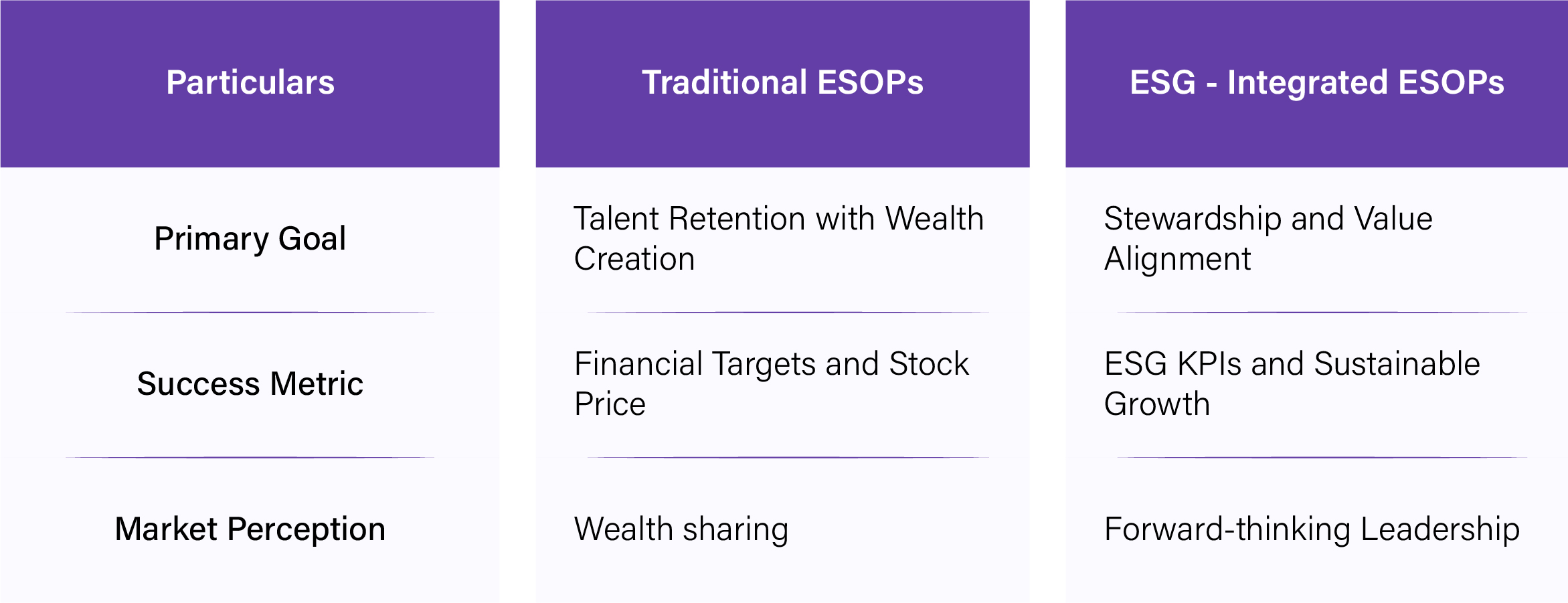
Institutional investors and proxy advisory firms are increasingly scrutinizing how executive and employee incentives are linked to long-term sustainability. An ESG-linked ESOP acts as a "Signal of Authenticity," proving that the company’s commitment to its BRSR goals is embedded in its incentive structure.
Incorporating ESG objectives into the ESOP lifecycle isn’t just possible; it’s transformative. It empowers employees to act not just as shareholders, but as stewards of the company’s long-term values, culture, and impact.
A well-structured ESOP plan isn’t just about wealth sharing; it’s about values sharing.