Private Company Equity Plans​

Phantom Stock Management Built for Private Companies​

Manage ESOPs for listed and private companies in one unified platform. From cap table to grants and vesting to exercises, reporting, and employee readiness, run ESOP operations with clarity, control, and compliance built in.​

Built for private companies, trust companies, PE-backed businesses, and professional services firms running phantom stock, SAR, and profit interest programmes.​​

Recognised by G2 as a Leader in Equity Management

Quality of Support
Ease of Use
Learn More
Qapita is one of the easiest equity management tools with one of the best support teams in the market. Highly recommended.
Aquibur Rahman, CEO & Founder, Mailmodo
The Problem

Does this sound familiar?

If you're in HR​

  • You manage grants in a spreadsheet. Every new participant means another row, another formula, another thing to update manually. When someone leaves, you recalculate how much is vested. When someone retires and the board approves acceleration, you do it again across the years of tranches.
  • Employees email you asking what they hold, when it vests, and what happens if the company is sold. You answer each one individually because there's nowhere for them to look it up.​​
  • The spreadsheet works, until the person who built it isn't there to explain it.​​

If you're in Finance​

  • You have a multi-tab Excel model for the liability accounting. It's technically correct. But only you truly understand it. Every quarter-end, you update fair values, recalculate the liability, allocate the expense, and rebuild the disclosure report for your auditors. It takes days.​
  • ​When your auditors ask for tranche-level detail, you produce it by hand. When a termination triggers an expense reversal, you recalculate and hope you caught everything.​
  • ​The model is not documented. If you left, the programme's financial reporting would leave with you.​​
The Solution

One platform. Two teams served. Zero spreadsheets.​

Qapita is an equity compensation management platform, built for private companies running phantom stock, SAR, and profit interest programmes. Grant administration for HR. Liability accounting for Finance. Visibility for everyone.​

For HR

Grant Administration

Set up ESOPs and founder equity: Create and track founder shares and ESOP pools, and issue digital grant letters from day one.

​​Align vesting with growth: Configure time‑based, milestone‑based, or performance‑based vesting schedules that match your company’s growth plan.​​

Stay compliant from day zero: Automate board approvals, shareholder resolutions, and ESOP registers so your cap table and ESOPs are always diligence‑ready.​

For Finance

Liability Accounting & ASC 718

See true ownership in one place: Track fully‑diluted cap table, ESOP pool, and grant utilisation so everyone knows where dilution stands.​​

Stay audit and DD‑ready: Maintain a single, accurate source of truth for ESOPs and cap table to share during fundraises and exits.​

​Streamline investor updates: Share clean ownership snapshots and ESOP overviews with investors without wrestling with spreadsheets.​

For Both

Single Source of Truth

Visualize ESOP value: Help employees see how much equity they hold, what is vested, and what it could be worth with intuitive dashboards.​

​Track grants and exercises: Provide transparency into vesting schedules, exercises, taxes, and payout events with digital ESOP statements.​

​Support during liquidity events: Guide employees through exercises and liquidity, so they understand timelines, taxes, and how to realize value.​
Product Features

What the platform does​

Grant Administration​

From spreadsheet to system, without the manual work​

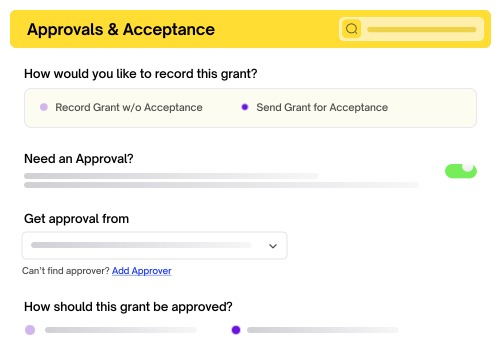
Issue phantom stock grants digitally. Upload a roster, assign plan terms and vesting schedules, and grant letters go out for e-signature in one workflow. Every accepted grant is archived against the participant's record​

  • Digital grant issuance with e-signature​
  • Vesting tracked automatically, per participant​
  • Terminations and forfeitures, no manual recalculation​
  • Employee portal: vesting status, awards, documents​
  • Acceleration for retirement, change-of-control, board exception
Approval and acceptance window
Liability Accounting​

Quarter-end in minutes, not days​

Update fair values at each measurement date, individually or by bulk upload. Qapita remeasures the liability, allocates the period expense, and produces the ASC 718 disclosure report your auditors expect.​

  • Quarterly mark-to-market revaluation​
  • Switch between liability or equity settlement​
  • Straight-line and graded amortisation
  • Tranche-level schedules​
  • Disclosure on demand​
  • Historical cost cut-offs​
transparent-blue-bg
Employee Experience​

Equity your employees can actually see​

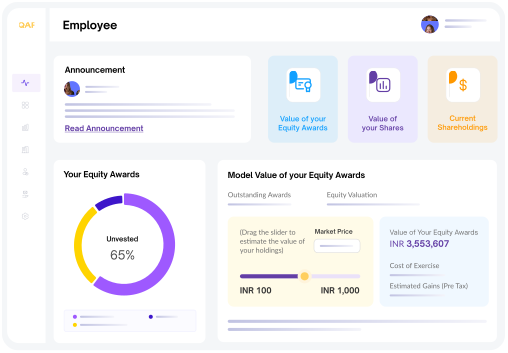
Every participant gets a portal showing their grants, vesting schedule, and programme status. When vesting happens, they see it. When an event affects their awards, the record updates itself and HR stops answering the same three questions by email.​

  • Award summary and vesting timeline​
  • Grant documents available any time​
  • Notifications for vesting, forfeiture, acceleration​​
Employee Experience dashboard
Audit & Compliance​

A record your auditors can navigate​

Every grant, event, fair value update, and report is timestamped and version-controlled. Your auditors get a complete history instead of a spreadsheet to interpret and every number traces back to the event that produced it.​

  • Version-controlled transaction ledger​
  • Document vault linked to each participant​
  • Full audit trail on fair value updates and reports​
  • SOC 2 infrastructure​

Ready to see it in action?​

Get a personalized walkthrough of Qapita’s Financial Reporting platform - tailored to your equity program.​
How it Works

Three steps from spreadsheet to platform​​

Set up your programme​

Upload your plan documents, define your vesting terms, and configure your accounting method. Our team works with you to migrate your existing grant data and set a historical cost cut-off so you start clean.​​​​

Issue and manage grants​

Add participants, generate grant letters, and track vesting automatically. When someone leaves or an event occurs, mark it in the system and move on.​​

Close the quarter​

Update fair values, run the ASC 718 report, and send it to your auditors. Everything your Finance team needs in one place, without rebuilding anything.​​​
Presence

Helping you elevate your ESOP management

Private Companies
3,000+
Listed Companies
180+
Equity Under Management
US $67B+
Equity Plans Designed
1,400+
Stakeholders
500,000+

See your phantom stock programme running on Qapita, not Excel.

We'll walk you through grant issuance, fair value updates, and ASC 718 reporting. Built for programmes that don't have a cap table.
FAQs

Frequently asked questions

How clean and accurate will my cap table be after moving to Qapita?​

Your cap table will reflect one canonical version of truth because Qapita rebuilds your entire equity history during onboarding and locks it into a transaction-based ledger. You won’t have mismatched share counts across sheets, incorrect vesting formulas, missing conversion entries, or duplicate certificates. Every number you see is generated directly from underlying events loaded into the system and not manual edits.​

Which instruments does Qapita support?

You can generate investor-ready cap tables, pre-money and post-money breakdowns, new share allocation schedules, ESOP pool increase scenarios, and dilution modeling instantly. Instead of updating a 15-tab Excel model with formulas that can break, Qapita gives a point-and-click interface where you enter round terms and the model updates automatically. This prevents inaccurate ownership numbers during diligence.​

How does Qapita handle quarterly revaluation?

Yes. Qapita’s exports match the formats preferred by major VCs and Big Four auditors including detailed movement logs, round-by-round ownership breakdowns, grant ledgers, vesting summaries, Ind-AS 102 files, and fully diluted views. Because each number is backed by a documented transaction, auditors perform faster reviews, and investors receive clear, verifiable capitalization snapshots during diligence.​

Do we have to rebuild years of historical expense data?​

​Yes. Admins can assign granular roles such as full admin, finance admin, HR admin, legal, investor-view, auditor-view, or employee. Each role controls which data they can view or modify, ensuring sensitive information is only visible to authorized users.​

Our programme is small. Is it worth the effort?​​

The question is not the size of the programme but the cost of running it manually. A CFO spending four to six daysa year on the model at their implicit hourly rate is already paying more for the manual process than for thesoftware. The cost of a material weakness finding is higher still.​

What does onboarding look like?​​

Our team works with your HR and Finance leads to configure the programme, set the accounting method, andmigrate participant data. You set a historical cost cut-off and go forward. Most companies are live within two tofour weeks.​

How do I set up an ESOP scheme for my Indian startup?​

First, draft an ESOP policy covering pool size, vesting, exercise price, and eligibility, then get board approval and shareholder special resolution (Section 62(1)(b)). Obtain SEBI-registered valuation, issue grant letters, maintain SH-6 register, and file PAS-3 after allotments. Qapita automates all this with compliant templates and workflows.​
ESOP Management 101

What is ESOP management?​

ESOP management (also called ESOP administration or stock option management) is the end-to-end process of creating, issuing, tracking, and reporting employee stock options for private and listed companies in India.​​

Think of it as the operating system for your employee ownership program. Founders manually juggle Excel sheets to track who got what grant, when options vest, exercise prices, tax implications, and compliance filings. This breaks during fundraises (investors demand clean cap tables) or audits (SEBI/ROC want SH-6 registers). ESOP management software like Qapita automates this entire lifecycle on one platform.​

What it includes:​

Stock plan administration: Setting up your ESOP policy, creating option pools (typically 8-12% for startups), defining grant terms, and structuring vesting schedules (4-year with 1-year cliff is standard in India).​

Exercise workflows: Tracking vested vs unvested options in real-time, processing exercises, handling changes like employee onboarding/offboarding, pool refreshes, or secondary buybacks.​

Employee experience: Digital grant letters, personal dashboards showing" your options worth ₹X today, ₹Y at next round", equity payslips, and education to reduce confusion about taxes or liquidity.​

Compliance & reporting: Automated SH-6 registers, Companies Act filings, Ind-AS 102 expense reporting, SEBI-registered valuations, board minutes – everything audit-ready for VCs, statutory auditors, or listing prep.

Why use ESOP management software?

Manual ESOP tracking in spreadsheets fails many startups when they scale. For instance, think broken vesting formulas during fundraises, forgotten SH-6 registe rupdates for SEBI compliance, or tax miscalculations that hit your Ind-AS 102 reports.​​

ESOP management software fixes this by centralizing your ESOP administration on a single audit-ready platform, saving founders hours monthly while eliminating compliance penalties.​

Common spreadsheet problems it solves:​

Error-prone cap tables: One mismatched grant can cascade into wrong dilution during VC diligence. Qapita rebuilds your history into a transaction ledger for 100% accuracy.​

Compliance chaos: Manual Companies Act filings, valuation tracking, and board approvals delay grants. Automated workflows handle Section 62(1)(b) resolutions, SEBI-registered FMV, and statutory registers out-of-the-box.​

​​

Employee confusion: Workers don't understand vested value, exercise windows, or perquisite tax (FMV - strike). Personal dashboards, equity payslips, and tax estimators boost employee retention.​​

Slow fundraises: Investors demand pre/post-money breakdowns instantly. Point-and-click scenario modeling shows option pool impact, exit waterfalls without having extensive Excel sheets.​

Audit delays: Statutory auditors reject manual reports. Qapita exports match Big Four formats: grant ledgers, vesting summaries, fully diluted ownership. All transaction-backed.​