


 Equity management

 Companies
- Fund management

 Funds
Funds - Fund managementFund management
- Fund managementFund management




TL;DR
Issues in founder agreements rarely start in legal docs - they start when expectations, and “what’s fair” are never clearly aligned.
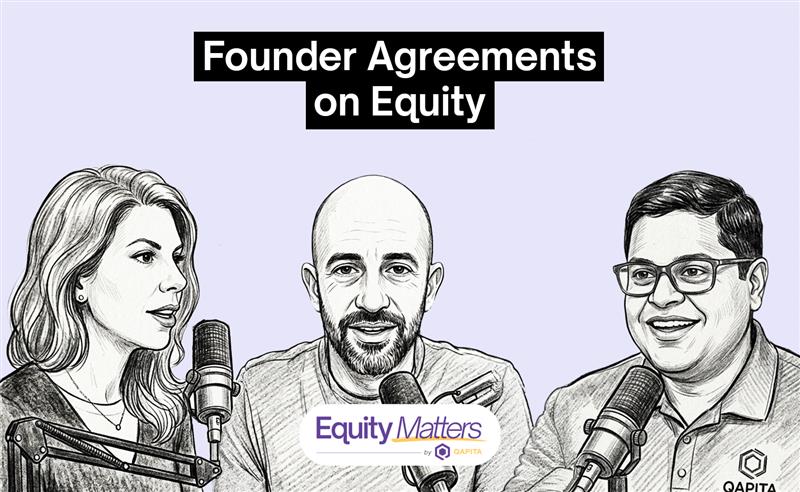
What made this conversation interesting was how closely Ravi Ravulaparthi (Co-founder & CEO of Qapita) and Lindsay Kaplan (Co-founder of Chief, Investor at Bullish) spoke from their own journeys - how they’ve thought about these decisions, what they’ve seen play out, and what they’ve come to believe over time.
Initial founder agreements rarely start with structure. They start simply with a quick discussion on equity, a split that feels directionally right, and often a quiet decision to avoid pushing too hard on the uncomfortable parts – with the assumption that things can be figured out later.
Ravi spoke about this directly from his own experience building.
“That was a very uncomfortable conversation to have very early… when the business was still on a PowerPoint.”
Decisions around equity splits, roles, decision-making, and what happens if someone leaves don’t feel urgent in the beginning - but they tend to come back later, when the context has changed, along with expectations.
The fix is simple to say and hard to do: treating founder agreements as a reflection of alignment, not a substitute for it.
You can watch the full conversation here:
The central takeaway was simple: founder agreements should reflect reality, not assumptions. But the implications run deeper than they first appear.
Most founders spend significant time thinking about product, hiring, and fundraising. Founder agreements, however, are often approached as a one-time decision - something to finalize early and move past.
In practice, they are far more consequential. They define how ownership evolves, how decisions are made, and how the company responds when roles change or relationships are tested.
In a recent session hosted with Charlie O'Donnell (Investor turned VC coach) from nextNYC, we explored how founders should think about structuring agreements that hold up over time - not just at formation, but across growth, conflict, and change.
If this topic is relevant to you, subscribe to the Equity Matters newsletter by Qapita to receive future insights like this directly in your inbox.
Most founders have either done or at least considered a 50/50 split as a signal.
That “we’re in this together.”
It feels clean. It feels fair. And more importantly, it lets everyone move forward without having to push too hard on the uncomfortable parts. That’s usually the trade-off.
As Ravi pointed out, the hard part isn’t deciding the number - it’s having the conversation that leads to it: “What’s the best thing for the business?”
That’s the principle he and his co-founders used. And it led them away from an equal split, even at a stage when the company was still just an idea.
Because equal can feel like the safest answer early on. It avoids conflict. It preserves momentum. It assumes that contribution, ownership, and long-term commitment will naturally stay aligned. In reality, those dynamics evolve quickly as the company grows.
Lindsay made a similar point - that no split, whether 50/50 or 60/40 really fixes that.
“You either have a solid working relationship or you don’t.”
She’s seen both sides of it. You can have a 50/50 split where one founder carries most of the company. You can also have a 70/30 split that feels completely right. Because what actually matters shows up in commitment, in how much each person is carrying, and in whether both founders are really in it the same way.
And that’s the part most early conversations don’t fully get into.
Related reads:
Fair and equal are two different things. That applies to compensation, and it applies to equity. As straightforward as this sounds, it’s where things start to get more nuanced.
Because once you move past the initial split, the question isn’t just what feels fair in the moment. It’s what continues to feel fair as the company evolves.
“It has to be fair…and has to be fair with keeping the business in mind.”
That is harder than people expect, because fairness requires context.
These questions form the foundation of a cap table that will need to survive multiple funding rounds, dilution, and changing responsibilities over time. Founders who take the time to map this early are better positioned to avoid friction later.
One of the most common structural issues shows up when a founder leaves but retains a meaningful portion of equity – and that becomes dead equity.
Ravi spoke about seeing this repeatedly - broken cap tables where a departed founder still holds a significant stake, but is no longer involved in building the company.
“Investors saw that as non-contributing equity sitting on the cap table.”
From the outside, this changes how the business is perceived. It reduces incentives for the remaining team and introduces friction in future fundraising.
“One of the fastest ways to make your company less investable is dead founder equity.”
What stood out in Ravi’s approach was how deliberately they planned for this. They assumed that things could change. That not every founder might stay for the entire journey. And they structured for that reality upfront.
“In our case, we said if there is a departing founder, then we were comfortable with the remaining founders getting that back in proportion to their existing equity.”
They also built in reverse vesting - effectively a clawback; so equity remained tied to contribution over time.
Well-structured founder agreements account future scenarios early. They introduce mechanisms that ensure the business keep running. These typically include:
Because at some point, roles change. Priorities shift. And not every founder can give a long-term commitment. The question is not whether that happens. It is whether the structure can handle it when it does.
Read in-depth: Founder's exit: What you should know
One of the most interesting moments in the conversation came when Lindsay Kaplan reflected on her transition from being an early employee at Casper to becoming a founder herself.
“I thought I was practically a founder, I was here pre launch. But I had no idea. There's a very big difference. There's just so much more pressure.”
That line captures something many early teams experience but rarely articulate. Early employees often feel like founders. They join before the company takes shape, take on broad responsibilities, and operate with a strong sense of ownership. In many ways, great founders encourage that mindset - and it is valuable.
But the difference becomes clear over time.
As Lindsay shared, the shift from early employee to founder is not subtle. It comes with more ownership, more pressure, and fewer places to hide. When you are a founder, the decisions sit with you. The outcomes sit with you. And the long-term responsibility doesn’t get distributed - it accumulates.
“Being early does not automatically make someone a founder.”
This is where confusion around titles and equity can creep in. What matters is not when you joined, but what you are responsible for and whether you are carrying the company through its most uncertain phases.
Clarity here matters more than it seems. Because when titles, ownership, and expectations are loosely defined, misalignment doesn’t show up immediately - but it compounds over time.
There’s a tendency to approach co-founder decisions as a math problem: what’s the right percentage to give? In reality, there isn’t a correct number.
But as Ravi described, that’s not really where the decision starts. It starts with a more fundamental question: “Can you build without this person?”
And if the answer is no, the next question becomes - how much does this person accelerate the journey? Because that’s the role of a co-founder. Not just to share ownership, but to meaningfully shorten the path to building something that works.
The other part is commitment. “Are they willing to commit to the full journey?” Because building a company is not a short-term effort. It takes years - often a decade or more, and the expectation is that you’re choosing someone to go that entire distance with.
That’s where Ravi framed it less like a hiring decision and more like a long-term partnership. Closer to a marriage than a transaction. And that framing changes the question.
“If that’s what it takes to build a large business, as long as 10+ years, the closest metaphor to it is a marriage”
Instead of asking, “What’s the right amount of equity to give?”, the better question is: “Is this the right person to do this with?”
If the answer is YES, you will figure out a split that works. If it isn’t, no number will fix the underlying mismatch.
Related reads:
This is also where founder agreements move from being a one-time decision to an ongoing system.
In the early days, equity feels simple. But as the company grows, that simplicity fades. Vesting progresses, new stakeholders enter the cap table, roles evolve, and early decisions begin to interact with new realities.
Managing this manually becomes increasingly difficult, especially when precision starts to matter more - during fundraising, audits, or strategic decisions. Spreadsheets become harder to manage, visibility drops, and small errors begin to surface at critical moments.
That is where cap table and equity management platforms like Qapita become relevant. Not as a replacement for good decisions, but as a way to ensure those decisions remain accurate and manageable over time.
With Qapita, teams can:
Whether it is maintaining a clean cap table or managing founder and employee equity, the goal is simple: the structure you design early should continue to reflect reality as the company grows.
Explore what Qapita offers:
Founder agreements are often seen as a way to protect the company. They are that, but more than anything, they force founders to confront how they actually work together.
The best agreements don’t assume equal contribution. They don’t rely on titles to create trust. And they do not use equity as a substitute for commitment. They make alignment visible - where it’s strong, where it’s fragile, and where more clarity is needed before the company grows further.
The goal isn’t to get everything perfectly right from the start. It’s to build something that can hold when roles evolve, when pressure builds, and when the relationship is tested.
If you enjoyed reading the insights, here are a few things we recommend:
And if this was valuable, subscribe to our newsletter to receive future insights on equity management, cap table governance, and compensation strategy directly in your inbox.

What’s the Equity Matters newsletter? Created by the Qapita team, each issue breaks down one small but powerful insight on equity management, cap tables, and ownership strategy for growing companies.
About us: Qapita is an equity management platform that helps companies design, manage, and scale ownership structures with clarity and control. Manage cap tables, fundraising, share issuance, equity awards, 409A valuations, and liquidity globally - all in one unified platform. Qapita supports founders and finance teams automate employee equity workflows, stay compliant, and move faster with confidence from seed to IPO and beyond.