


 Equity management

 Companies
- Fund management

 Funds
Funds - Fund managementFund management
- Fund managementFund management



If you are new to the world of startups and venture capital, you will tend to believe that every funding round brings more money and a bigger evaluation of your company than before. But as it turns out, this is not always the case. A down-round financing scenario is one such instance where a company raises less money than in the previous funding round.
Let's break down everything you need to know about Down Rounds.
To raise funds, every company goes through a pre-money and post-money valuation with its investors. The pre-money valuation reflects the company's worth before any new investment comes in. This valuation helps investors determine their ownership stake, set stakeholders interest and negotiate the level of control the founders retain.
In a typical fundraising round, the company issues a set number of new shares in exchange for a fixed amount of capital. The price per share is calculated based on the company's updated capital structure which includes the money recently raised. This process results in two valuations: the pre-money and the post-money.
A Down Round is specifically when the pre-money valuation of the new round is lower than the post-money valuation of the previous round. In simpler terms, this happens when investors value the firm lower than they valued it before. This inevitably leads to the firm selling its shares/stocks for a lower price which brings in less money for them in the funding stage.
With every subsequent funding stage, a company expects its valuation to grow, which will also eventually bring a rise in their share price. But sometimes this does not true hold because of several reasons including but not limited to change in market, change in investor sentiments, poor performance by the startups and invalidated expectations.
A down round usually happens due to below reasons:
Moreover, since most of the industries function in an open market system, the entry of new entrants from time to time may offer steep competition, leading to a lower valuation for the company. Down rounds can also be linked to investors decreasing the value of a business to accommodate or account for risk management.
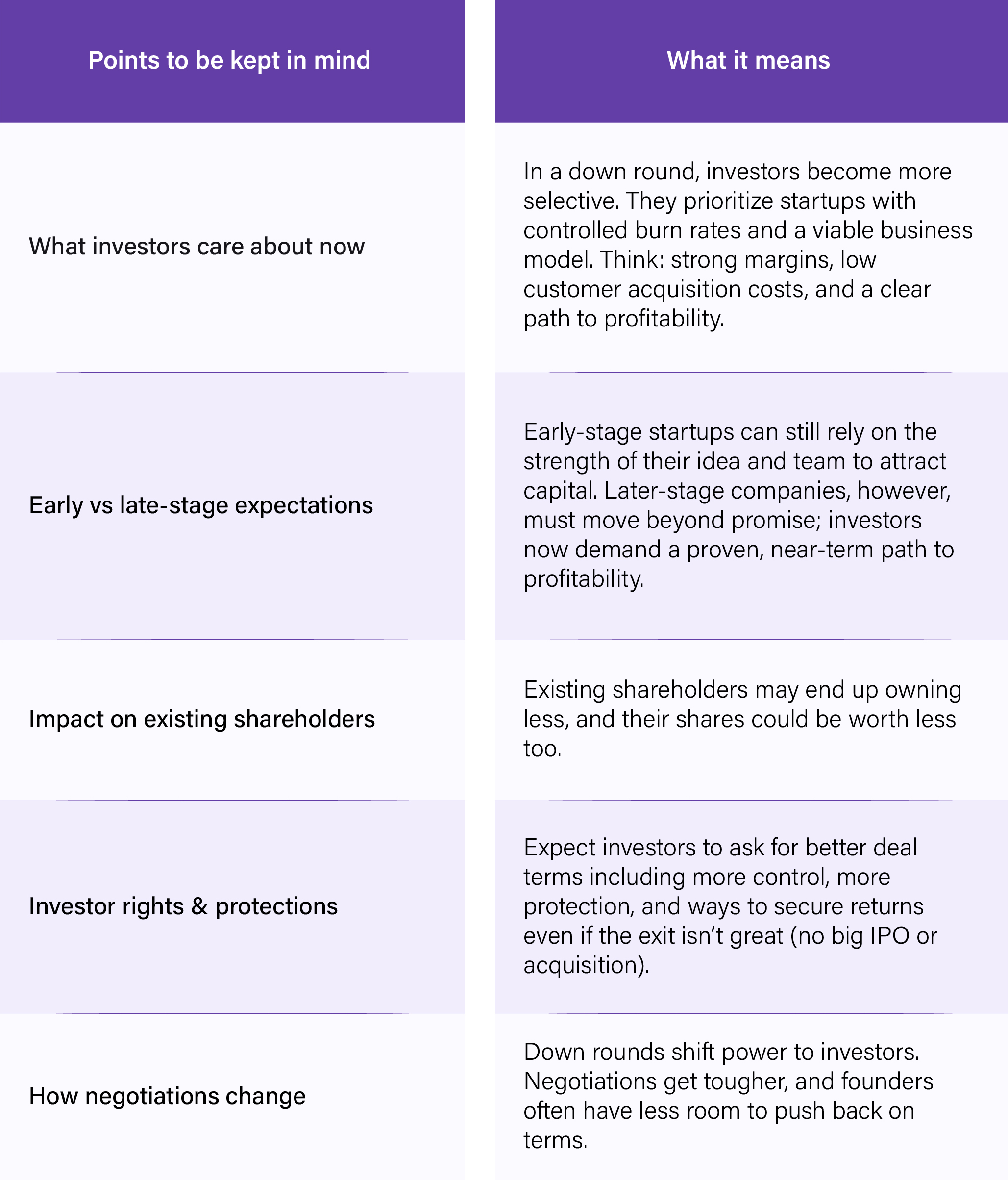
If a down round is your last option, keep these key points in mind.
Here are some of the common rights and preferences investors may negotiate to include:
Down rounds affect more than valuations. They ripple through the cap table. Venture funds mark down portfolio companies, directly impacting total value to paid-in (TVPI) and internal rate of return (IRR).
A major write-down can damage a general partner (GP) track record, making it harder to raise the next fund or call capital.
For startups, though, the fallout can be even more intense:
Together, a down round triggers a tough cycle of lower confidence, morale, and cap table changes that make recovery harder.
However, it's important to remember that not all down rounds are equal. If the whole market is hit, stigma drops. Context matters, a lot.
Consider cost reductions to delay a down round by optimizing teams, prioritizing impact, and pausing non-essentials. If the gap persists, raising at a lower valuation or exploring funding and strategic options, such as M&A or restructuring, can provide a thoughtful path forward.
When raising capital becomes challenging in a down market, founders can benefit from considering alternative funding sources. There are several alternative financing options worth exploring:
A down round can be difficult for those who invested at higher valuations. Raising capital at a lower share price typically means issuing more shares and diluting existing shareholders' ownership, forcing them to consider the impact on their equity. Here is how down rounds affecf the different stakeholders.
.jpg)
After a down round, monitor cash burn and focus on steady, sustainable growth. If growth falls short, adopt a conservative budget. Use scenario planning to extend the runway and delay the next fundraise.
A down round can understandably be difficult for employees, especially when it affects how they perceive the value of their equity. With empathy and open communication, companies can help maintain morale and trust during this time.
Here are a few ways to support teams:
Anti-dilution protection helps investors during down rounds by adjusting valuations. It does not give out extra shares for free.
Instead, it changes the conversion ratio for preferred to common shares. For instance, 1 preferred share may now convert to 1.1 or 1.2 common shares, giving investors a larger share without new shares being issued.
Why does this matter? It avoids diluting everyone by issuing new shares without capital, and prevents increasing the investor’s liquidation preference above original terms.
It also protects investors on the upside. If the company succeeds, they convert to common stock and earns a greater share of the returns.
Two common investor protections during a down round are full ratchet and broad-based weighted-average anti-dilution. The latter is more common.
In today’s volatile market, down rounds are increasingly prevalent. While sometimes unavoidable for both companies and investors, it is crucial that all stakeholders understand their full consequences. This includes the effects on employees and existing shareholders, as well as the specific legal, governance, and structural challenges that may emerge.
Engaging seasoned advisors helps manage these complexities and maximize outcomes for all parties. Likewise, companies and investors can reduce risks through disciplined, well-defined processes. Maintaining a robust board process, supported by thorough documentation, and adopting meticulous deal structure not only improves operations but also positions the company for more successful future fundraising or ongoing support from current investors.
A down round may indicate to investors that the company is having difficulties, which could make it harder to obtain money later. Nonetheless, the business may still be able to draw in more funding if it can show that it has stabilized and performed well after the downturn.
Yes, there are a few options. These include debt funding, bridge loans, and even looking into strategic alliances all of which are non-dilutive sources of financing, i.e, it does not impact stakeholders share in the company. Businesses may also think about internal cost-cutting strategies or revenue-generating projects to postpone the requirement for a downturn.
A down round is the right option, when you believe that your need for capital outweighs the dangers of dilution and market perception. If it gives the company the runway it needs to stabilize and reposition for growth, then it becomes the appropriate decision.
Before raising in a down round, communicate transparently and review existing terms, such as anti-dilution clauses, that may increase founder dilution. Explore alternatives such as cost cuts or debt, and clearly present a forward plan as you prepare for stricter investor terms.
A cramdown is a down round where existing investors set strict terms that heavily dilute non-participating investors. These can include forced share conversions, pay-to-play rules, and special rights that hurt non-participants.