


 Equity management

 Companies
- Fund management

 Funds
Funds - Fund managementFund management
- Fund managementFund management




Key takeaways
Accelerated vesting speeds up an employee's equity vesting schedule so that unvested shares, stock options, or restricted stock units (RSUs) vest earlier than the original timeline. Companies build this mechanism into equity plans to protect employees during specific events, such as an acquisition, an IPO, or an unexpected termination.
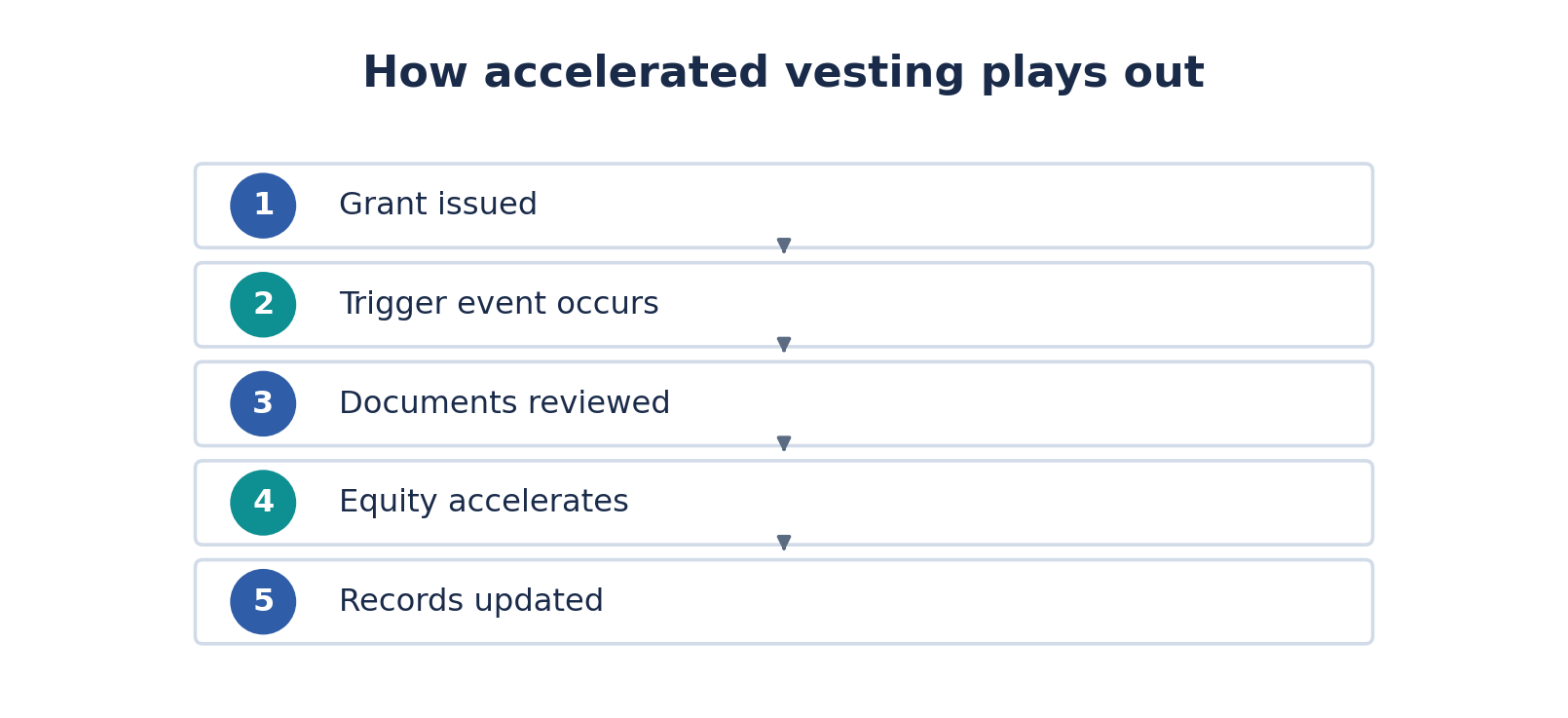
A standard vesting schedule spreads equity ownership over several years, commonly four years with a one-year cliff. Acceleration follows a defined sequence once a plan includes the clause:
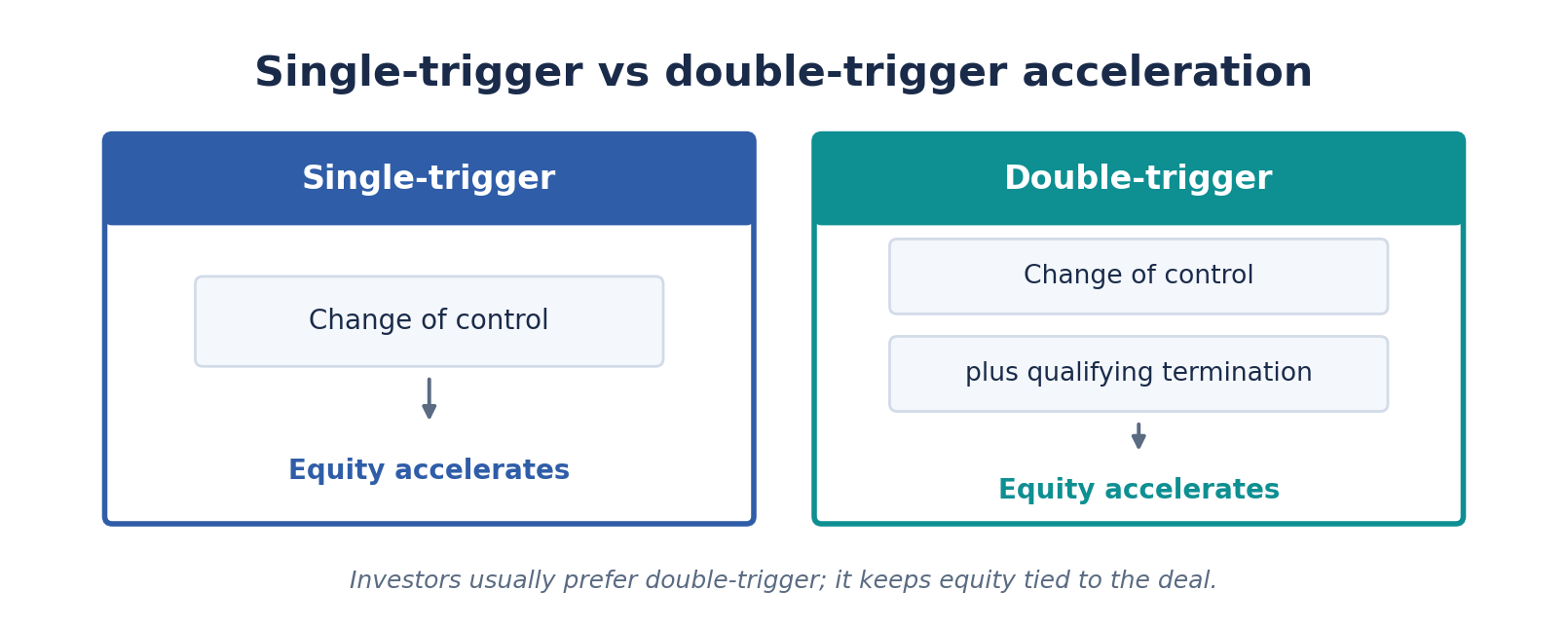
Two structures cover most acceleration clauses:
Full acceleration means 100% of unvested equity vests at once when the trigger fires. If someone has three years left on a grant, they own all of it immediately. Partial acceleration vests a set portion a 25% or 50% chunk, say, or additional months of vesting credit added to what's already earned. Full acceleration shows up more often for founders and senior leaders, while partial acceleration is common in broader plans: it rewards employees during an event while keeping some equity unvested, which supports retention through the transition.
Acceleration is tied to defined events written into the agreement. These are the triggers you will see most often.
Termination without cause is one of the most negotiated acceleration triggers, particularly for senior hires. If a company lets an employee go for reasons unrelated to misconduct or poor performance, such as a restructuring, a role elimination, or a strategic pivot, the acceleration clause can vest a portion or all of the remaining unvested equity.
This differs from termination for cause, where the employee typically forfeits unvested equity outright and, depending on the plan, can lose vested-but-unexercised options too. Severance agreements and executive contracts often pair acceleration with cash severance, giving the departing employee both a payout and equity value they'd otherwise have lost.
Each award type reaches "vested" differently, so acceleration changes a slightly different thing depending on which one an employee holds:
Let's take a hypothetical scenario: say an employee is granted 10,000 stock options vesting over four years with a one-year cliff. After two years, half the grant has vested on schedule: 5,000 vested, 5,000 unvested. The company then gets acquired, and the acceleration clause kicks in.
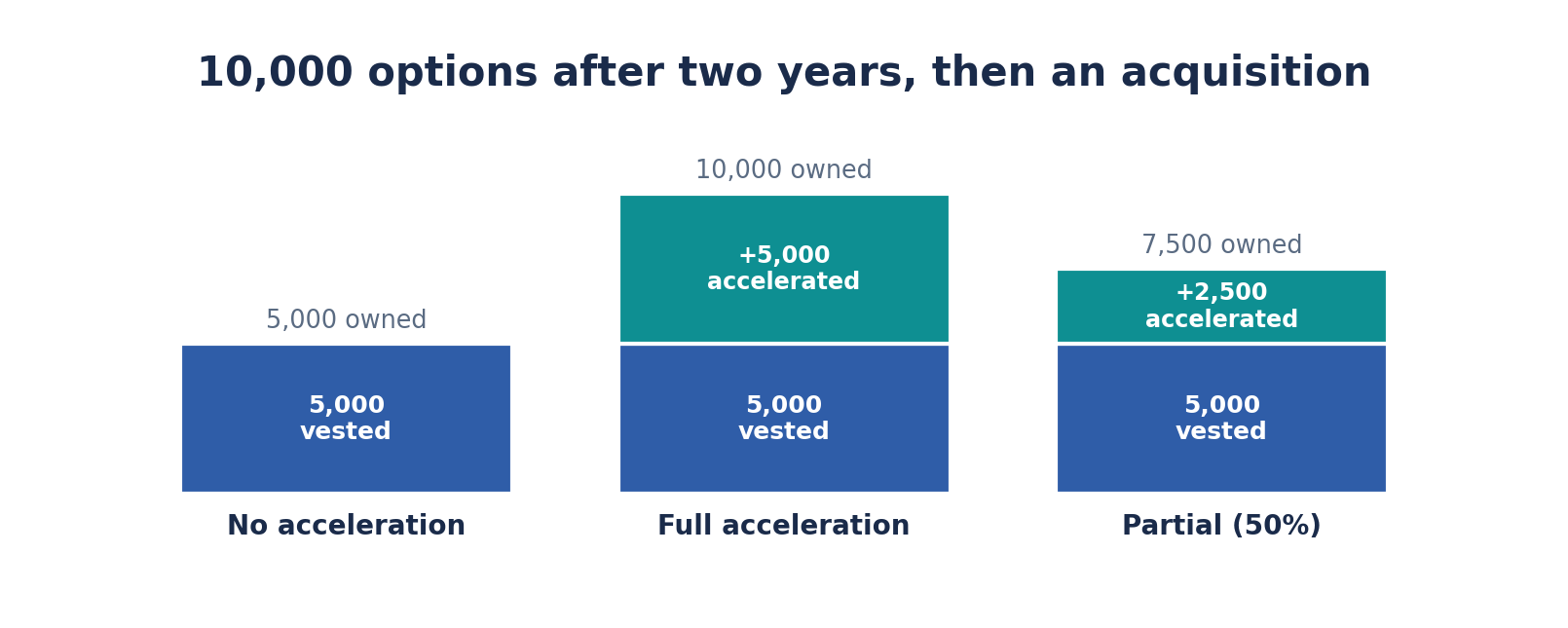
Under full acceleration, the remaining 5,000 options vest immediately on the qualifying acquisition, and the employee owns the entire grant. Under partial acceleration at 50%, only 2,500 of the unvested options accelerate, leaving 2,500 still on the original schedule. Actual outcomes depend on the plan, the grant agreement, board approval, and the transaction documents; treat this as an illustration, not a prediction.
Accelerated vesting doesn't create a new kind of tax, it just moves the usual tax event earlier than planned. Here's what typically applies:
Rates, thresholds, and elections vary by country, so a local tax advisor should review any acceleration clause before a company rolls it out or before an employee signs an agreement containing one.
Yes. Acceleration clauses are negotiable, especially for senior roles, specialized hires, or founders raising early-stage capital. Common negotiation points include:
Pros:
1. Retention through uncertainty: A promise of accelerated vesting can keep employees engaged through a merger or acquisition, when they might otherwise leave before a deal closes.
2. A hiring differentiator: Offering acceleration clauses can set an offer apart in competitive hiring markets, especially for senior roles.
3. Supports deal execution: Acquirers often prefer double-trigger acceleration since it keeps key employees in place through close, easing integration risk on both sides.
4. Rewards employees who built the value: Acceleration gives employees a fair share of the value they helped create, especially useful for early team members who might otherwise never see a liquidity event if they'd left before an IPO or acquisition.
5. Flexible by design: Plans can set a percentage below full vesting, so companies can balance reward with continued incentive without an all-or-nothing outcome.
Cons:
1. Cash flow hit for the company: A large accelerated payout compresses years of equity cost into one event, which can strain cash flow at exactly the moment a company is managing a transaction.
2. Weaker long-term retention lever: Once equity is fully vested, the incentive to stay through the rest of the original vesting period disappears, the golden handcuffs effect loosens earlier than planned.
3. Compressed expense recognition: Companies typically have to record the remaining unrecognized compensation cost immediately once acceleration triggers, creating a one-time expense spike rather than a smooth cost spread over the original schedule.
4. Sudden dilution: When equity accelerates for many people at once, say, after an acquisition, a large batch of unvested awards converts into outstanding shares or options all at once, which can shift ownership percentages and deal economics faster than expected.
5. Harder to administer accurately: Tracking which grants qualify, calculating exact unvested balances, and updating cap tables and records correctly under deadline pressure raises the risk of errors if it's done manually.
Tracking acceleration clauses across many grants, multiple award types, and several trigger conditions gets complex fast, particularly during a live M&A process when timelines compress. Qapita's stock plan management platform tracks vesting schedules, trigger conditions, and grant-level terms in one system. Book a demo to see how Qapita's stock plan tools support your acceleration clauses and equity administration.
Accelerated vesting protects equity value for employees during company transitions and gives companies a structured way to handle change-of-control events and unexpected terminations. Understanding the difference between single-trigger and double-trigger clauses, the tax consequences tied to each award type, and the negotiation points available before signing puts both employees and equity administrators in a stronger position. Employees reviewing an offer letter and founders structuring an equity plan both benefit from getting these clauses right from the start.
Generally no. Most clauses tie acceleration to employer-initiated termination without cause or to a good-reason resignation defined narrowly in the agreement. A standard voluntary resignation typically doesn't qualify.
It's usually forfeited outright, and acceleration clauses typically don't apply to a for-cause termination, those clauses protect against job loss through no fault of the employee, not misconduct-driven exits.
No. RSUs are taxed on their full value at the (now earlier) vesting date. Options require an exercise step first, and tax is based on the spread between the strike price and current share value at exercise, not just the vesting date.
It's more common in executive contracts and founder agreements, but many venture-backed companies extend acceleration clauses, usually double-trigger, to broader employee equity plans as well.
Yes. A plan can specify a fixed percentage (25%, 50%, etc.) or extra months of vesting credit rather than accelerating the entire unvested balance at once.
It's much harder. Acceleration terms are easiest to negotiate before signing an offer letter or executive agreement once the equity plan and grant are in place, changing the clause usually needs a formal amendment and company approval.